
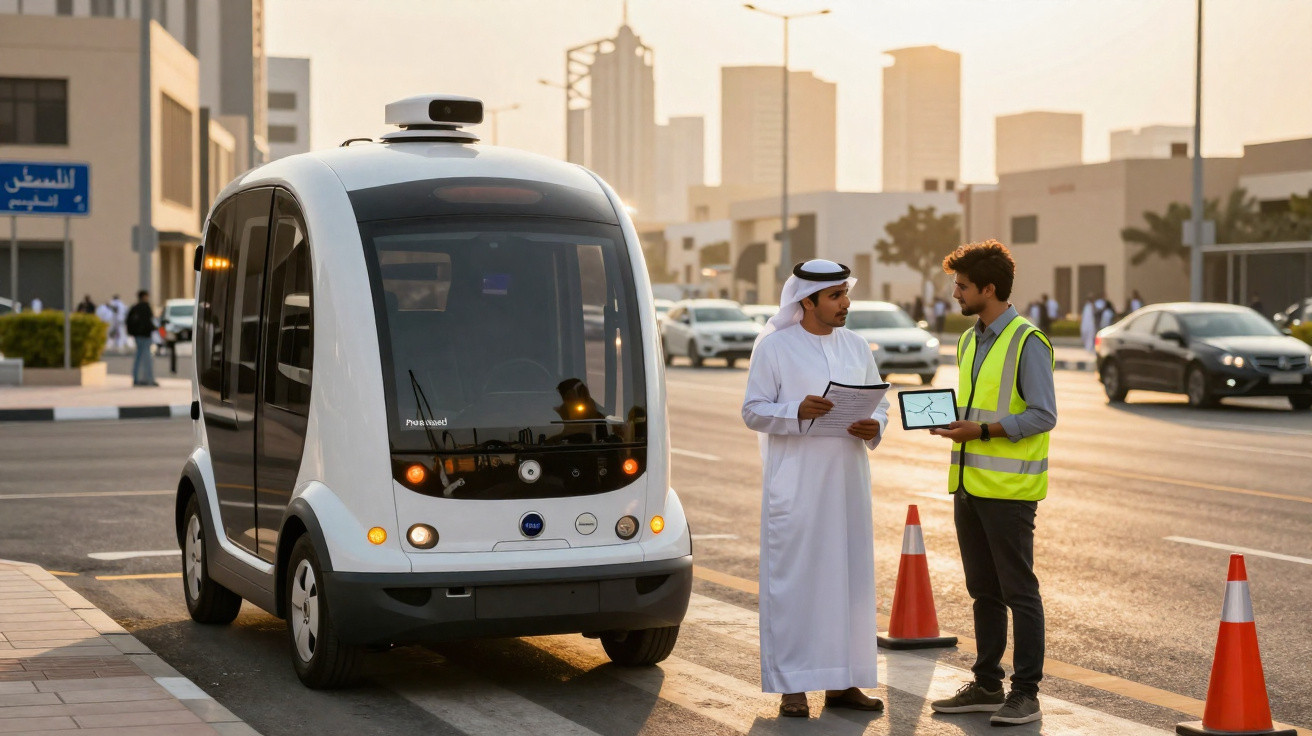
One late-autumn morning, people heading to work in Riyadh realised the small white autonomous shuttle that had been looping around a newly built business district had simply disappeared. There was no statement, no farewell photo opportunity-just an empty kerb and a handful of fading sensor traces on the road surface. The technicians who used to hover near lidar-equipped SUVs stopped showing up. Online chatter about “futuristic robo-taxis” tapered off until it was gone.
On paper, the kingdom’s autonomous transport revolution was meant to be unstoppable. Vision 2030 presentations promised smooth fleets, calmer streets, and AI directing traffic with balletic precision. But at street level, a more delicate reality was emerging: a measured pull-back, carried out quietly.
Somewhere between the glossy future renderings and everyday roads, the narrative shifted.
From roaring promises to a quiet pause in the streets
Not long ago, on a pleasant evening in Riyadh, a small crowd turned up at a demonstration track near King Abdullah Financial District. Parents took pictures as a streamlined autonomous minibus trundled around behind plastic barriers. Engineers in branded polo shirts kept fixed smiles whenever the shuttle paused uncertainly or braked earlier than expected. The mood suggested the future was nearly here-almost ready, almost routine.
When some of those visitors came back a few months later, however, the gates were shut. The track was deserted, with dust beginning to soften the tyre marks. There was no public explanation and no official notice of a “pause”, only the sense that someone, somewhere, had quietly switched things off. Driverless mobility, so loudly showcased, had retreated behind closed doors.
Within transport agencies, the change in tone was even quicker than the change in the streetscape. Internal notes started leaning heavily on words such as “caution”, “incremental”, and “reputational risk”. International safety incidents-the robo-taxi that blocked an ambulance in San Francisco, the pedestrian collision in Arizona, emergency crews complaining about muddled driverless vehicles-made the rounds in WhatsApp chats among Saudi regulators. Those stories landed differently in a country where public confidence in high-profile, state-led initiatives is both valuable and vulnerable. A single major crash on a busy Riyadh boulevard could tarnish not only a firm, but a national storyline.
Saudi Arabia’s wager on autonomous mobility was never purely a technical one. It also concerned image, economic diversification, and the promise of jumping straight into a post-oil, AI-driven future. Yet as pilot shuttles in controlled areas repeatedly encountered “edge cases”-roadworks, unpredictable human driving, children running across service roads-regulators began to feel the full weight of accountability. Quietly, a judgement took shape: rapid nationwide trials now looked less like smart ambition and more like an avoidable risk.
What actually went wrong behind the polished AV demos
At the beginning, the AV efforts appeared unstoppable. Megaprojects such as NEOM and the Red Sea developments were promoted worldwide using glossy footage of driverless pods gliding between glass towers. Technical teams teamed up with international partners, and test vehicles in Riyadh, Jeddah, and around university campuses sprouted sensors. Influencers filmed themselves crawling along in autonomous shuttles, laughing nervously as the steering wheel turned “by itself”. It all carried an air of inevitability.
Then the reality of existing streets asserted itself. Unlike contained smart-city environments, Saudi roads as they are today can be noisy, layered, and governed by unspoken conventions. Drivers flash headlights as a subtle form of negotiation, lanes are improvised during rush hour, and delivery riders thread through gaps so tight that even experienced motorists flinch. For a machine, that is not merely untidy-it is a constantly shifting wall of uncertain signals. Sensor suites that behaved well in Western suburbs began to falter under intense desert glare, dust storms, and reflective glass façades.
Engineers started recording “near-miss” episodes that never surfaced in public summaries. An autonomous SUV waited too long at a roundabout and nearly got hit from behind by an impatient driver. A shuttle stopped dead after detecting a stray cat, blocking a lane and triggering a chain of horns. Nothing disastrous, but each event added to a growing nervousness among officials who were already tracking global headlines about AV failures. You could feel the shift from “how fast can we scale this?” to “what exactly are we risking here?”
Let’s be frank: risk assessments tend to be ignored until the moment something goes wrong. Inside ministries and transport authorities, legal teams began pressing for clearer answers. If a state-backed autonomous pilot harms a pedestrian, who carries responsibility? How does Islamic jurisprudence weigh accountability when no human is technically “driving”? How would local media portray an incident involving a foreign-built AI system operating on Saudi roads? None of that fit neatly into a slide deck. All at once, nationwide scaling looked less like a moonshot and more like gambling with public trust.
How regulators are quietly rewriting the AV playbook
What’s happening is less a blanket cancellation than a deliberate reconfiguration. In practice, it means fewer public pilots in mixed city traffic and more tightly bounded trials in fenced areas or industrial corridors. Rather than demanding that AI handle every scenario on Riyadh’s ring road, officials are pushing projects towards routes that are stable and repetitive-airport shuttles, port logistics, and internal loops within mega-compounds where outside drivers rarely enter.
A specific approach gaining traction is “shadow mode” testing. Human drivers remain fully responsible, while an autonomous system runs quietly in parallel, generating its own decisions that never touch the steering or pedals. Engineers can then measure what the AI would have done against what the human actually did. It is slower, less showy, and nearly impossible to sell on billboards, but it is much better at exposing weak points without turning the public into unsuspecting crash-test subjects.
Regulators are also moving towards phased permissions. Instead of broad authorisations covering whole cities, approvals are being split into tightly defined scenarios: low-speed shuttles inside a sealed resort; driverless lorries on a fixed port-to-warehouse route at night; supervised AVs in dedicated lanes during quieter hours. This step-by-step method may irritate some technology evangelists, but it suits a system in which the state is expected to prioritise protection of citizens first and experimentation second.
For overseas AV companies targeting Saudi Arabia, the new landscape demands patience and a degree of humility. The fantasy of instantly blanketing multiple cities with robo-taxis for publicity has faded. In its place is a quieter expectation: prove reliability, report transparently, and be candid about what the systems cannot yet do. The unspoken signal is clear-Saudi Arabia still wants futuristic mobility, but not at the price of a viral crash video that could shadow Vision 2030 for years.
What this pause really means for the future of driverless mobility
A senior adviser close to the transport portfolio put it bluntly during a closed-door session in Riyadh:
“We haven’t given up on autonomous transport. We’ve just lost interest in being the test case everyone else learns from the hard way.”
The direction now taking shape resembles repositioning more than retreat. Instead of racing to put driverless cars everywhere, planners are seeing greater value in carefully chosen forms of autonomy: freight convoys across desert motorways, maintenance robots in sealed industrial sites, automated trams in new districts where junctions are designed for machines from day one. These applications may be less cinematic than robo-taxis in central Riyadh, but they align better with how complicated technologies typically mature-incrementally, away from the brightest glare, before becoming commonplace.
Underneath this shift sits a straightforward emotional reality. Many people recognise the feeling: the shiny new thing is thrilling until it becomes clear you’re the one carrying the real risk. Saudis are not opposed to technology; daily life is phone-centric, delivery apps are widely used, and digital government platforms are heavily relied upon. What people do not want is to be treated like extras in someone else’s experiment. Once regulators absorbed that properly, the quiet winding-down of city-wide AV trials looked less like defeat and more like a necessary reset.
Internal discussions are also becoming more candid about timing. Earlier talk of “full autonomy by 2030” has been replaced by more grounded planning language focused on “progressive integration” and “coexistence with skilled human drivers”. It may sound less thrilling on a conference stage, but it tracks more closely with lived reality.
- Ambitious vision still intact
- Public pilots scaled back
- Focus shifting to safer, narrower use cases
- Regulators asserting more control
- Tech companies adapting to a slower burn
A future that’s less shiny, but maybe more real
The arc of Saudi Arabia’s autonomous transport trials is not a simple journey from hype to failure. It is more complicated than that, and more human. A country that has often projected itself through speed and spectacle has eased off one of its flashiest promises-not with a grand declaration, but with empty test tracks and silent shuttles. In that hush, something more intriguing is forming.
On Riyadh’s outskirts and along long desert motorways, experimentation continues-just farther from smartphones and television cameras. Engineers iterate, regulators wade through dense reports rather than glossy decks, and policymakers weigh prestige against duty of care. That process may not generate headlines like a dramatic robo-taxi launch, but it may be the way lasting change arrives: offstage, and then suddenly.
For anyone watching from outside the kingdom, the Saudi example reflects a broader dilemma facing every country tempted by driverless promises. How much risk are we truly willing to hand over to algorithms built in labs thousands of miles away? And for how long will we accept “almost safe enough” because the allure of being first is so strong? These are not only Saudi questions-they are urban questions, human questions, and they are not going away.
| Key point | Detail | Value for the reader |
|---|---|---|
| Shift from nationwide trials to targeted pilots | AV tests now concentrate on closed zones and specific corridors | Helps you understand where driverless tech is actually likely to appear first |
| Regulators growing more cautious | Liability, public trust, and global AV incidents shaping local decisions | Shows why bold tech promises often slow down once safety is on the table |
| New, quieter AV strategy | Focus on freight, industrial sites, and controlled environments | Offers a more realistic view of how autonomous mobility may enter everyday life |
FAQ:
- Question 1 Did Saudi Arabia completely cancel its autonomous vehicle programmes? Not entirely. Large, highly visible public pilots across cities have been dialled back, while smaller, more controlled tests in industrial zones, megaprojects, and logistics corridors are still moving ahead.
- Question 2 Why did regulators become more cautious about AVs? A combination of minor local incidents, difficult driving conditions, and global high-profile crashes made officials much more sensitive to safety, liability, and reputation risks.
- Question 3 Will ordinary Saudis see driverless taxis any time soon? Unlikely at a large scale in the short term. You’re more likely to encounter autonomous shuttles in closed campuses or driverless lorries on defined routes than robo-taxis roaming freely in city traffic.
- Question 4 How does this affect global AV companies targeting the Gulf region? They now face slower, more controlled roll-out conditions, stricter oversight, and pressure to demonstrate reliability in narrow use cases before gaining wider access.
- Question 5 What can other countries learn from Saudi Arabia’s experience? That ambitious timelines and futuristic marketing often collide with messy real-world roads, and that building public trust can matter more than being the first to deploy headline-grabbing driverless fleets.




Comments
No comments yet. Be the first to comment!
Leave a Comment