
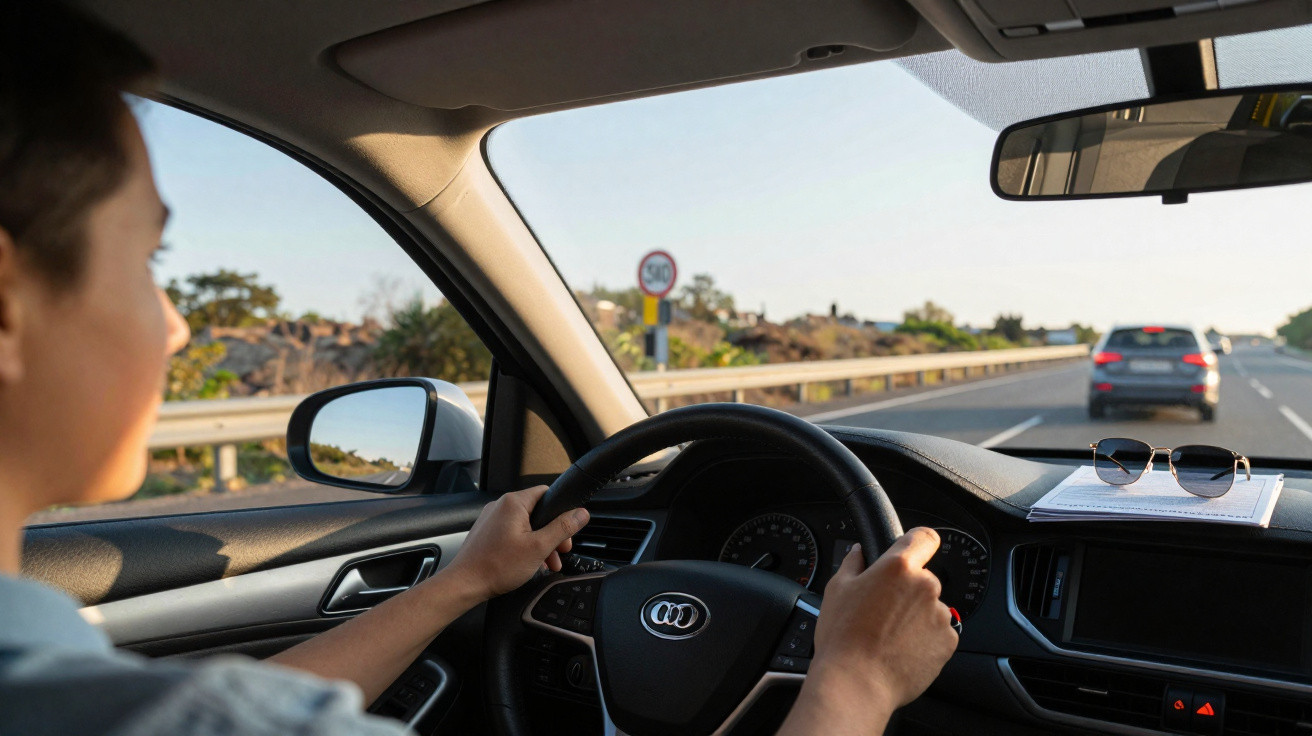
It nearly always plays out the same: a queue of cars trapped behind a lorry, a rare straight stretch, and that faint twitch in your right foot. The sign says 80 km/h. Your speedometer sits stubbornly on 78. Up ahead, the lorry is plodding along at 65, while the driver behind is clearly irritated, sitting so close they may as well be attached to your rear bumper.
Your eyes flick to the broken centre line. You know you could pull out, press on a touch, and have it all over with in seconds.
But then the doubt kicks in: “If I go above the limit, is that unlawful… even if it’s only to overtake?”
Plenty of motorists think they already know.
Plenty of them don’t.
Why this “little extra speed” feels so natural on the road
On a clear road, adding speed while overtaking can feel almost instinctive-like the car is designed for it. You squeeze the pedal, there’s that clean surge, the needle climbs from 80 to 95, and a moment later you’re back in lane with open road ahead. In your head, it feels logical-almost like the sensible thing to do.
You reassure yourself that getting past quickly is safer than lingering alongside at roughly the same pace as the vehicle you’re passing. You’re not trying to show off or race anyone; you simply want that lorry, or that slow Sunday driver, out of your way.
Even so, there’s usually a lingering question in the background about what the rules actually allow.
Imagine this: you’re on a national road with a limit of 80 km/h. A caravan in front is doing 70. The road is quiet, sight lines are good, and the line is dashed. You pull out, briefly take it up to 95 km/h to minimise time in the oncoming lane, then slip back in without drama.
A couple of minutes later you spot it: a mobile speed camera parked at the roadside. You weren’t speeding “for fun”, you tell yourself-you were overtaking. Part of you expects the law to recognise that distinction.
The ticket that lands a few days later doesn’t recognise any distinction at all.
In many countries, the principle is blunt: the speed limit applies continuously, including during an overtaking manoeuvre. Legally speaking, there is no “tiny allowance” to jump from 80 to 95 for a few seconds. The camera doesn’t make an exception either.
Some places-and some older eras-did include limited tolerance for overtaking in writing. However, most modern highway codes have removed that wiggle room in the name of simplicity and safety. The catch is that driving habits haven’t kept pace with the rulebook.
That leaves an uncomfortable mismatch: the law says one thing, and everyday road behaviour often does another.
How to overtake without breaking the speed limit (and still feel safe)
The most legal-and safest-overtake begins well before you touch the indicator. It starts with restraint. You scan what’s coming: bends, signs, side roads, junctions, and any approaching traffic. Then you decide whether the pass can be completed at the legal limit, not 10 or 20 above it.
In practice, that comes down to one straightforward check: “At my speed and theirs, do I genuinely have enough clear road to get past without hurrying?” If the truthful answer is no, you don’t go.
You drop back slightly, leave a sensible gap, and wait for the next proper opportunity rather than trying to manufacture one.
Most overtaking errors aren’t caused by a complete lack of ability; they come from impatience and pride. You don’t want to be the person “stuck forever” behind the slow vehicle, so you pretend there’s more time and space than there really is. You tell yourself you’ll “just accelerate a tad more” and it will all work out.
The law won’t accommodate your need to get to work or home faster. Physics won’t either. If you’re wrong by even two seconds, the speed of an oncoming vehicle turns those seconds into metres you simply do not have.
And, honestly, hardly anyone gets this perfect every day.
Traffic officers and road-safety specialists repeat the same essential guidance. They know most people learnt overtaking from a mixture of old lessons, second-hand advice, and ingrained bad habits. Some experts even argue that the best overtakes are the ones you abandon at the last moment because your instincts say “this doesn’t feel right”.
“Drivers think overtaking is all about power and acceleration. In reality, it’s mostly about renouncing,” a highway patrol officer once told me. “The bravest drivers are the ones who accept to wait for the next chance.”
- Look well ahead before you even signal.
- Keep at or under the limit throughout the whole manoeuvre.
- Back out early if your view is interrupted for even a second.
- Don’t turn it into an ego contest with the car behind.
- Accept that, at times, the safest pace is the slow driver’s pace.
The rule almost nobody really knows… and what it changes for you
Here’s the uncomfortable legal reality: in most countries, you’re not permitted to exceed the speed limit-even for a moment-even “just to overtake”. There isn’t a hidden legal window where a camera simply ignores 97 in an 80 zone because you were passing a tractor.
That doesn’t mean the law is blind to reality, but it is merciless with numbers.
The difference between what many drivers assume and what the law states is enormous. People will swear that an instructor, a parent, or a friend once told them it was acceptable to “go a little over” to make overtaking safer. That may have been partly true decades ago in certain places. On today’s roads-packed with automatic enforcement and tighter rules-that old belief quietly turns into fines and licence points.
Yet the contradiction remains: driving manuals talk about “reducing the time spent in the opposite lane”. Your right foot draws its own conclusion.
| Key point | Detail | Value for the reader |
|---|---|---|
| Legal rule | Speed limits apply even while overtaking, with no general exception | Avoid unexpected fines and licence points |
| Driving strategy | Plan overtakes that can be done at or below the limit, or don’t do them | Lower stress and safer manoeuvres |
| Mindset shift | Accept staying behind a slower vehicle when conditions aren’t perfect | Fewer risky decisions, more relaxed journeys |
FAQ:
- Can I legally exceed the speed limit just to overtake? In most jurisdictions, no. The posted limit applies at all times, including during overtaking. Any extra speed can be penalised, whatever your intention.
- What if I accelerate slightly but no radar catches me? If you’re not recorded or stopped, you won’t receive a ticket-but the risk still exists, and if there’s a collision, that “slight” speeding becomes a serious factor against you.
- Are there countries that allow a small overtaking margin? Older legal texts sometimes mentioned minor tolerances, but modern enforcement is much stricter. Check your local highway code and assume there is no exception unless it is clearly written.
- Is it safer to overtake quickly, even if I go a bit over the limit? In pure physics terms, spending less time on the wrong side can seem safer, but the safest option is to overtake only when it can be done within the legal limit and with a very generous safety margin.
- What should I do if I’m stuck behind a very slow vehicle? Leave a bigger following distance, stay calm, and wait for a genuinely clear and legal opportunity. If none appears, adjust your expectations about arrival time rather than forcing a risky manoeuvre.



Comments
No comments yet. Be the first to comment!
Leave a Comment