
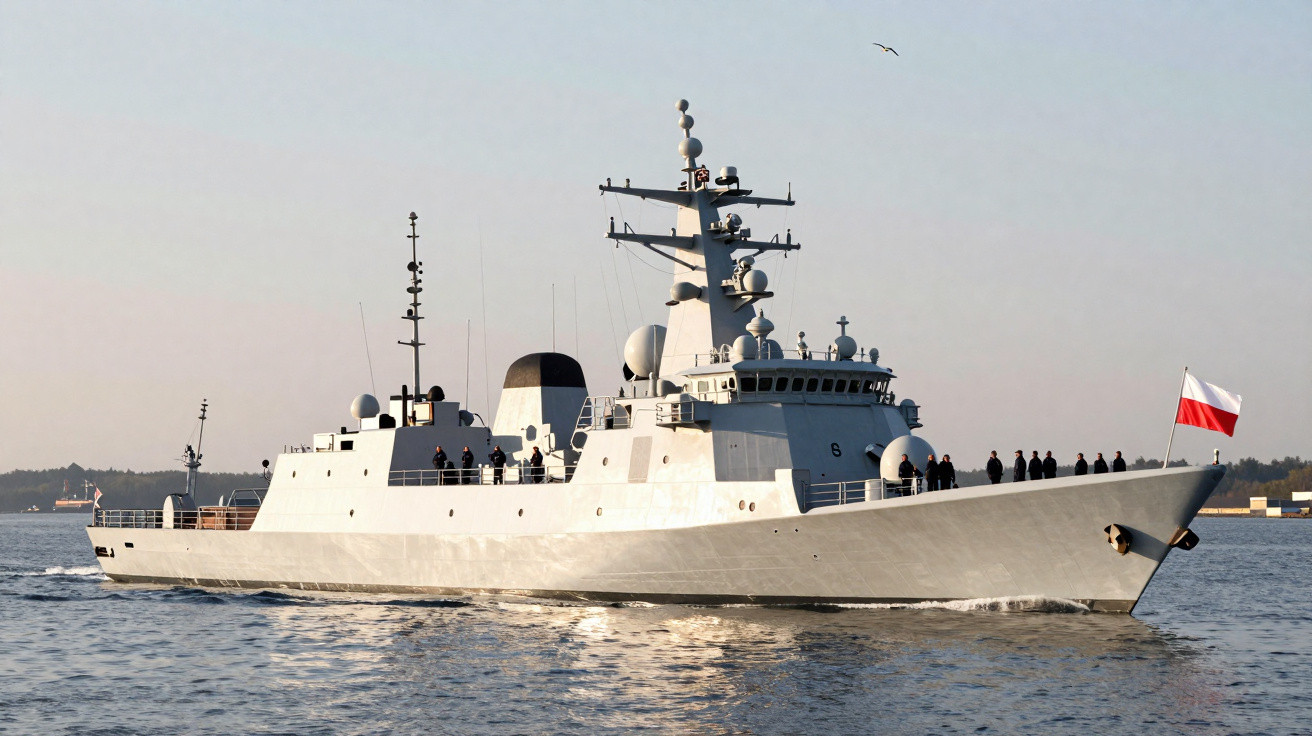
Poland has put to sea its second purpose-built signals intelligence vessel, widening a low-profile yet steadily more important capability as tensions and military movements increase around the Baltic Sea.
New spy ship enters Poland’s Baltic fleet
On 14 January 2026, the Polish Navy reached a notable milestone in its modernisation drive when ORP Henryk Zygalski was launched in Gdańsk. She is the second and final signals intelligence (SIGINT) ship being produced for Poland under the “DELFIN” programme, led by Swedish defence company Saab.
Her sister vessel, ORP Jerzy Różycki, entered the water earlier, on 1 July 2025. With both hulls now launched, the project shifts into an extended and technically intensive period of outfitting and verification before either ship can commence operational patrols.
ORP Henryk Zygalski is the second and last SIGINT ship in Poland’s DELFIN programme, cementing a new national capability at sea.
After their mission suites are installed, the pair will serve as seaborne listening posts. Their task is to observe and interpret electronic activity across the maritime domain, ranging from radar transmissions to encrypted radio communications.
Saab and Poland strengthen defence ties
Saab is acting as prime contractor for the DELFIN programme, linking Swedish and Polish industry at a moment when regional security cooperation is becoming more pressing. Physical construction is being carried out by Remontowa Shipbuilding S.A. in Gdańsk, among Poland’s largest and most seasoned shipyards.
Saab is supported by Polish company MMC on design activities, while other national defence firms provide specialised equipment and sub-systems. Saab remains fully accountable for integrating the advanced mission systems that transform a standard hull into a working intelligence platform.
The DELFIN project is as much about industrial cooperation and technology transfer as it is about adding two hulls to the Polish fleet.
Handover to the Polish Navy is planned in phases. Following the installation of sensitive electronics and lengthy sea trials, the ships are due to be delivered in 2027 and 2028.
What a SIGINT ship actually does
Signals intelligence is one of the least conspicuous, yet most valuable, elements of contemporary military activity. These ships are not designed to launch missiles or dispatch helicopters; their principal role is to listen.
With antenna arrays, receivers and high-performance computing on board, a SIGINT ship can intercept, store and assess many kinds of electronic signals, including:
- Radar emissions from naval and coastal systems used to track vessels and aircraft
- Radio communications used by military and government users
- Data links connecting ships, aircraft and land units
- Electronic signatures associated with weapon systems and sensors
By observing such emissions over time, analysts can develop detailed profiles of foreign forces-pinpointing radar locations, understanding training rhythms, identifying which frequencies are used and gauging how rapidly a navy or air force reacts to activity near its frontiers.
For a coastal state such as Poland-sharing the busy Baltic with Russia, Germany, Sweden and other NATO members-this level of situational awareness is especially valuable.
From raw signals to usable intelligence
Intercepting transmissions is only the starting point. The real benefit comes from converting raw collections into clear judgements that decision-makers and commanders can use.
| Stage | What happens |
|---|---|
| Detection | Ship sensors pick up radar pulses, radio traffic or data bursts. |
| Classification | Systems compare signals against known libraries to identify likely sources. |
| Analysis | Specialists assess patterns, locations and technical characteristics. |
| Reporting | Findings are sent to national and allied intelligence centres in near real-time. |
This loop runs continuously while a SIGINT ship is deployed. The outcome is a steady flow of information about who is operating at sea, where they are located and how they conduct themselves.
Why the Baltic Sea is such a sensitive stage
The Baltic Sea has become one of Europe’s most intensely monitored security flashpoints. Russia’s Kaliningrad exclave-wedged between Poland and Lithuania-remains heavily militarised, featuring advanced air-defence networks and coastal missile systems. NATO exercises take place regularly, and submarines and surveillance aircraft from multiple countries traverse the area.
In such conditions, failing to catch a radar transmission or missing an unfamiliar message can translate into a lost opportunity-or an unpleasant surprise. Poland’s new SIGINT ships are intended to help prevent that.
By extending its electronic “ears” out to sea, Poland aims to spot unusual activity earlier and understand it better.
The vessels are also expected to support NATO’s wider situational awareness. Although specific capabilities are classified, information collected by Polish platforms can contribute to alliance intelligence assessments, reinforcing the shared understanding of Russian and other regional military behaviour.
From launch to operational service
A launch is a highly visible marker, but the most sensitive work begins afterwards. Over the coming months and years, ORP Henryk Zygalski and her sister ship will be fitted out with large quantities of specialist equipment, installed and protected against interference-and against unwanted scrutiny.
Sea trials will evaluate not only fundamentals such as propulsion, navigation and stability, but also how effectively the sensor masts perform in heavy weather, amid electromagnetic interference and within dense civilian shipping lanes.
Their crews will require substantial training, both afloat and in simulators, to operate complex consoles, manage significant data flows and work closely with intelligence centres ashore.
Names that carry a story
The ships’ names are chosen with deliberate historical resonance. Henryk Zygalski and Jerzy Różycki were members of the Polish team that broke early versions of the German Enigma cipher before and during the Second World War.
By commemorating these codebreakers, Poland draws a clear connection between earlier cryptologic successes and today’s high-technology intelligence tasks. The implication is straightforward: listening, decoding and understanding have long formed part of the nation’s defence culture.
How SIGINT ships fit into wider maritime operations
Signals intelligence ships seldom operate in isolation; they both enable, and are enabled by, other forces. During a Baltic crisis, a Polish SIGINT ship could, for example:
- Follow foreign naval formations at range while charting their electronic behaviour
- Give coastal missile units and air defences early warning of unusual activity
- Provide data to allied aircraft and drones tasked with visual identification
- Support submarine tracking by monitoring related surface and air movements
In peacetime, the same platforms will probably spend extended periods on routine patrol, building a reference picture of what “normal” looks like. That baseline makes it easier to detect changes as tensions mount.
Key terms and risks worth understanding
Some of the terminology around programmes such as DELFIN can be unclear. “Maritime electronic intelligence” describes gathering electronic signals generated in the maritime environment, including from ships, coastal sites and aircraft operating over water.
The wider term “SIGINT” includes both communications intelligence (COMINT), which centres on spoken or written messages, and electronic intelligence (ELINT), which focuses mainly on non-communicative emissions such as radar.
Such vessels also come with risks. Their prominent antenna fits and distinctive silhouettes can make them conspicuous targets in wartime. Opponents may try to jam, spoof or saturate their sensors. There can also be legal sensitivities when operating near disputed or politically sensitive waters, even when remaining within international law.
Against that, the advantages are considerable. A single SIGINT ship can survey a broad area without crossing borders, collecting information that cannot easily be obtained from land alone. Combined with satellites, drones and coastal stations, it becomes part of a layered intelligence architecture.
That architecture will not, by itself, prevent conflict. It can, however, provide political leaders and commanders with earlier warning, stronger context and more choices. Poland’s investment in two specialised SIGINT ships-built with Saab alongside a group of domestic companies-signals a long-term commitment to knowledge as a core ingredient of Baltic security.






Comments
No comments yet. Be the first to comment!
Leave a Comment