
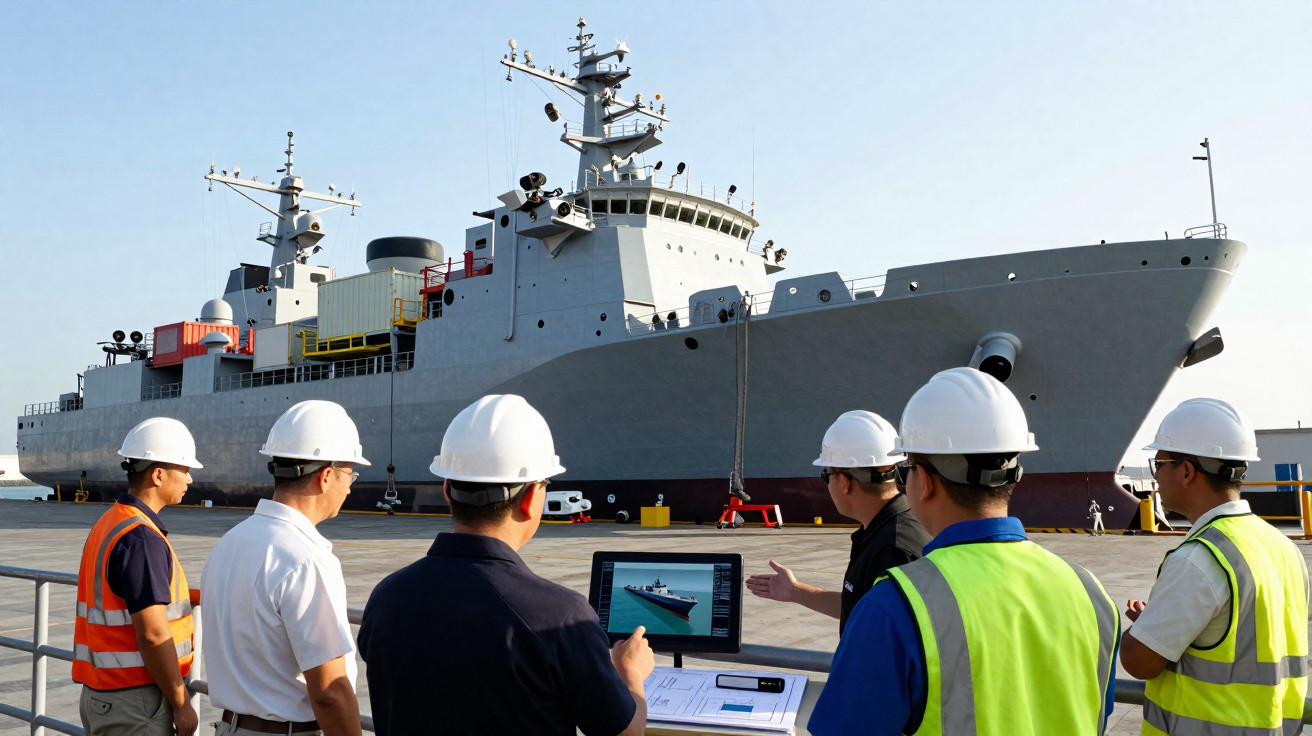
Blue Water Autonomy, a US firm focused on unmanned maritime capability, has revealed that construction is about to begin on the first Liberty-class autonomous logistics vessel for the U.S. Navy. Delivered in collaboration with the Dutch consortium Damen Shipyards, the effort is presented as a significant step towards wider naval use of autonomous systems by pairing a mature hull design with operational autonomy and a production approach suited to series builds. Under the current timetable, work on the first ship is due to start in March 2026 at Conrad Shipyard in Louisiana, with handover planned for the end of 2026.
Liberty-class autonomous logistics vessels: size, range and roles
The Liberty-class is set out as a 60-metre vessel with a steel hull. It is expected to achieve a range of more than 10,000 nautical miles and carry in excess of 150 tonnes of payload. Blue Water Autonomy states the ships are intended to remain at sea for months without a crew, and to be equipped for logistics tasks as well as sensing and combat-support duties. In operational terms, they are designed to integrate as complementary assets alongside the U.S. fleet’s crewed ships.
The programme’s broader objective is to increase naval operational capacity through a platform that can be produced quickly, adapted into multiple configurations, and sustained using existing US industrial infrastructure and supply chains.
Damen Stan Patrol 6009 and the “Axe Bow” hull form
At the core of the Liberty-class is Damen’s Stan Patrol 6009 hull, which is known for its vertical “Axe Bow” arrangement. This bow shape is intended to slice through waves more effectively, helping to reduce pitching and improve seakeeping when conditions deteriorate. With more than 300 vessels of this family already operating worldwide, the design brings a track record that helps limit technical risk, allowing Blue Water Autonomy to concentrate its engineering effort on modifying the internal layout for autonomous operation.
Autonomy reengineering and serial production under the DTC model
Turning the baseline design into the Liberty class has involved extensive redesign of the mechanical, electrical and propulsion architecture, including the addition of automated fault-management capability to support long-duration deployments with minimal human input. By combining new hardware, software and artificial intelligence, the company aims to deliver a highly autonomous vessel able to conduct sustained, long-range ocean operations in challenging environments. As Blue Water Autonomy CEO Rylan Hamilton put it: “The Liberty class reflects our commitment to building autonomous ships designed from the outset to operate for long periods and to be produced at scale.”
The partnership with Damen Shipyards is being delivered through the Damen Technical Cooperation (DTC) model, under which the Dutch shipbuilder licenses its designs to partner yards around the world. Used previously across commercial and government work, this structure is intended to draw on local expertise to build complex vessels. Within this arrangement, Conrad Shipyard is expected to use advanced welding methods and automated assembly processes to enable serial output of between ten and twenty Liberty vessels per year, establishing what the companies describe as a scalable and efficient industrial approach for the U.S. Navy.
You might also be interested in: *The U.S. Navy strengthens sustainment capabilities for its F-16C aggressor fighters*


Comments
No comments yet. Be the first to comment!
Leave a Comment