
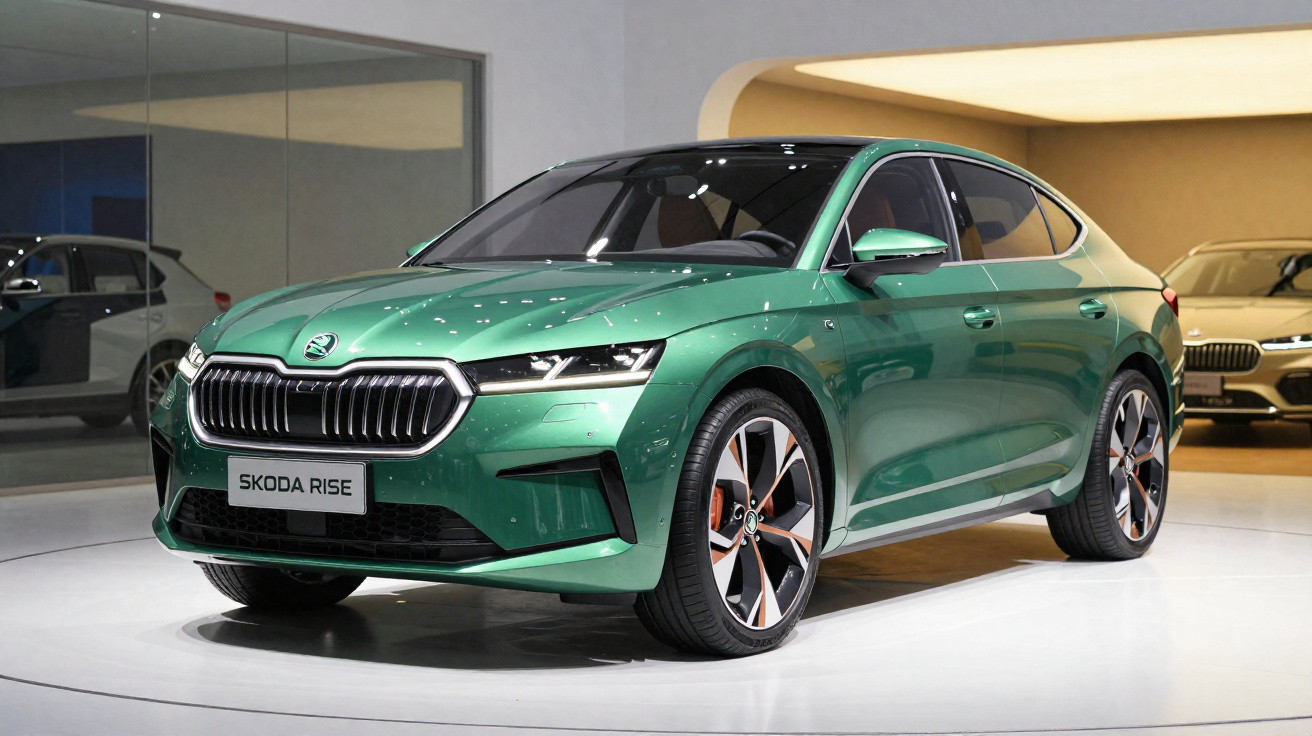
In just a few years, the Czech carmaker has shifted from being the budget alternative to becoming a dependable profit engine inside the group. While other brands across the VW universe wrestle with softer demand and costly investment in electrification, Skoda is posting record results for both volumes and earnings. That performance is not down to luck; it is the outcome of a fairly clearly mapped-out approach.
Skoda grows while others falter
In 2025, Skoda delivered around 1.04 million vehicles worldwide. That puts the brand among Europe’s biggest volume manufacturers. About 17% of those sales are already fully electric cars, with the remainder split between petrol, diesel and hybrids.
The headline figures show just how strongly Skoda is performing right now. Revenue rose to €30.1 billion. More striking still is operating profit: €2.5 billion. That is only slightly below the €2.6 billion that Volkswagen generates despite selling roughly three times as many cars.
Skoda generates almost the same operating profit as the Volkswagen core brand while selling far fewer cars.
Over the same period, other group brands such as Audi or Porsche have faced weaker demand, the cost burden of new model programmes and a tougher competitive landscape. Against that backdrop, Skoda can seem like the group’s “stabiliser”, reliably putting money into the till.
Why Skoda still delivers solid margins despite EVs
From a manufacturer’s perspective, fully electric cars typically carry lower margins than combustion models. Batteries are expensive, competition is intensifying, and many buyers expect state incentives or discounts. Even so, Skoda has managed to keep profitability at a healthy level.
Rather than pursuing a dramatic break with the past, the management board is following a kind of parallel-track plan:
- An EV push with selected models
- A continued strong presence in petrol and hybrid vehicles
- Consistent use of technology from the VW parts bin
- Tight cost discipline in development and production
Skoda CEO Klaus Zellmer has made it clear that pure combustion models do deliver higher margins, but the brand is deliberately sticking with a mix. The reason is straightforward: ignoring battery-electric cars risks hefty penalties for excessive CO₂ emissions. Those fines would weigh on the bottom line far more than slightly lower profit per EV.
The smart route into electromobility
Instead of converting the entire range to electric power at breakneck speed, Skoda is expanding its EV line-up step by step. At the same time, established models with combustion and hybrid drivetrains remain on sale. This balance particularly appeals to customers who are open to new propulsion options but do not want to give up familiar technology.
In its current and upcoming line-up, the manufacturer is working with a clearly structured offering:
| Segment | Example models | Powertrain |
|---|---|---|
| Compact and mid-size | Octavia, Superb (future variants) | Petrol, diesel, hybrid |
| Electric SUV | Enyaq, Elroq | Fully electric |
| New EV models | Epiq, Peaq | Fully electric |
Right now, the compact Elroq and the larger Enyaq form the backbone of Skoda’s electric fleet. Over the next few years, two more EVs are due to join them: a cheaper city SUV called Epiq, aimed primarily at price-sensitive buyers, and a large family SUV called Peaq.
Combustion engines remain - but in a different form
While some manufacturers are almost hurriedly cutting combustion cars from their catalogues, Skoda is planning to keep them as a long-term second pillar. Modern hybrid systems, in particular, are set to be central. The brand is drawing on a new hybrid unit from within the group that is already used in the current T-Roc.
This approach reduces development spend because Skoda can adapt existing technology instead of pursuing costly solo solutions. At the same time, it resonates with buyers who prioritise range, towing capacity or fast long-distance driving.
Strategic course correction: fewer electric models than planned
Notably, Skoda has recently narrowed its EV ambitions again. The original plan listed six new electric models. For now, the manufacturer is working with four. The fully electric Octavia has been pushed back to the start of the next decade.
Skoda is responding to real market demand rather than rigidly sticking to old plans - and in doing so it protects its returns.
In some countries, EV demand has levelled off, subsidy schemes are ending or changing, and many customers are hesitant given high prices. Skoda is taking those signals seriously and is prioritising models that, from today’s perspective, genuinely add up financially.
Why this caution makes sense
Large-scale EV programmes consume billions. For a brand like Skoda, a misstep in a segment with weak demand would be risky. So the company is focusing on vehicles where the combination of price, size and use case is proven: compact and mid-size SUVs that appeal to both families and fleet customers.
At the same time, the plan leaves room to move later. If demand for electric estates or saloons rises significantly, a model such as an electric Octavia could be introduced at a later date - with more mature technology and potentially cheaper batteries.
What sits behind Skoda’s “recipe for profitability”
Skoda’s success model essentially rests on three pillars:
- Relentless cost control: Platforms, engines and infotainment largely come from the group shelf. Skoda adapts them rather than developing everything from scratch.
- A broad but disciplined model range: No oversupply in niche areas; instead, clear focus on volume segments where demand remains steady.
- A pragmatic technology step: The manufacturer pushes electromobility forward, while still letting customers choose the pace and the drivetrain.
On top of that sits the image of the “down-to-earth brand”: many buyers associate Skoda with generous space, sensible pricing and robust engineering, not with luxury or “show-off attitude”. That positioning fits surprisingly well at a time of high living costs and expensive mobility.
What this means for customers and competitors
For car buyers, the current direction has two clear effects. First, Skoda offers classic combustion models, modern hybrids and EVs within the same vehicle classes. Second, prices are likely to remain more stable than at some sister brands in the group, because Skoda is firmly focused on economic efficiency.
For rivals, Skoda is now far more than a peripheral player. When a manufacturer can achieve VW-level margins with relatively moderate list prices, premium brands come under pressure to scrutinise their cost structures. At the same time, other volume brands can see that they must fine-tune both their product mix and their EV strategy if they want to avoid falling behind.
Terms such as operating margin or CO₂ fleet limits may sound dry, but they are exactly what drives decisions like these. Operating margin describes how much of revenue remains as profit after operating costs are deducted. On that measure, Skoda is closing in on the VW core brand - despite lower volumes and the expensive shift towards electrification.
Especially over the next few years, brands with flexible strategies are likely to benefit: those that combine combustion, hybrid and electric power intelligently, avoid over-reliance on individual markets, and keep a tight grip on costs can stay profitable even in a volatile environment. Skoda is currently providing a very clear illustration of what that balance can look like.


Comments
No comments yet. Be the first to comment!
Leave a Comment