
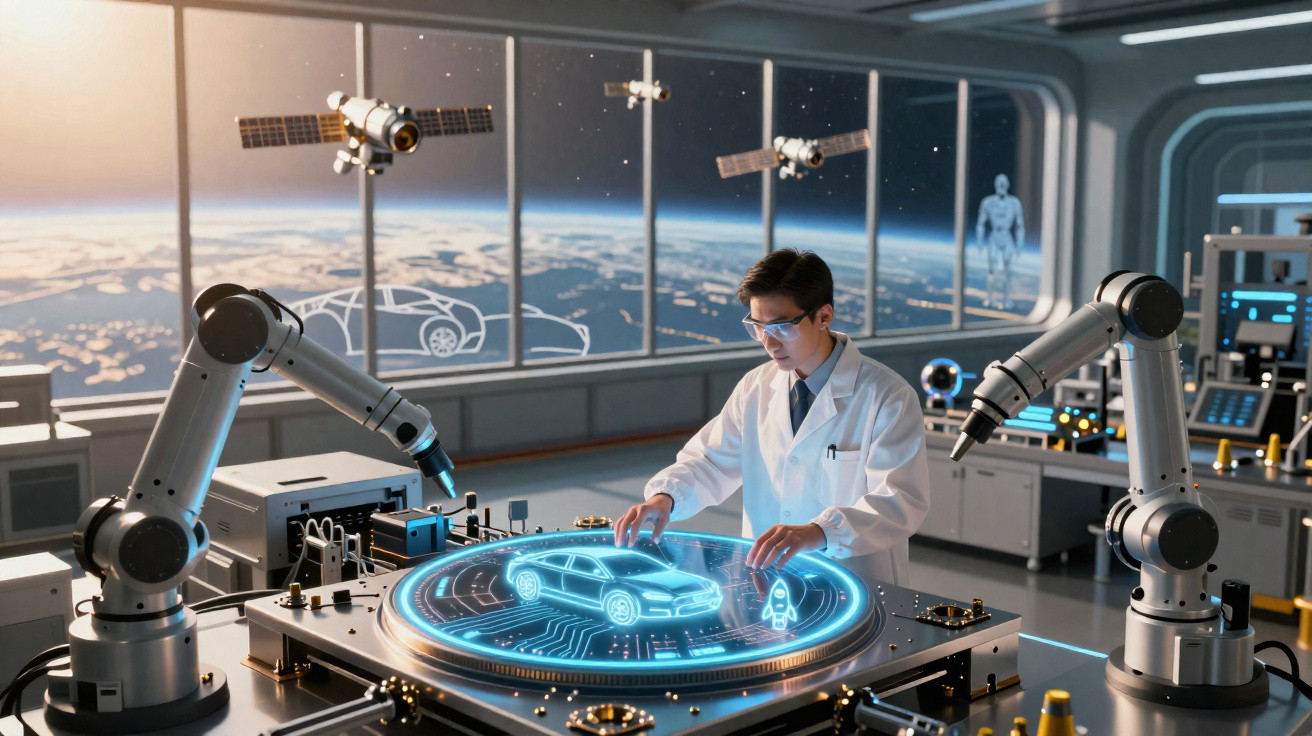
A new industrial heavyweight is taking shape in Texas: Elon Musk is pooling Tesla, SpaceX and xAI into a chip initiative designed to power roads, robot factories and Earth orbit at the same time.
In Austin, Elon Musk is preparing his next major move against the wider technology sector. Under the name “Terafab”, a vast semiconductor site is planned to produce dedicated AI chips for Tesla vehicles, the humanoid robot Optimus, and future data centres in space. The ambition places Musk squarely in a market long dominated by giants such as TSMC, Samsung and Micron - with the aim of bringing his entire hardware pipeline under his own control.
What sits behind Musk’s Terafab project
Terafab is intended to be far more than another shed in Texas dust. People close to the effort say two advanced facilities are planned in Austin, backed by Tesla and SpaceX, which is now closely intertwined with Musk’s AI company xAI.
- Plant 1: Chips for cars and humanoid robots (“edge” processors that run directly in the vehicle or inside the robot)
- Plant 2: High-performance semiconductors for data centres - including those expected to operate in orbit later on
The message is straightforward: Musk no longer wants to wait for others to supply enough chips. By his own account, global manufacturing capacity today comes nowhere near what his longer-term roadmap requires. Demand for AI compute is surging, and Terafab is pitched as a way to bridge that gap.
Terafab is meant to supply the AI chips that Teslas, robots and orbiting servers will consume in gigantic quantities over the coming years.
A plant built for the terawatt ambition
The name is meant to signal the scale. Over time, Terafab is expected to enable around one terawatt of compute capacity per year. That figure reflects a blunt objective: Musk wants a meaningful share of global AI infrastructure to be powered by his own chips.
What makes the Texas plan unusual is the push for a near fully vertically integrated semiconductor chain - effectively an all-in-one chip facility. The intention is to place the following under one roof:
- Chip design (circuit design and architecture)
- Lithography (patterning tiny transistors using extreme ultraviolet light)
- Wafer fabrication
- Memory production
- Packaging (assembly and housing of the chips)
Analysts put the required investment at 20 to 25 billion US dollars. That price tag indicates the level Musk is targeting: Terafab is planned to produce chips with 2 nanometre process technology - a tier currently reachable only by the top global group.
Why 2-nanometre chips matter so much
In semiconductors, the rule of thumb is simple: the smaller the feature size, the more transistors fit into the same area. At 2 nanometres, chips are expected to deliver:
- substantially more compute in a compact footprint
- lower energy use per calculation
- smaller, cooler hardware - well suited to cars, robots and satellites
For Tesla and SpaceX, this translates into more AI capability running directly in a vehicle or robot, less reliance on external data centres, and powerful hardware that can keep operating reliably in space for years.
Data centres in orbit: Musk moves the cloud basement into space
One of the more futuristic elements concerns chips that must function in vacuum and under cosmic radiation. One of the two Austin plants is expected to be set up specifically for that purpose: semiconductors designed to run in space rather than in Earth-based, air-conditioned halls.
The concept is that Starship rockets will, over the coming years, deliver entire data centres into Earth orbit. This orbital infrastructure is meant to draw on two natural advantages:
- Constant solar energy: Solar panels in space operate without clouds, day–night cycles or weather swings.
- Efficient cooling: Heat can be shed radiatively in vacuum, without enormous cooling towers or water consumption.
The “cloud” could literally grow into the sky - with AI data centres circling above Earth instead of humming beneath it.
The plan is further buoyed by the valuation of the SpaceX–xAI combination, which is said to be around 1.25 trillion dollars. With that financial cushion, Musk is attempting to shift energy-intensive AI workloads away from Earth’s strained power infrastructure and into orbit.
A direct challenge to TSMC, Samsung and the rest
Terafab sends a pointed signal to established leaders in chip manufacturing: a major customer wants to build its own fabs. Tesla and SpaceX are not only aiming to reduce costs, but also to shape the rules of the game.
Building chips in-house offers several levers:
| Lever | Benefit for Musk |
|---|---|
| Technical control | Chips can be tailored precisely to Tesla software, Optimus robots and SpaceX systems. |
| Supply-chain security | Reduced exposure to geopolitical tensions or bottlenecks at contract manufacturers. |
| Cost structure | A large upfront investment, but long-term potential for lower unit costs. |
| Standard-setting | Musk can establish his own norms for automotive, robotics and space AI. |
For traditional fabs, this creates a dilemma: one of the most attractive growth markets - AI chips for autonomous systems and space applications - could partly slip away once Musk builds enough internal capacity.
Why Musk is taking this risky step
Competing at the cutting edge of chip manufacturing is among the most expensive and technically demanding plays in the technology industry. Even so, the move fits Musk’s logic: his plans for autonomous cars, humanoid robots and large-scale AI services depend on access to specialist chips.
Even today, car makers complain about shortages of relatively basic control units. For state-of-the-art AI accelerators, the scramble is even more intense. Anyone who remains dependent on suppliers risks delays stretching into years.
That is why Musk is opting for the path other tech heavyweights have hinted at: proprietary chips, proprietary manufacturing, and minimal dependence. While firms such as Apple or Amazon largely focus on design and then use TSMC for fabrication, Musk wants to unify the entire value chain - from blueprint to packaged chip - within a single organisation.
Opportunities and risks of Terafab
The strategy opens up huge possibilities, but it also carries clear downsides:
- Technical risk: If 2-nanometre production fails or slips, billions could effectively sink into the Texas sand.
- Financial pressure: 20 to 25 billion dollars ties up capital that could otherwise go towards expanding Gigafactories or Starlink.
- Political dimension: With Terafab, the US gains another building block for technological sovereignty relative to Asia.
If the plan succeeds, Musk would not only remain a car maker and rocket builder, but also become a significant force in the global chip market - with direct influence over the next generation of AI systems.
What this means for AI, cars and spaceflight
For Tesla drivers, this may sound abstract at first, but it could become tangible over the medium to long term. Proprietary AI chips can enable more frequent and more substantial Autopilot software advances, stronger processing of camera and radar data, and capabilities that currently feel like science fiction.
For the humanoid robot Optimus, specialised silicon is crucial so it can perceive its surroundings in real time, grasp objects, maintain balance and learn from mistakes. The more of that compute happens locally inside the robot rather than in the cloud, the faster the response and the greater the independence.
In spaceflight, Terafab chips could underpin a new class of satellites and orbital platforms: self-optimising communications networks, autonomous maintenance robots, and AI-assisted observation systems for climate, agriculture or security. Many such ideas have previously been constrained by limited compute in orbit, or by the challenge of transmitting vast volumes of data back to Earth.
Terms and background: what readers should know
The phrase “edge chip” is appearing more often in this discussion. It refers to processors operating at the edge of the network - in a car, a robot or a machine - processing data immediately where it is generated. That reduces latency and eases the load on central data centres.
Equally notable is the proposal to move especially power-hungry AI models into orbit. In practical terms, training runs for large language models or image generators could be executed in space-based data centres, while devices on Earth would pull down only the finished models or results. In theory, that could relieve electricity grids, avoid CO₂-intensive peak power plants and unlock new scaling effects.
It would not come without new challenges: space debris, reliance on Starship launch cadence, and security questions around access to orbital servers all matter. Still, Terafab illustrates a direction of travel - away from AI as a purely software story and towards a world where AI, the automotive industry and spaceflight converge on a shared, purpose-built chip foundation.

Comments
No comments yet. Be the first to comment!
Leave a Comment