
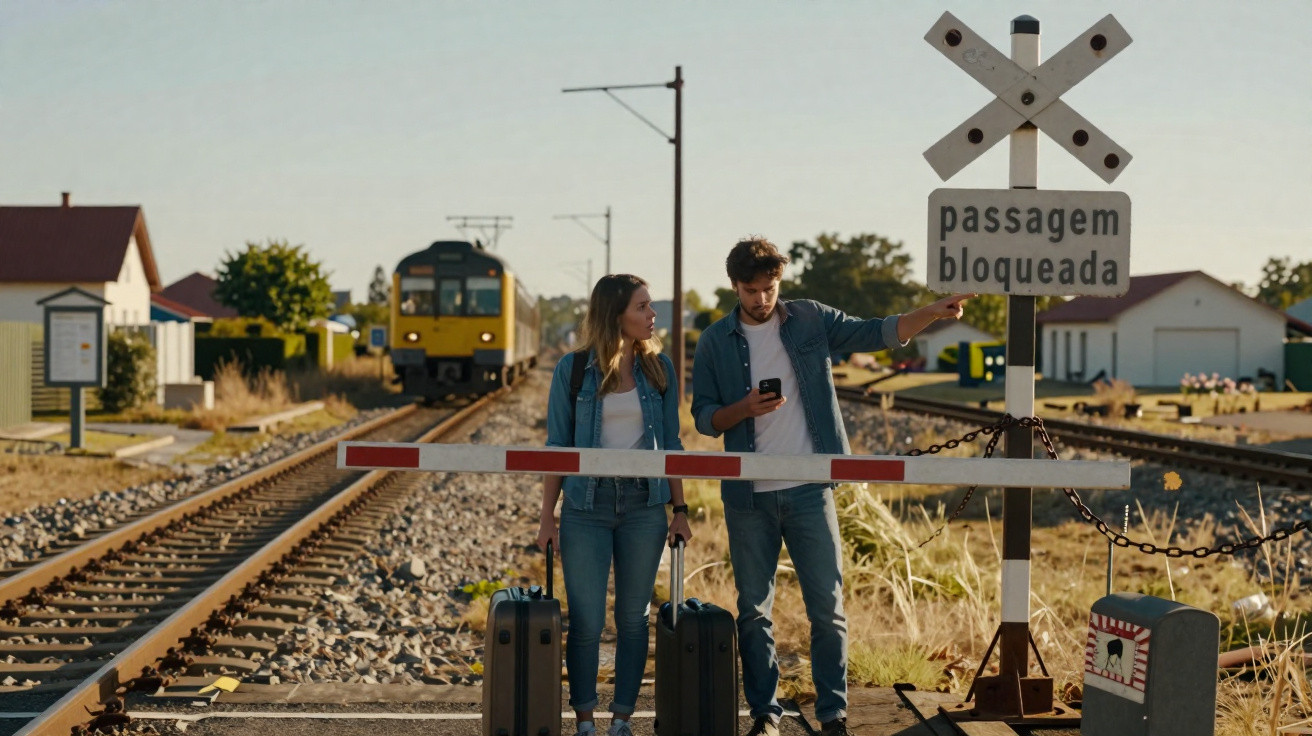
A young couple stand on the platform at King’s Cross, fingers still looped through their bag straps, staring at the receding tail-lights of the train. They’d legged it from the taxi, slipping between commuters, chests tight and burning. They were convinced they’d got there in time.
They hadn’t.
And the whole mess began with one blocked junction half an hour earlier, back on a quiet residential street where, supposedly, nothing ever happens. Or so they assumed.
The blocked junction that changed everything
It was one of those awkward weekday afternoons when the roads can’t decide what they are: not quite rush hour, not quite quiet. Their sat-nav sent them down a “shortcut” in North London-the sort of side road that looks innocent on a map and turns nasty the moment you commit.
Midway along, everything seized up. Horns didn’t so much blare as fidget. Traffic stacked in both directions because a junction ahead was half-choked by roadwork barriers and a large NO ENTRY sign, slumped at a careless angle as if it couldn’t be bothered.
The driver kept glancing at the time. The couple watched the minutes leak away while they sat under an unbroken chain of brake lights. Every so often one of them refreshed the train ticket email, as though the act might somehow conjure extra time. It didn’t. The train went without them. Their booked seats stayed vacant.
Later that night, still fuming, they replayed the journey on Google Street View. Online, the junction that had held them up was shown as open both ways. There was no official warning, no diversion markings, nothing that resembled the chaos they’d met.
Interested, the man started digging further. He landed in a local Facebook group where residents grumbled about “phantom roadworks” and questionable signs that pop up on side streets. Then a neighbour posted a line that made him stop: “That blocked junction by the park? Those signs aren’t even council-approved.”
The sentence lodged in his head like grit.
When a road sign lies
Once you start paying attention, you notice it all over the place: cones that appear out of nowhere, handwritten parking restrictions, tired plastic boards that look official enough if you pass at 30 mph and don’t look too closely. Our streets are dotted with things that resemble authority but don’t actually have it.
So the couple returned in daylight. They walked to the junction that had cost them their train. The barriers were flimsy, generic plastic-no branding, no council marking. The NO ENTRY sign had been fixed to a garden stake, not mounted on a proper post. And the small print on the back? A hire company stamp, with no permit reference at all.
They emailed the local council and attached photos. A week later, the council replied: there had been no traffic order for that junction on the date in question. No authorised closure. No legal signage. In other words, the road had been blocked for nothing.
The reality was almost ridiculous. A private contractor had apparently left kit behind after completing a different job. The junction was, for all practical purposes-and unlawfully-shut. That quiet, makeshift closure set off a domino effect: a missed train, a missed meeting, and a hotel night rebooked at an eye-watering price.
It’s tempting to shrug and say, “That’s life.” Traffic happens. People miss trains. But this wasn’t simple misfortune. It was an error sitting in plain sight. And it prompts an uncomfortable question: how many everyday delays are triggered by things with no legal basis whatsoever?
How to spot when a junction is illegally marked
There’s one habit that can spare you the worst of this: take a second look, even when you’re under pressure. When you come up on a blocked junction or a sudden restriction, a quick scan can hint at whether you’re dealing with proper authority-or just a slapdash workaround.
Begin with the obvious. Genuine highway signs follow strict standards: solid metal posts, approved colours, reflective faces, and clear positioning, often with council or government identifiers. Temporary roadworks should also provide readable information nearby: permit numbers, dates, the company responsible, and an emergency contact.
If what you’re seeing is wobbly, handwritten, strapped to a wheelie bin, or perched on a traffic cone, you’re probably right to be wary. You don’t need to become a legal scholar at the wheel. You only need to clock when something doesn’t add up and, when it’s safe, record it. One decent photo can be invaluable later.
Think of it as a small radar for nonsense. Most days you’ll never use it. When you do need it, though, it can make all the difference.
Most drivers don’t challenge what’s in front of them. A NO ENTRY sign appears, and we comply. A barrier blocks a side street, and we divert. That trust is almost automatic-which is precisely why illegal or unauthorised markings are so effective, and so quietly harmful.
On that North London street, the driver did have alternatives. Just before the blocked junction, there was a narrow but legal turning that could have cut ten minutes from their trip. But he followed the barrier’s instruction, because ignoring it felt dangerous and wrong.
Let’s be honest: nobody really does this day to day.
Nobody pulls over, walks up to a sign, and studies the small print while a delivery van sits on their bumper. We react to urgency, not paperwork. And that’s exactly why anyone placing “sort-of-official” signs can rely on drivers to obey without asking.
The couple later owned up to something that stung: they had noticed the sign looked oddly placed. They’d clocked there was no clear diversion, no road crew, no advance warning. They felt that flicker of doubt-and pushed it aside, because the dashboard clock drowned out their instincts.
What to do when a sign doesn’t feel right
When you reach a suspicious junction in real life, you almost never have room for a legal argument. You’ve got seconds, not hours. The useful move is to split the immediate choice from the longer fight.
In the moment, safety usually wins. Don’t drive through a closure simply because you suspect the sign is dubious. Take the delay-but turn the irritation into evidence. When you’re stationary and it’s safe, take clear photos from your seat. Get the sign, the context, and any missing details.
Then, once you’re off the road and your head has cooled, send what you captured to someone who can act: the local council, the city traffic department, residents’ groups. In the heat of the moment it can feel slow and pointless. It often isn’t. It’s exactly how that rogue North London junction eventually got sorted.
Some people reading this will be thinking, “I don’t have energy for that. I just want to get where I’m going.” Fair enough. Life already feels like an endless queue of hidden admin. Still, there’s a quiet strength in spending ten minutes now and then to push back.
If you repeatedly miss trains, flights, or meetings because someone somewhere is bending the rules of the road, staying silent has a price. It takes an emotional toll too. It’s draining to feel as if the world runs on random bad luck, when sometimes the cause is simply sloppy signage.
On a human level, this couple’s story isn’t really about traffic law. It’s about that familiar gut-drop as time drains away behind somebody else’s mistake. On a civic level, it’s about who gets to control our streets-and how easily they can do it when nobody asks.
“The worst part wasn’t missing the train,” the woman told me. “It was realising we’d done everything right, and lost the day anyway because of a junction that shouldn’t have been blocked in the first place.”
That’s the part that stays with you. One careless closure was enough to rewrite their day-their plans and their mood included. And they only uncovered the truth because they were stubborn enough to check.
- Take quick photos when a junction looks wrong, even if you comply.
- Report suspect signs to the local authority with date, time and location.
- Use street-view tools later to compare what “should” be there.
- Talk to neighbours; shared frustration often reveals a pattern.
- Keep proof of costs if you’re delayed-you may have a case.
What this one blocked junction reveals about the rest of us
We like to imagine our journeys are shaped by big, obvious forces: train timetables, traffic lights, weather, strikes. In truth, it’s more delicate than that. Small actions-where a cone gets left, how a sign is tilted, whether a barrier is collected on time-quietly rearrange entire days.
That couple in London did eventually catch a later train. The ending is fairly tame. They arrived worn out, a bit poorer, and with a new (slightly obsessive) habit of scrutinising road signs. But their anger points to something bigger than a single missed service.
Every city contains these tiny failures: a junction set up wrongly here, an outdated restriction there, a private contractor treating public space like temporary storage. We hit them, swear, and carry on. Yet each time it happens, a little trust gets rubbed away. We start doubting not only the signs, but the system that’s meant to stand behind them.
On a quiet evening, once the traffic noise fades, it’s hard not to think about how much of life is spent responding to things we never chose. Barriers. Timetables. Rules. Some essential, some careless, some outright illegal. Sharing stories like this isn’t about rage; it’s about gently asking, “Who put that there, and why?”
Maybe the next time you’re stuck at a mysteriously blocked junction, you’ll look more carefully. Maybe you’ll take a photo. Maybe you’ll send that email. Or maybe you’ll mention it to a friend-and they’ll start noticing too.
We don’t control the trains. We rarely control the roads. But we aren’t entirely powerless. Sometimes the smallest action-a picture, a complaint, a shared link-can be what quietly gets a street reopened for everyone.
| Key point | Detail | Why it matters to you |
|---|---|---|
| Spotting questionable signs | Check the quality of the stand, whether official logos are present, and if any readable information is provided | Helps you make safer calls in confusing situations and cuts down on “unlucky” delays |
| Capturing evidence on the spot | Take clear photos as soon as the car is stationary and it’s safe to do so | Gives you proof if you want to report it or try to recover costs later |
| Reporting it afterwards | Contact the local council, the city, or highways services with the location, date and images | Supports removal of illegal or lazy closures so everyone benefits |
FAQ:
- How can I tell if a junction is illegally marked? Look for missing official logos, careless positioning, no clear dates or permit information, and signage that feels improvised in a way that doesn’t match how serious the restriction is.
- Can I ignore a sign if I think it’s not legal? No. In the moment, follow what’s posted for safety, then challenge it afterwards with photos and a report. Ignoring a sign could still lead to a fine or put you in danger.
- Who should I contact about a suspicious road closure? Start with your local council or city traffic department. Many offer online forms or apps for reporting road issues, including poor or unauthorised signage.
- Can I claim compensation if I miss a train because of this? It can be difficult. You’ll need solid evidence and it may only work if a public authority or contractor clearly acted outside the rules. Keeping records at least gives you a chance.
- Is this problem common or just a one-off story? Drivers’ reports suggest it’s more widespread than most people assume, especially in cities with constant construction where temporary signage quietly turns semi-permanent.






Comments
No comments yet. Be the first to comment!
Leave a Comment