
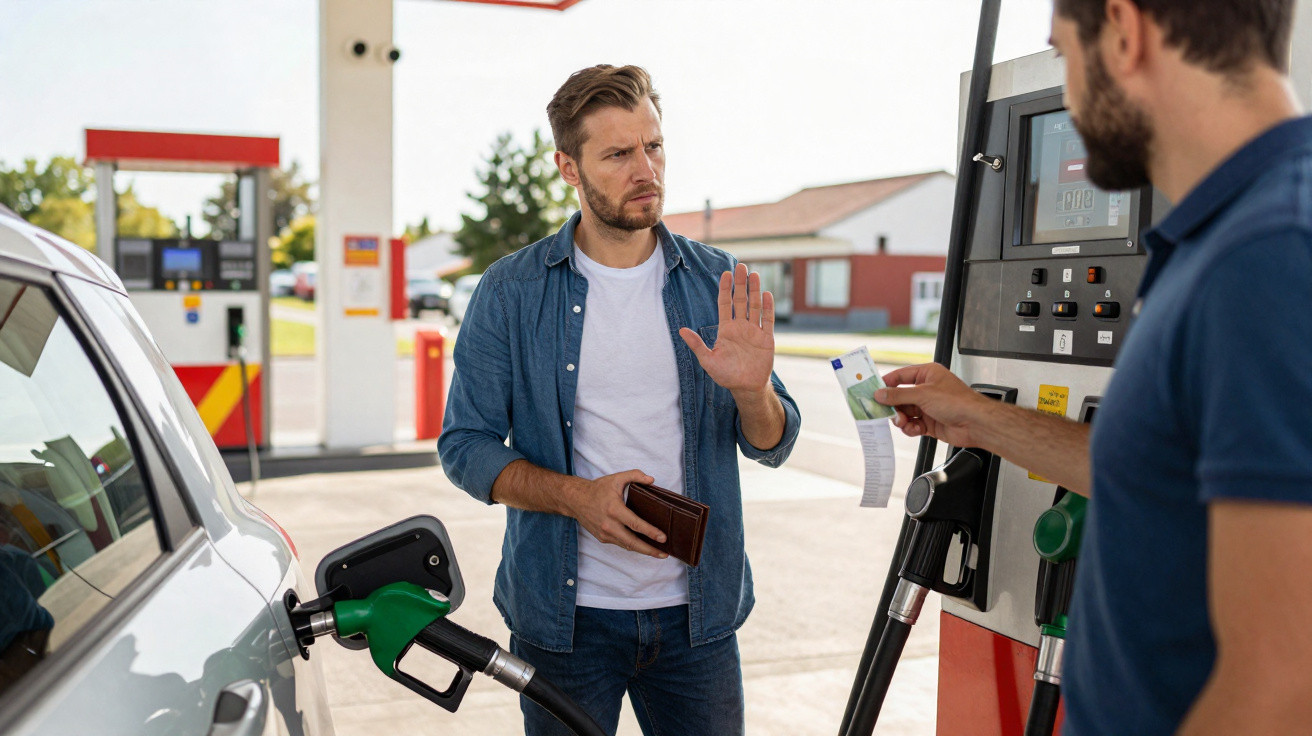
A particularly nasty scam is currently spreading at petrol stations in France: what looks like a harmless swap of 5 euros for a few litres of fuel can leave drivers facing bills of up to 90 euros. The fraudsters rely on surprise, pressure and the guilt of people who want to help. The method is so straightforward that it could just as easily appear in Germany at any time.
How the five-euro note petrol trick works
It usually starts without drama. A driver is stood at the pump, thinking about the cost of filling up, grabbing a few items, or getting to the next appointment. That is when a stranger approaches. They claim their bank card is not working or that they have forgotten their wallet. In their hand is a five-euro note, and they ask you to authorise a few litres of petrol for their pump.
At first glance, it seems plausible: the sum is small, the person appears anxious or embarrassed, and the story sounds believable. If you agree, you pay with your own card for the requested amount on the relevant pump - and then start fuelling the other vehicle.
When helping suddenly turns into pressure
This is where the situation changes. The moment the nozzle is in the tank, the tone shifts. The supposed emergency becomes intense coercion. Additional people may appear, moving in close to the victim and crowding them. What felt like a polite favour quickly starts to feel threatening.
"The supposed five-euro swap ends in forced fuelling - often until the scammer’s tank is completely full."
If you try to stop at that point, you may feel intimidated. Many people affected say they carried on pumping simply to avoid a physical confrontation. In the end, the display shows 60, 70 or even 90 euros - charged to your own card, for a stranger’s car.
Where the offenders prefer to target people
The scam mainly affects drivers at self-service petrol stations where payment is card-only. These locations in particular are higher risk:
- unattended, automated stations with no staff on site
- remote or poorly visible forecourts
- late-night and early-morning hours when there is little activity
- pumps at the edge of larger sites, away from the till area
In France, reports have focused on bigger cities and their outskirts. However, the same approach also suits rural areas where a few isolated, poorly lit pumps are available. What matters to the perpetrators is minimal witnesses, ideally no employee present, and enough time to build pressure.
Why so many people fall for it
The scammers exploit several very human weak spots at once:
- Surprise: Few people expect an aggressive scam while they are simply filling up. Most react on impulse.
- Willingness to help: Anyone assisting in an apparent emergency feels they are doing the right thing - and does not want to look “cold”.
- Fear of escalation: When multiple people appear and step closer, stress rises quickly. Many pay just to avoid trouble.
- Unclear legal situation: Some are unsure what they are allowed to do once fuelling has started.
"The perpetrators deliberately play on victims’ guilt - and then turn it into fear."
How drivers can protect themselves from the five-euro scam
A few simple habits can significantly reduce the risk. The key rule is: strangers at the pump should stay strangers - especially where money and bank cards are involved.
Practical behaviour rules at the petrol station
- Turn down approaches politely but firmly
If asked for money or fuel: “No, I’m not doing that” - no debate and no justification. - Keep your distance
If people move in unusually close, create space, lock your doors, and only open windows a small amount. - Check what is happening around you
Particularly at night: look for others lingering in the background or positioning themselves quietly. - Choose busy, well-lit stations
Where possible, opt for branded sites with staff, CCTV and regular footfall. - Do not pump into someone else’s tank
Never use your own card to activate a pump for another vehicle.
What to do if the situation turns
Sometimes there is little time to think. If you are already in an uncomfortable situation, it helps to follow a clear plan.
Emergency strategy for those affected
- Press stop immediately
Every pump has a lever or button that ends the fuelling process - even mid-flow. - Get back into your car and lock it
If the mood feels threatening, return to the vehicle, lock the doors and start the engine. - Call the police
Dial the emergency number and clearly state that you are being harassed or coerced at a petrol station. - Use cameras and witnesses
Note number plates, clothing and distinguishing features, or take a photo on your phone if it is safe to do so.
"If you feel threatened, you can stop at any time - even if the nozzle is already in someone else’s tank."
Other variants: fake petrol stations and contaminated fuel
The five-euro scam is only one version. In some cases, mobile or semi-legal “mini petrol stations” appear in car parks or back yards. Strangers tempt drivers with extremely cheap fuel prices, often cash-only and without a receipt.
The risks include:
- Contaminated fuel with water, dirt or incorrect additives, which can lead to expensive engine damage.
- No liability if the vehicle breaks down - operators are often anonymous and disappear quickly.
- Potential criminal involvement if the fuel is stolen or illegally siphoned and decanted.
Why the scam also matters for Germany
The basic concept works across borders: anonymous fuelling, card payment, minimal staffing and a rushed atmosphere. Those exact conditions exist at many automated stations in Germany too, particularly at night on motorways and in industrial estates.
On top of that, many drivers are familiar with classic frauds such as fake prize draws or questionable online shops, but do not expect confrontation at the petrol station. That blind spot is precisely what offenders exploit.
Everyday practical tips
- For night journeys, plan in advance where you will stop for fuel.
- Keep all vehicle doors locked while refuelling, especially in quiet locations.
- If your instincts feel off, move to another pump or simply drive on.
- Report suspicious incidents to the police, even if no money was lost.
The term “coercion at the pump” is appearing more frequently in police reports. It describes situations where people are pushed into making payments through threats or the presence of a group. In criminal law terms, the five-euro scam often sits in that territory - and may also involve fraud and intimidation.
Knowing this helps drivers act more confidently: a polite refusal is entirely reasonable. And the moment strangers try to gain access to your card, the pump, or your refuelling process, there is only one priority: create distance and, if needed, get help.




Comments
No comments yet. Be the first to comment!
Leave a Comment