
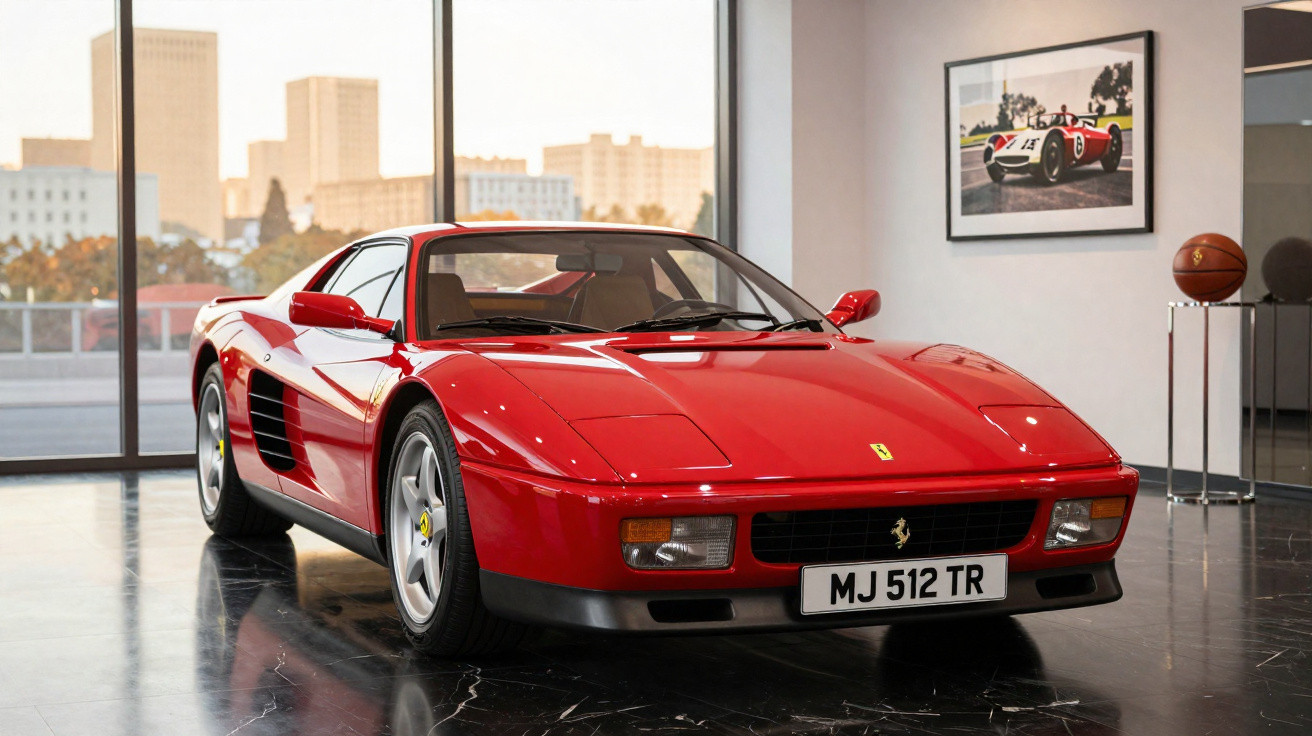
Hidden for years in a dusty California garage marked by wildfire damage, one of Michael Jordan’s hardest-to-find belongings has finally come back into view.
The black Ferrari 512 TR that Jordan once left outside Chicago Stadium-Bulls cap on, suit perfectly cut-has re-emerged after disappearing for 15 years. Its return is more than a supercar anecdote; it’s an unlikely blend of NBA memory, painstaking sleuthing and sheer chance.
From Bulls dynasty to total blackout
Back in the early 1990s, Jordan’s collection of cars carried its own mythology, almost matching the reputation of his fadeaway. The headline act was a black Ferrari 512 TR, supplied new on 29 February 1992 to Highland Park, Illinois, via Lake Forest Ferrari.
This particular example, chassis number 1341, embodied peak early-1990s extravagance. It featured a 4.9-litre V12 producing more than 420 bhp, could exceed 300 km/h, and wore dramatic styling that looked lifted from a science-fiction concept sketch. Finished in black with a pale interior, it fitted Jordan’s aura: crisp, imposing and slightly out of reach.
One image, especially, has stuck with fans. During the 1992 play-off series against the New York Knicks, Jordan is pictured outside Chicago Stadium in a suit and Bulls cap, leaning on the 512 TR. On the rear sat the personalised plate “M-AIR-J”. For plenty of young supporters, that Ferrari signified achievement almost as clearly as the championship rings.
For a brief moment in the 1990s, Jordan’s Ferrari 512 TR was almost as photographed as its famous owner.
Jordan kept the Ferrari for a few years, then moved it on in 1995. On 13 October that year, he sold it to businessman Chris Gardner, whose later life story would inspire the Will Smith film “The Pursuit of Happyness”.
Gardner wasn’t the sort to keep it hidden away. He used the car, enjoyed it, and made his own playful statement with the number plate: “NOT MJ”. Same Ferrari, different chapter.
2010: an auction and then silence
In 2010, Gardner entered the car into Barrett-Jackson’s Orange County sale in California. The 512 TR went under the hammer and reportedly changed hands for somewhere between $61,600 and $100,000, depending on which record you trust. With today’s values, it reads like a steal.
After that, everything went quiet.
No fresh registration trail appeared. There were no Instagram posts, no casual sightings, no forum threads from an excited new custodian. For a Ferrari associated with one of the world’s most famous athletes, the lack of noise felt distinctly odd.
For 15 years, the Ferrari 512 TR once driven by Michael Jordan became a ghost: no photos, no sightings, just rumours.
The obsessive hunt for Jordan’s missing Ferrari
That unexplained silence turned into a fixation in Miami. Curated, a specialist firm dealing in rare 1980s and 1990s supercars, set out to locate Jordan’s 512 TR. To them, it wasn’t merely another Ferrari-it was pop culture rendered in metal and rubber.
The search began with a wide net: they identified every black 512 TR they could, cross-checking chassis numbers, build sheets and old auction catalogues. Leads came from collectors and dealers across North America and overseas, and each one had to be verified.
At one stage, the team devoted eight months to pursuing a black 512 TR that appeared to fit: matching colours and a plausible backstory. But when they inspected the VIN in person, it wasn’t the right car. Another promising route ended abruptly.
In the absence of proof, speculation took over. Some insisted the Ferrari had been dismantled for parts. Others swore it had been quietly shipped to the Middle East or Asia. None of it could be confirmed.
The breakthrough phone call
The crucial moment hinged on a detail most people would overlook: a phone number connected to chassis 1341.
Someone at Curated decided to ring it, expecting a dead line or a wrong person. Instead, a woman in California answered. She said her husband had purchased a black Ferrari 512 TR at a Barrett-Jackson auction in 2010-and then essentially put it into storage.
Not long after buying it, he was diagnosed with a rare cancer. The Ferrari stayed in the garage, coming out only occasionally for night drives when he felt strong enough. No public meets, no online photos-just private, low-key use.
“There are very few moments in this business that genuinely give you chills. This was one of them,” recalled Curated’s John Temerian.
A fire-scarred neighbourhood and a time-capsule Ferrari
When Curated reached the location, it looked like a film set. The surrounding Californian area bore unmistakable wildfire damage: destroyed homes, blackened trees and empty plots where garages had once been.
One property had made it through. Its garage remained intact-and inside, beneath layers of dust built up over years, sat a black Ferrari 512 TR.
The tyres had gone flat. The paintwork had deteriorated. The car seemed frozen in time, as though someone had hit pause in the mid-2000s and never pressed play again. Yet the cabin was unexpectedly well preserved, having been protected from sunlight and heavy wear.
Then came the confirmation. The chassis number was checked: 1341. Michael Jordan’s missing Ferrari had been found.
- Model: Ferrari 512 TR
- Year delivered to Jordan: 1992
- Engine: 4.9-litre V12, ~420 bhp
- Original plate: “M-AIR-J”
- Later plate with Gardner: “NOT MJ”
- Years off the radar: around 15
From dusty garage to Italian revival
With the car’s identity verified, the next move was straightforward: a comprehensive restoration. The 512 TR has now been transported to Italy and sent to Carrozzeria Zanasi in Maranello. The firm is Ferrari’s official partner for paint and bodywork, including special programmes and prominent restorations.
The projected cost to return Jordan’s 512 TR to near-new condition is estimated at between $200,000 and $250,000. That sum accounts for the body and paintwork, mechanical recommissioning, an interior refresh and the painstaking detail required after years of low use and long periods of inactivity.
A standard 512 TR can command around $250,000; with Jordan’s name attached, this one could eventually clear $1 million.
Even without celebrity ties, a well-presented 512 TR is already a substantial asset, with values generally sitting in the mid-six-figure range. Add a famous first owner, a documented chain of custody and a high-end, factory-approved restoration carried out in Italy, and the car’s position in the market changes entirely.
Some observers now suggest the upside could exceed $1 million-particularly if Michael Jordan ever expresses interest in buying it back, or even simply acknowledges it publicly. In the collector-car world, celebrity provenance remains one of the strongest value multipliers.
Why athlete-owned cars keep rising in value
Vehicles connected to star athletes, musicians or actors frequently outperform broader market trends. The machine becomes more than engineering; it turns into personal history-something that shared day-to-day life with a figure most people only ever see on screens.
With Jordan, that effect intensifies. His influence spans sport, fashion, trainers and wider culture. A Ferrari he drove during the Bulls’ early-1990s championship run resonates simultaneously with NBA followers, car enthusiasts and collectors of Jordan memorabilia.
So the purchase isn’t simply a 512 TR. It’s a physical link to an era defined by six titles, “Air Jordan” bedroom posters and VHS highlight reels.
What makes Jordan’s 512 TR special to collectors
A number of factors combine to give the car its pull:
- A clear, documented first owner: Michael Jordan during peak Bulls years
- Photographic evidence of the car in period outside Chicago Stadium
- Famous personalised plates that fans still remember
- A second owner with his own remarkable story, Chris Gardner
- A long disappearance that created myth and scarcity
- A restoration in Maranello, adding technical credibility
Together, those ingredients push the 512 TR beyond normal pricing logic. For many collectors, story carries as much weight as horsepower-and this Ferrari offers both.
How such a car can vanish for 15 years
A question naturally hangs in the air for many readers: how can a Ferrari associated with Michael Jordan simply disappear?
Part of the explanation is how disjointed vehicle records can become after a high-profile auction. Following Barrett-Jackson, the new owner appears to have preferred privacy over attention. Discreet registration choices, minimal mileage and a quiet suburban routine helped keep the car out of sight.
It also matters that online car culture only truly exploded in the past decade. In 2010, Instagram had barely arrived. TikTok didn’t exist. A private owner could easily avoid broadcasting their possessions-whether deliberately or simply by habit.
Add a serious illness, shifting family priorities and later the upheaval of California wildfire seasons, and the Ferrari ended up tucked away in an unusually silent corner of real life.
What a full Ferrari restoration really involves
A six-figure restoration invoice might sound outrageous, but a job like this goes far beyond applying fresh paint.
Specialist workshops commonly dismantle the vehicle, examine the chassis for corrosion or heat-related issues, renew suspension and brakes, replace fuel lines, and rebuild critical parts of the V12. They test electrical systems, swap brittle plastics, and re-dye or repair leather to the original specification.
For a car that has sat for years, fluids break down, seals harden and rubber components can crack. Simply starting it without that work can trigger serious internal damage. In that sense, the restoration budget functions as protection against a very real risk.
Once the car is completed, the owner still faces a decision: keep mileage minimal to defend value, display it at events and museums, or use it properly on the road. Each route involves a different balance between enjoyment and potential financial return.
If you ever dream of chasing a “lost” celebrity car
Tales like Jordan’s Ferrari can tempt people into hunting for their own missing treasures. In reality, that kind of pursuit demands patience-and a healthy level of scepticism.
Anyone considering a search like this should focus closely on:
- Documentation: period photos, registration documents and auction catalogues
- VIN and chassis numbers: the only way to be sure a car is the real thing
- Condition: long-stored cars can hide very costly problems
- Provenance gaps: years without paperwork raise questions that need clear answers
At the same time, emotional value doesn’t require a famous first owner. For many enthusiasts, the real prize is uncovering a machine that reconnects them with their own memories-whether that’s a childhood poster, a family road trip, or the sound of a V12 on a late-night drive.





Comments
No comments yet. Be the first to comment!
Leave a Comment