
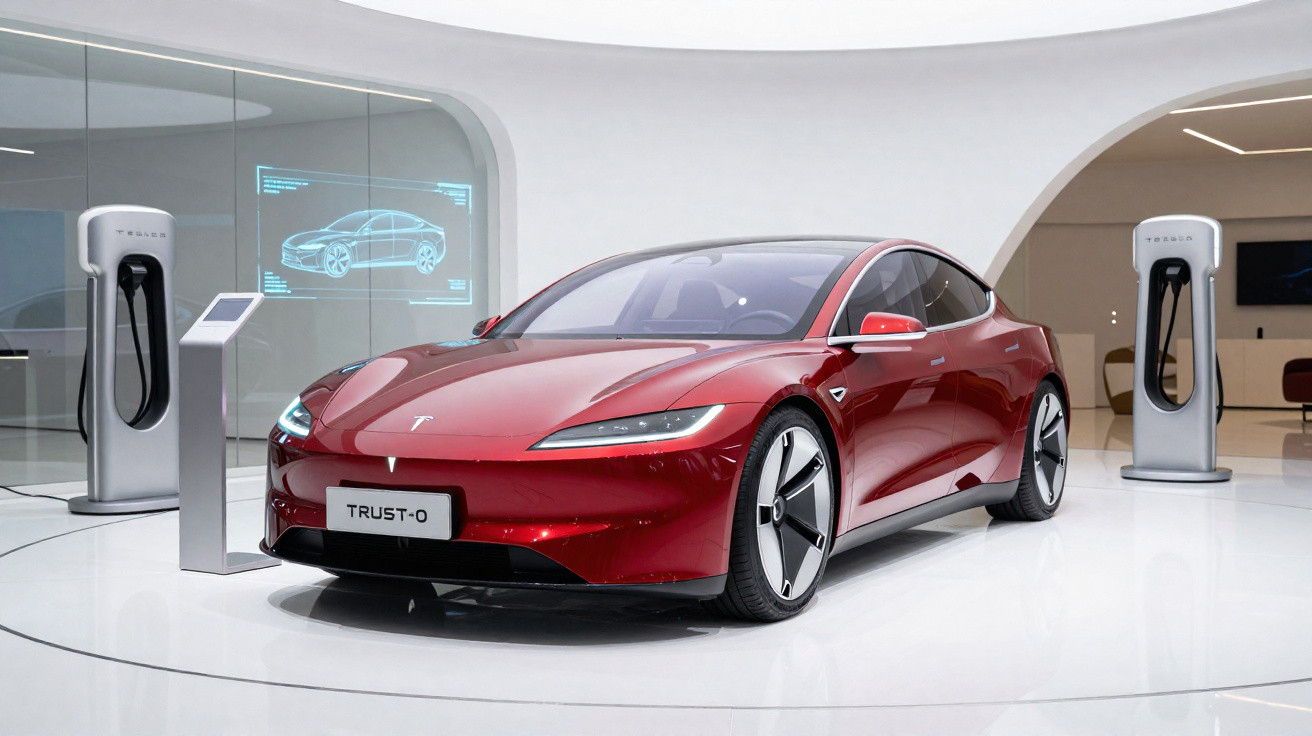
The showroom felt nearly deserted, apart from a huge display replaying the same polished Tesla promotional clip on a loop. A young couple lingered by a Model Y, murmuring about software updates and resale value, while the sales representative gestured at a QR code rather than simply opening the door. No coffee. No printed brochure. Just an app - and a grin that looked a couple of firmware updates away from being replaced by a chatbot.
On X, just a few taps away, die-hard supporters were hailing it as “the future of car buying”. Over on Wall Street, traders kept the share chart open on a second monitor, watching a very different tale unfold in red and green.
That distance between the two realities seems to be stretching week by week.
Innovation on paper, whiplash in real life
Tesla loyalists often insist they bought into a technology company, not a traditional car manufacturer. Rapid iteration, experimental features and audacious autonomy ambitions: that’s the buzz, the storyline, the near-cult momentum that has kept the badge gleaming for more than ten years.
Yet if you zoom out beyond the memes and the hero worship, another picture comes into focus: a business making moves so unpredictable that even committed long-term believers are starting to ask what, exactly, the plan is.
The products still present as futuristic. The conduct around them can feel oddly ad hoc.
Consider the Cybertruck saga. Back in 2019 it was positioned as a stainless-steel breakthrough - smashed window and all - and hundreds of thousands of $100 preorders were treated like a crowd-funded tech fantasy. Then came the years of waiting. The vehicle eventually turned up in very small numbers, accompanied by recalls, idiosyncrasies, and an on-the-road price that made some early fans gulp.
Or take the dramatic pricing lurches on the Model 3 and Model Y over the past two years. Buyers committed at one figure, then watched it fall by several thousand dollars not long afterwards, only to see incentives and sudden “inventory discounts” appear overnight. For a purchase that’s meant to be major and long-term, that yo-yo effect can land as a personal slight.
You can only ask devoted customers to shrug and say “that’s innovation” so many times.
Markets tend to sniff out risk before anyone speaks it plainly. When a company repeatedly pivots strategy, slips timelines, and keeps advertising “full self-driving” that is always nearly ready, investors begin to price in something costlier than factories or robots. They start to price in uncertainty.
Trust is an invisible line item. If you scorch it with missed deadlines, overcooked demos and midnight CEO tirades, you’re not only damaging the next quarter - you’re asking customers, regulators, partners and employees to live with more ambiguity than they signed up for.
Eventually, what once looked like brave disruption starts to resemble a leadership issue.
From charismatic chaos to confidence crisis
You can see this loss of trust in a very practical place: the way people talk about buying a Tesla in 2026. The early pitch used to be pure excitement - “I want the instant acceleration, the tech, the cool factor.” Now a different set of doubts keeps surfacing: “Should I hold off? Will the price drop again? Is this build already old news?”
For a brand that once persuaded people to order a car on their phone without seeing it, that hesitation is enormous. It reshapes the mood in the showroom, the temperature in online groups, and the conversations where friends and family talk you into - or out of - the purchase.
A choice that used to feel like stepping into the future now feels like staking money against volatility.
Browse Tesla forums and you’ll notice the same themes returning. Owners who paid top money last year now watching “inventory clear-out” offers carve chunks off the price of near-identical cars. Buyers who purchased the “Full Self-Driving” package years ago still waiting for the transformative software that was sold as just around the corner.
There’s the retired engineer who travelled three states to collect his dream Model X, only to find panel gaps and unfinished software functions on the day of delivery. He stayed loyal, sorted the problems, posted his range figures. Then, months later, his neighbour picked up a cheaper, newer build with incentives he never received. The tone of the engineer’s posts shifted from evangelical to quietly resentful. That emotional pivot is the real story hidden behind the glossy delivery stats.
Markets don’t process this as individual stories - they see the aggregate. Slowing EV demand growth, intensifying competition from China, and margins slipping after repeated price cuts: those are the hard metrics. On top sits the softer, harder-to-model layer: a CEO splitting attention across multiple firms, firing off spontaneous product promises on social media, and picking public fights with regulators and journalists.
Investors recognise a rhythm: bold targets followed by retreat; theatrical unveilings followed by delays; efficiency drives that begin to look like corners being cut. The share price ends up reflecting more than macro conditions. It captures a quiet, growing doubt about whether the leadership still has a firm hand on the wheel.
Let’s be honest: nobody reads a 10-K and comes away comforted by vibes alone.
How a trust-rich company behaves differently
Companies that treat trust like oxygen tend to operate in a noticeably different way. They don’t abandon innovation; they match every big promise with a clear delivery plan, steady (even boring) progress updates, and a humility that’s strangely reassuring. They set conservative timelines, deliver strongly on unglamorous details, and talk to customers as collaborators - not as beta testers.
For Tesla, that would mean fewer headline-grabbing feature teases on live streams and more consistent, plainly communicated product cycles. It would involve saying “we’re not ready yet” on autonomy, rather than repeating “next year, for sure” every year.
Trust increases when reality turns up slightly better than the expectation you set yesterday.
The emotional snare - particularly for fans - is mistaking attachment for accountability. It’s possible to adore the acceleration, the minimalist cabin, and the way over-the-air updates can feel like magic on a Tuesday morning, while also acknowledging that a company you respect may be sliding into disorder. Those two truths can live in the same garage.
People often hold back because they don’t want to hand “ammo” to critics or short-sellers. The price of that silence is that honest feedback stops reaching the people who could correct course. When loyal owners start to feel manipulated - on pricing, software commitments or resale value - the sense of betrayal runs deeper than any angry post.
Most people know that moment: your brand loyalty is met with a shrug rather than a hand.
“Trust is built on three things,” a former auto-industry executive told me. “Consistency, transparency, and the sense that leadership is driving for the long term, not chasing this week’s headlines. You can get away with volatility for a while if the dream is big enough. But you can’t defy human patience forever.”
- Consistency over spectacle Stable pricing, predictable model refresh cycles, and fewer surprise discounts reduce buyer anxiety and help rebuild confidence in long-term value.
- Transparent timelines Plausible delivery dates, candid updates when schedules slip, and fewer sweeping “coming soon” claims restore credibility with both customers and the markets.
- Long-term signals Keeping public messaging centred on product quality, safety data and service improvements - rather than personal drama - signals that the company, not a personality, is setting the direction.
The thin line between bold and reckless
Tesla still occupies an unusual position: it can move markets with a single slide at an investor day, and shift culture with one eccentric design decision. The cars are still impressive machines. The supercharger network remains a tangible advantage. And the mindshare is vast.
Even so, a quiet weariness is spreading through both the fan base and the financial crowd. People are tiring of being told that every concern is FUD, that every wobble is merely the cost of greatness, and that any criticism amounts to treachery. That story worked when the upside felt infinite. It chafes when rivals are closing the gap and the product no longer seems light-years ahead.
The boundary between bold and reckless isn’t defined in a press release. It’s drawn slowly through the lived experiences of drivers, shareholders and employees - one small disappointment at a time.
| Key point | Detail | Value for the reader |
|---|---|---|
| - | Innovation without dependability reads as chaos, not brilliance | Helps you assess Tesla’s actions beyond the hype cycle and gauge risk more clearly |
| - | Price volatility and postponed promises weaken long-term trust | Adds context for timing a purchase or deciding whether to hold, sell, or avoid the stock |
| - | Trust can return, but only through consistency and transparency | Offers a simple way to track whether the company’s behaviour is genuinely improving |
FAQ:
- Question 1 Is Tesla still considered an innovative company by the market? Yes, markets still view Tesla as highly innovative, particularly in software and manufacturing. What’s shifting is the discount investors apply when innovation is paired with unpredictable execution and communication.
- Question 2 Why do some fans defend every decision while the stock drops? Many early adopters are emotionally invested; they identify with the brand narrative and the CEO. That attachment can blur the boundary between rational judgement and tribal loyalty, even when the share price reflects concern.
- Question 3 Are constant price cuts always a bad sign? Not necessarily. They can indicate efficiency gains or a push for volume. When cuts become frequent and difficult to anticipate, they start to harm resale values and hint at demand or strategy problems.
- Question 4 What would restore confidence for sceptical investors? Clearer product roadmaps, fewer missed timelines, more attention to core automotive measures (quality, margins, service), and less erratic public messaging from leadership would all help.
- Question 5 Should buyers wait before ordering a Tesla right now? That depends on your risk tolerance. If unpredictable pricing and changing features would irritate you, waiting for greater stability is sensible. If you prioritise cutting-edge tech and can live with volatility, buying now may still feel worthwhile.

Comments
No comments yet. Be the first to comment!
Leave a Comment