
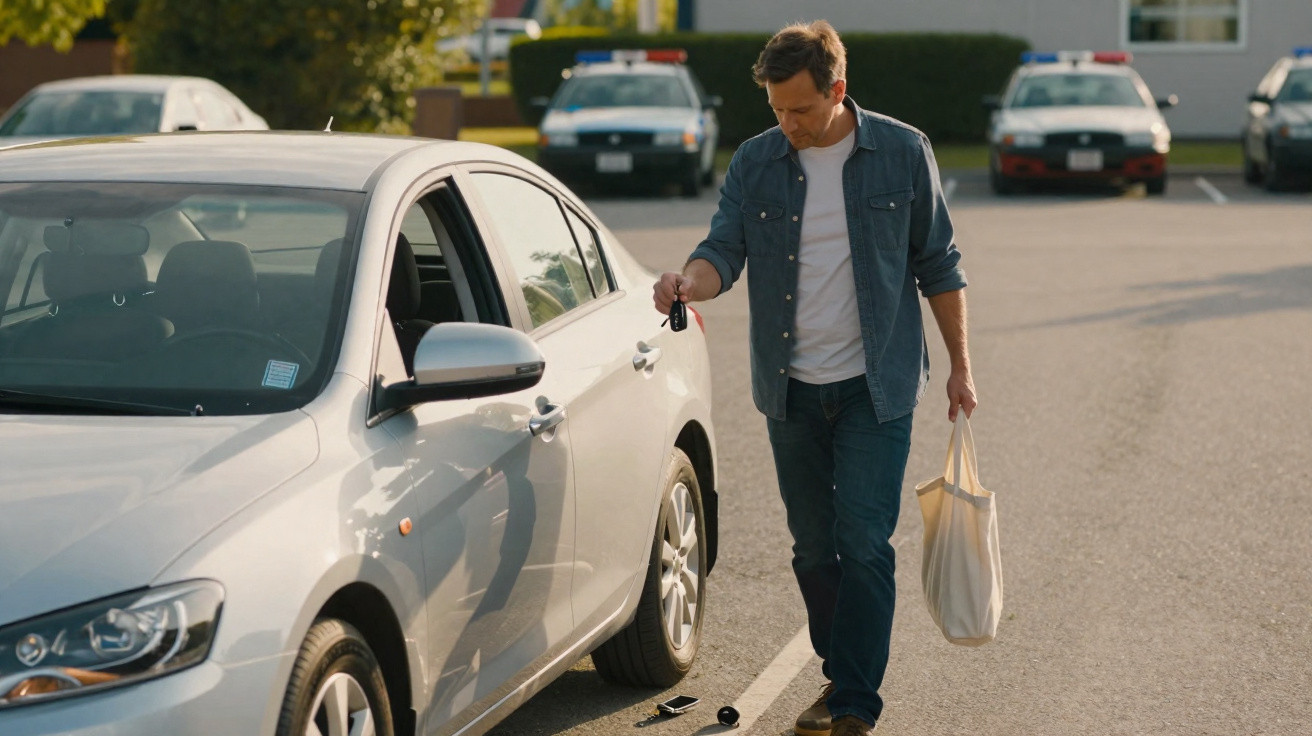
A fresh warning from the French gendarmerie highlights one straightforward action that can prevent a large share of these thefts: take a brief pause and check the ground before you even put your hand on the car door.
Why police now tell drivers to look down first
The notice follows incidents recorded by the French gendarmerie, yet the method described is no longer confined to France and has already been seen in other countries. It typically homes in on motorists leaving supermarkets, workplaces or schools-most often at the end of the day-when people are hurrying and carrying multiple bags.
Officers say the same scenario crops up repeatedly: criminals operate in car parks that appear routine and low-risk. Many victims report that everything seemed normal until they discovered a handbag, laptop or wallet had disappeared from the front passenger seat.
Police warn: a small object at your feet, placed near your door, can be the first step of a coordinated theft.
The set-up is deliberately unremarkable. As you arrive at your vehicle, there is suddenly something on the ground right beside the door: a coin, a key ring, a trolley token, and sometimes even a house key. It is meant to look like it has just been dropped.
Most people respond automatically. They crouch down, shift their body away from the car, release the door, or set their handbag on the seat “just for a second” while they retrieve the item.
The “distraction at your feet” scam, step by step
As described by the gendarmerie, the scheme depends on a small group-often two people-each playing a part. One person draws attention away; the other takes advantage. From start to finish, it can be over in under ten seconds.
How the thieves operate
- They pick busy, spacious car parks with constant footfall.
- They single out motorists who appear rushed, loaded down or preoccupied.
- They prefer high-traffic periods: school pick-ups, lunch hours, and late-afternoon shopping.
Typically, the first accomplice stays a few metres away, scanning for someone who fits the profile. Once they spot a target-often a person juggling bags, a mobile and keys-the routine begins.
Officers outline a common sequence as follows:
| Step | What the driver sees | What the thieves do |
|---|---|---|
| 1. Approach | The driver walks up to the car, unlocks it, and may crack the door open. | An accomplice edges closer, prepared to place an item. |
| 2. The drop | A coin or key appears by the door, seemingly by chance. | The first thief “accidentally” drops it or acts as though they have just noticed it. |
| 3. Distraction | The driver bends down, releases the door, or turns their gaze away. | The second thief moves around-often to the far side or behind-and opens a door. |
| 4. Theft | The driver is focused on the ground and may even be speaking to the first person. | Items left on the seat disappear: bag, wallet, phone, laptop. |
| 5. Exit | The driver straightens up, sometimes with the planted object in hand. | Both thieves leave casually, commonly melting into the crowd. |
Police describe this as opportunistic theft rather than a violent robbery. There is no snatching and no face-to-face aggression. The tactic depends entirely on one brief lapse: the moment the driver’s attention drops to the ground.
The thieves do not need force. They only need five seconds when your eyes leave the car interior.
Why this scam works so well on busy drivers
The thinking behind it is straightforward. Once people reach their car, they often feel protected-as though they have stepped into a private space-even when the door is still open and valuables are visible on the passenger seat. That false sense of security creates the perfect mismatch between what feels safe and what actually is.
Alongside this, many of us have an ingrained impulse to pick up something that looks useful or valuable, or that could be ours. A coin on the tarmac, a set of keys or a parking token can trigger that reflex instantly.
Criminals also exploit manners. The first accomplice may point down and say, “You dropped this, sir,” or “Miss, you forgot your key.” Victims often say afterwards they bent down partly out of politeness, simply to see what the stranger meant.
That tiny moment of cooperation-stooping, turning your head, answering a quick comment-can provide the second thief with just enough cover and time.
Advice from the gendarmerie: simple habits that block the scam
The French gendarmerie is now urging drivers to adjust what they do when approaching or leaving a vehicle, especially in large open car parks. The aim is not to alarm people, but to build a short, repeatable routine.
Before you open the door
- From about 1–2 metres away, check the ground near the driver’s door.
- If something is oddly positioned by the door, stay cautious and look around you.
- Keep your keys in your hand, and keep your bag zipped and close to your body.
Officers recommend a practical rule of thumb: if an item is sitting exactly where your foot would go, resist the urge to bend down straight away. Move back, scan the area, and see whether anyone is approaching from the far side of the car.
Once you are in the car
Police guidance aligns with broader urban safety advice:
- Sit in the car properly, shut the door, and lock it immediately.
- Put your handbag, wallet or briefcase under the seat or in the boot rather than on the passenger seat.
- Do not leave laptops, branded shopping bags or electronics clearly visible.
If an object on the ground seems suspicious, get inside, lock the doors, secure your belongings, then decide what to do next.
Police add that if someone keeps pressuring you to pick something up, or tries to hold your door while talking about an item on the ground, it is best to end the exchange promptly. A locked door and closed window give you space to judge what is happening without being hurried.
What to do if you suspect you have been targeted
An item near your car does not automatically mean a theft attempt. People genuinely drop things, and wind can blow coins and receipts around. Even so, officers say that unusual behaviour around you-especially if it repeats or feels coordinated-should be taken seriously.
If you think someone is orbiting your car or using excuses to keep your attention elsewhere, you can:
- Go back into the shop or building and wait a few minutes.
- Request staff or security to walk with you to your vehicle.
- If it is safe, take note of registration plates and descriptions.
- Contact the police if a theft has happened or if the behaviour clearly looks organised.
Even where nothing is ultimately taken, reports can help police identify patterns in timing and pinpoint locations where offenders are attempting this type of scam.
Other car-park tricks drivers should know about
The “object on the ground” method is one example within a wider group of car-park scams built around split-second distraction. In recent years, police services across Europe have also warned about bogus officers carrying out fake roadside checks at night, or individuals claiming there is a “problem” with your tyre to get you out of the car.
Common variants include:
- A stranger rapping on your window to say your bumper is damaged, while an accomplice takes your bag from the other side.
- Someone pointing at a supposed fuel leak under your car to make you kneel down and look away.
- Fake charity collectors or survey workers who keep you talking at the driver’s-side window.
Each approach aims for the same outcome: to separate you from your belongings for long enough to grab them. Simply being aware of these tactics can change how you move and respond around your vehicle.
Turning vigilance into a habit, not a source of anxiety
Road safety messaging usually concentrates on speed, seat belts and drink-driving. The gendarmerie’s warning introduces another element: small, everyday security decisions around the car in places people mistakenly assume are harmless.
A quick internal checklist can keep this awareness useful rather than exhausting. Some road-safety trainers suggest linking it to other automatic actions: when you reach for the keys, you also glance at the ground; when you click your seat belt, you also confirm bags are out of sight.
This scam also feeds into a wider discussion about “situational awareness”-noticing what is happening immediately around you. Many police forces now cover this in sessions at schools, community centres and driving schools. Simple role-play demonstrations show how attention narrows when people look at their phone, rush between errands or manage children in the back seat.
Small changes in routine can remove the conditions that make rapid, coordinated theft so effective. It begins with a surprisingly powerful move: before you even think about starting the engine, look down at the ground. Then lift your gaze and check around you-not only your screen, your shopping list or your keys.





Comments
No comments yet. Be the first to comment!
Leave a Comment