
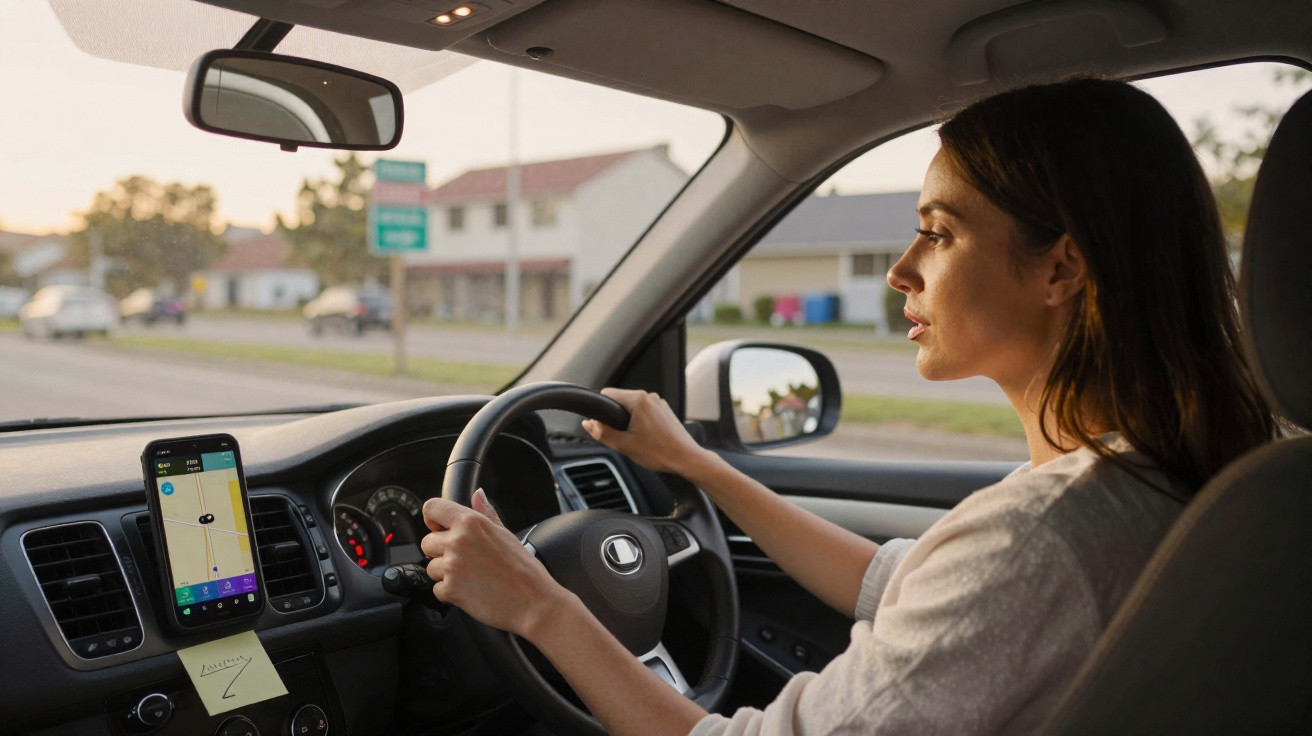
There’s a particular hush that fills a car the moment the sat-nav voice goes silent and nobody is quite sure which exit to take. Your grip firms on the steering wheel, your gaze darts between tarmac and screen, and a small, unhelpful panic starts buzzing in your chest. Perhaps you’re running late. Perhaps there are children in the back already chanting, “Are we there yet?” Perhaps it’s dark, the rain is coming down, and every motorway sign looks like the same washed-out blue. You narrow your eyes, make a call, and hope you’ve chosen the correct lane.
Now imagine the same situation with one key difference: you’re quietly narrating the drive like a slightly eccentric cabbie. “Okay, second exit after the services… stay in the middle lane… not that slip road, the next one.” From the outside it sounds faintly absurd, but inside the car something settles. Your mind feels less frantic, choices seem more deliberate, and the odds of a wrong turn appear to shrink. Psychologists argue it’s not merely a funny habit; it may be a low-key advantage we’ve been chuckling at for years.
The secret life of the car mutterer
Most of us have witnessed a driver suddenly snapping at the windscreen: “No, not there, that’s the old Tesco!” You might look over, momentarily startled, before it clicks that they’re not having a go at you. They’re simply speaking their thoughts. They call out each sign and each turn as though they’re providing live commentary on their own trip. It can sound odd, even mildly uncomfortable, yet there’s usually a steadiness to it-like the driver is fully “with” the road.
Psychologists refer to this as “externalised cognition” – in other words, thinking that spills out of your head and becomes spoken language. When you mutter your way through a fiddly junction or talk yourself into one lane rather than another, you’re pulling vague, half-built thoughts into the open. That tiny pause for extra processing matters. It slows you down just enough to avoid blindly following the wrong on-screen arrow, or tailing the car ahead because it “looks like it knows where it’s going.”
Evidence for this is stacking up. In driving simulators and eye-tracking experiments, people who verbalise their choices are less likely to miss exits, overlook road signs, or make rash, last-second swerves. It’s not that they’re more gifted. They’re not secretly rally drivers. They’re simply giving the brain another pathway to work through, using a running narration to keep everything aligned. It’s like converting your mind’s messy handwriting into large, legible print.
Why saying things out loud actually sharpens your brain
For a long time, talking to yourself was treated as shorthand for being “a bit odd”. Yet psychologists have been quietly demonstrating the reverse: it often signals a brain concentrating hard, not one unravelling. If you say, “Next left by the petrol station,” you’re not filling the air for the sake of it. You’re building a small anchor for memory and attention. Your brain registers the words, lines them up with what you can see, and your internal map suddenly feels more secure.
Researchers exploring “self-talk” repeatedly find that people do better on tasks when they voice the steps. Athletes use it to hold routines together. Pilots rely on it for checklists. Surgeons do it with an open body in front of them, naming each action like a quiet script. Driving-particularly somewhere unfamiliar-demands a similar juggling act. You’re balancing speed, distance, road signs, lights, and the emotional background static of being late, stressed, or scrutinised by whoever is in the passenger seat.
Speaking gives your attention somewhere firm to land. The mental clutter-the radio tune, the row you had earlier, the message you never sent-gets shoved aside briefly. The job at hand moves centre stage. Okay, two more roundabouts; keep right; watch for the brown sign with the castle. Saying it out loud makes it tangible, and tangible things are harder to ignore than vague intentions humming at the back of your mind.
The sat-nav voice isn’t enough
It’s tempting to think, “But I already have a voice guiding me – it’s called Google Maps.” And it’s true: digital navigation has prevented countless wrong turns and plenty of arguments. Even so, your phone or built-in sat-nav has no idea what else is happening in your head-or on the road. It doesn’t know a lorry has blocked your view of the sign. It doesn’t care that the exit looks exactly like the previous one. It simply barks, “In 300 yards, take the slip road,” and leaves you to make sense of the chaos.
When you repeat those instructions-or reword them-you adapt them to what’s actually in front of you. “Okay, that must be the slip road after this white van. Not this one, the next one.” You take cold, automated directions and turn them into something human and specific. Suddenly it’s no longer just an order; it becomes a decision you’re actively owning. That act of translating the sat-nav’s flat delivery into your own words is where the effect seems to kick in.
Psychologists often note that language doesn’t merely express thought; it also moulds it. Behind the wheel, that shaping can be the difference between smoothly easing into the correct lane and making a sharp, mortifying swerve across the hatch markings because you spotted your exit too late. And, if we’re honest, that swerve happens more often than most of us would like to admit.
The quiet safety trick nobody taught us in driving lessons
Cast your mind back to your first lessons: hands at “10 and 2”, mirror checks, mind your speed. You were probably told to “plan ahead”, but it’s rare an instructor says, “Talk me through what you’re about to do.” Still, they sometimes steered you towards it without naming it: “Tell me which exit you’re taking. Describe the hazard. What are you going to do next?” That was self-talk in disguise-and your brain took to it.
Observational studies of learner drivers show a straightforward trend: those encouraged to “think out loud” make fewer obvious mistakes. When someone approaches a junction saying, “I can’t see, so I’m going to edge forward slowly,” they’re less likely to creep out blindly. When they say, “Third exit, signal after the second,” their timing tends to be cleaner. The language leads the behaviour, rather than the behaviour scrambling to catch up with the words.
What’s striking is how quickly we drop the habit once we pass. As soon as the L-plates disappear, the talking often disappears too. We don’t want to feel daft or exposed, as though everyone can hear us narrating our own drive. So we retreat back into our heads, where thoughts are quieter, blurrier, and far easier to disregard. Research suggests we may be binning a genuinely helpful safety tool simply because it feels a touch embarrassing.
A second pair of ears – even when you’re alone
One of the smartest parts of self-talk is that it creates an imaginary listener. When you say, “I’m going too fast into this bend,” you hear it in the same way you’d hear a mate. It’s obvious-almost uncomfortably direct. You can’t pretend you didn’t notice; you just said it. That brief moment of self-confrontation may be enough to lift your foot, slow down, or take a breath before the next decision.
This “second pair of ears” effect is why some psychologists liken self-talk to having a co-pilot. Not a nag, not a backseat driver-just a calm, factual voice nudging you towards better choices. It doesn’t need to be theatrical. “Stay in this lane, don’t rush. Check the sign for the town name, not the colour.” Nobody else has to hear it; your brain will take it from there.
When the road gets emotional, words calm the storm
Plenty of driving errors aren’t about not knowing the route; they’re about feeling the wrong thing at the wrong time. The spike of panic when you miss an exit. The flash of anger when someone cuts across you. The sting of shame when you hesitate for a second in a busy city and get honked. Those emotions sit right on top of your ability to make clear, steady navigation choices.
Psychologists examining driving stress have noticed that, when people feel overwhelmed, they often go silent. Quiet inside a car isn’t always calm; sometimes it’s tightly wound. In that hush, thoughts merge into one blur: “I’m late, I’m lost, everyone behind me hates me.” It becomes difficult to hear the simpler truth underneath: “You just need the next exit. You can turn around.” Speaking turns that truth into something solid again.
Drivers who naturally talk themselves through those wobblier moments often recover more quickly. “Okay, missed it. Fine. Next exit, swing back. No one died.” It sounds basic, even a little childish, but it breaks the emotional spiral and reopens the rational one. A small navigation slip doesn’t cascade into more slips. You make the mistake, you talk, you correct, and the loop stops-rather than dragging on for miles into the wrong town.
The small, human rituals that keep you on track
In one UK study, a woman described a routine she called “chatting the road”. She’d come out with lines such as, “Hello, roundabout, where are you sending me today?” or “Don’t you dare hide that sign behind a tree.” It sounds daft-almost like speaking to a pet. Yet she was among the most accurate navigators in the group. She hardly ever missed junctions, rarely made last-second turns, and kept a strong sense of where she was, even in unfamiliar places.
Another participant-a delivery driver-commentated on his routes like a radio host. “Left on Baker Street, bus lane on the right, watch that cyclist.” His van became a studio. By day’s end he felt worn out from talking, but he also noticed fewer wrong drop-offs and fewer U-turns. He wasn’t depending on memory alone or a quick, silent glance at the map. His words stitched the trip together into a single, continuous thread.
It’s easy to write these rituals off as personality quirks. Yet they’re exactly what many psychologists now describe as “adaptive strategies” – small, self-made techniques that help a brain under load keep functioning. They aren’t polished or elegant. They simply work-quietly-in the gap between what you think and what you do.
How to talk to yourself in the car without feeling ridiculous
Be honest: nobody gets up in the morning thinking, “Can’t wait to spend my commute muttering at the steering wheel.” It can feel a bit performative. But you don’t need a full-blown monologue, and you don’t have to keep it going for the entire journey. What tends to help is dropping in a few well-timed sentences at moments when the road is asking a little more of your brain.
A straightforward place to start is at junctions. As you approach, say softly, “I’m taking the second exit. Stay in this lane, then indicate after the first.” That on its own can reduce last-minute drifting and awkward lane changes. Another option is to restate crucial sat-nav prompts in your own language: “Turn right after the bridge, not before.” By the time you reach the bridge, your brain has already rehearsed the manoeuvre.
You can also use self-talk as a reset button when you feel lost. Rather than stewing in silence, tell yourself, “Pause. Find a safe place to pull over. Check the map.” It’s obvious advice, but saying it turns it into a next step rather than a frustration. The words give you permission to stop battling the road and regroup.
You’re probably already doing it – just not out loud
If the thought of speaking to yourself makes you cringe, there’s a reassuring point: you’re probably already doing a version of it silently. You notice a sign, you think, “Oh, that’s my exit,” and you move across. The only real change with spoken thinking is volume. Turning that muttered thought into an audible one makes it feel more concrete, easier to remember, and more likely to guide you correctly.
The first couple of attempts may feel awkward. You may even chuckle at yourself-“Listen to me, chatting away like an old taxi driver.” Then something small will shift. You’ll spot a sign earlier, avoid the wrong slip road, or glide through a confusing roundabout because you’d already described it to yourself. That’s usually when the embarrassment drains away and gets replaced by something better: quiet confidence.
The road is noisy; your voice cuts through
Driving today comes with constant noise: bass thumping from the car next to you, notification pings from a phone, the engine’s hum, tyres hissing on wet tarmac, a coffee cup lightly rattling in its holder. Your brain is expected to take all of that in and still pick out the correct small road sign half-hidden behind a tree. In that mess, your own voice can be the clearest signal you have.
When psychologists report that people who think aloud while driving make fewer navigation errors, they’re not describing something alien. They’re pointing back to something ancient and deeply human: using language to steer our lives, not just our cars. As children we talk ourselves through new skills-tying laces, crossing roads, cooking tea. Somewhere along the way, we decided grown-ups ought to do all of it silently.
Perhaps the car is the ideal place to invite that habit back. There’s no audience and no judgement-just you, the road, and a few softly spoken directions that make the trip run more smoothly. Next time you’re heading into a confusing, poorly signed roundabout, give it a go. “Second exit, stay calm, watch the sign.” Your passengers may not even register it. Your brain will-and it might repay you by getting you precisely where you meant to be.




Comments
No comments yet. Be the first to comment!
Leave a Comment