
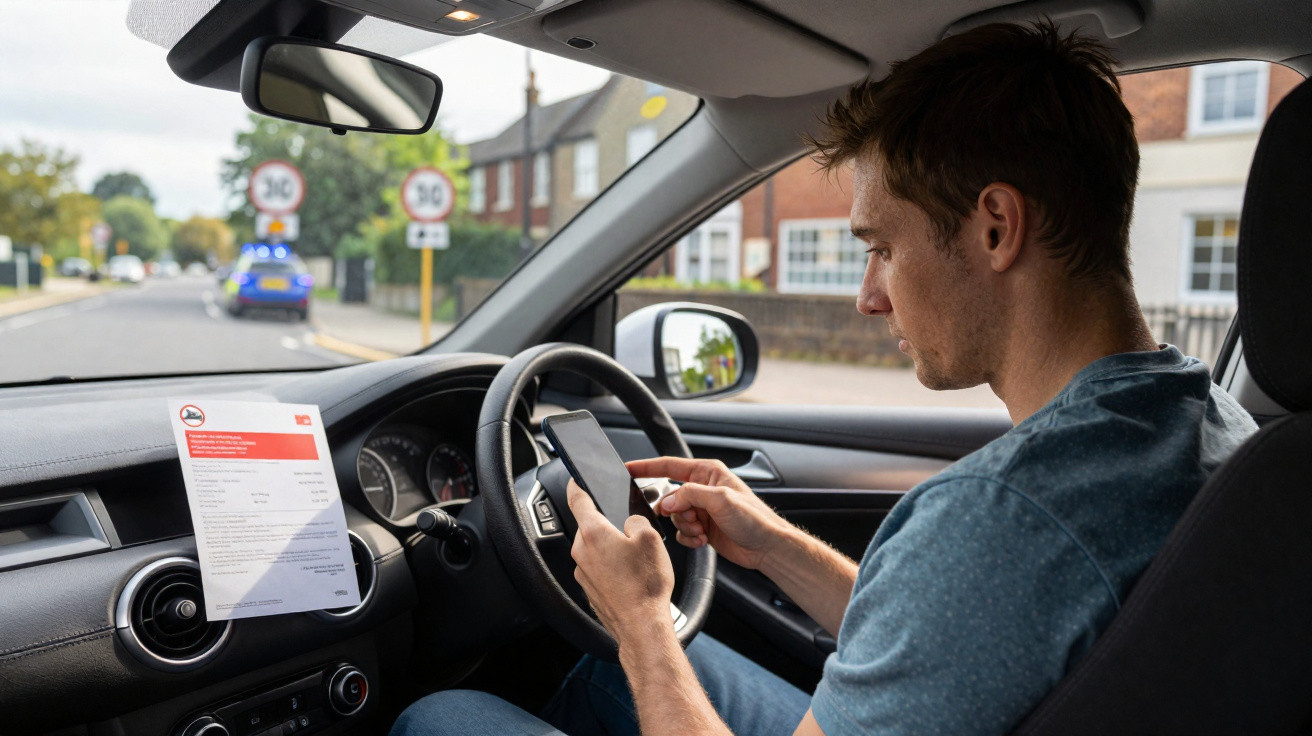
The lights flip to green on a rain-soaked Tuesday morning in Manchester, and the line of traffic stays still.
Right at the front, a small hatchback remains planted in place, brake lights burning red, the driver bent over a bright screen.
Behind it, horns begin to jab at the silence. A cyclist threads through the gap, shakes his head, and gestures towards the phone.
Half a minute later, the car lurches ahead. The driver looks rattled - and entirely unaware a roadside camera has already recorded the moment.
She will learn soon enough, when a brown envelope drops through the letterbox.
A fine. Penalty points. A blunt sign that England’s roads are shifting, almost unnoticed.
And one particular change is catching people out sooner than they expect.
What’s changed on England’s roads – and why fines are piling up
All over England, drivers are now being monitored differently.
It is not a weary officer parked in a lay-by, but low-profile cameras that do not blink - and are not especially interested in your speed.
These “traffic enforcement” systems are aimed at what the driver is doing inside the vehicle.
A phone held at the lights. A fast scroll while traffic crawls. Someone trying to steer with one hand while a takeaway coffee wobbles on the wheel.
The Highway Code has been revised, the legislation has been tightened, and the penalties have increased.
Even so, thousands of people still get behind the wheel as though nothing has altered.
That mismatch - between the rules on paper and everyday habits on the road - is exactly where the big fines are now landing.
On a dull stretch of the A10 in Hertfordshire, police carried out a week-long operation using a camera set high on an unmarked van.
They were not hunting speeders. They were looking for hands holding phones.
Over seven days, they recorded hundreds of motorists using mobiles, often at very low speeds or in heavy traffic.
Some were on video calls. Others, astonishingly, were watching films.
A lot assumed they were in the clear because they were not “really driving” - edging forward in congestion, waiting at temporary lights, or sitting in a queue for a roundabout.
That is precisely where the updated rule applies: if the engine is running and you are on a public road, your phone cannot be in your hand.
Engine running plus phone in hand equals a potential £200 fine and six points.
On paper the adjustment can look minor, but it overturns years of casual behaviour.
The older message was straightforward: do not use a handheld phone while “driving”.
Now, what counts as “use” is much wider.
Tapping to skip a track, glancing at a map, scrolling a notification, recording a clip for social media - all of it may qualify.
Even using your phone for sat nav can become a problem if you are holding it or fiddling with it while moving, or while stationary in traffic with the engine on.
The law is not impressed by “it was only a second”.
It is concerned that at 30 mph, a second is enough time to miss a child stepping off the kerb.
How to adapt fast – and avoid a nasty surprise in the post
The most effective protection is to change what you do before you start the engine.
Sort your destination, your playlist, and your hands-free connection while you are still properly parked.
After that, put the phone somewhere it cannot “accidentally” end up in your hand.
A glovebox, a closed compartment, or a fixed cradle out of reach - not merely tucked out of sight.
If you genuinely need it for sat nav, secure it in a proper holder and only touch it when you are safely parked with the engine switched off.
Not in an active lane. Not at a red light.
That small routine before setting off prevents a great deal of hassle later.
A lot of drivers only vaguely know the rule has changed, and that is where problems begin.
They understand that texting while driving is banned, so they assume a quick tap in slow-moving traffic is acceptable.
Others cling to old folklore: “If I’m not moving, it doesn’t count.”
Or, “I’ll keep it low near my lap - nobody will notice.”
Roadside cameras, bus-lane-style enforcement, and dashcam submissions from other motorists are steadily destroying those assumptions.
Modern tech can zoom in, crop tightly, and freeze-frame your hand mid-scroll.
Once the image is captured, the debate is effectively over.
There is also a human side that rarely gets mentioned.
On a hectic day, a phone can feel like a lifeline - family messages, work emails piling up, group chats constantly pinging.
“I only looked down because my daughter had texted twice in a row,” a 39‑year‑old delivery driver from Leeds told us. “By the time I looked up, the car in front had stopped. I braked so hard I thought I’d gone through the windscreen. I’d rather get a fine than ever feel that again.”
- New rule in plain English: no handheld phone use at all while driving or sitting in live traffic, even just tapping the screen.
- Instant penalty: £200 fine and six points, with a real risk of losing your licence if you’re a new driver.
- Hidden trap: using your phone “just” as a sat nav is only safe if it’s in a holder and you don’t touch it while moving or stopped in traffic.
Beyond the fine: what this shift really means for everyday drivers
This is not only about penalties; it is about what sort of roads we are willing to tolerate.
On a crowded ring road at rush hour, a single distracted glance can set off a chain reaction - sudden braking, near-misses, and minor collisions that snarl traffic for miles.
Most of us have been stuck in a jam with no clue why everything abruptly ground to a halt.
Often it started with something small: a driver drifting because they were half-reading a message under the steering wheel.
The new enforcement tools are meant to cut off those tiny sparks.
By making the financial hit hurt, they are trying to make that “one quick look” feel wildly not worth it.
There is a quieter change happening as well: how it feels to drive.
Drivers describe an ongoing pressure to reply instantly - to a manager, to a group chat, to the relentless stream of notifications.
Putting the phone down for half an hour can feel strangely radical.
Yet many people who do it say the drive becomes calmer, more attentive, and - honestly - less draining.
Let’s be honest: nobody manages this perfectly every day.
There will be moments when you forget, reach for the phone at the lights, and stop yourself halfway.
Those small flashes of awareness are where the habit begins to loosen.
In time, the rule may even influence how cars are built.
More steering-wheel controls. Better voice assistants. Tighter integration so you rarely need to look down at all.
Until that is standard for everyone, the truth is simple, and slightly uncomfortable.
The law now expects you to treat a phone in the car the way earlier generations treated a lit cigarette beside a full fuel tank: keep it controlled, or do not be shocked by the consequences.
On a cold evening on the M6 - rain needling the windscreen, brake lights stretching into the distance - that decision feels immediate and real.
And that is exactly where this updated rule will reveal what kind of driver you are when nobody appears to be watching - apart from the camera.
| Key point | Detail | Why it matters to you |
|---|---|---|
| Scope of the new rule | Bans any use of a handheld phone, even when stopped in traffic with the engine running. | Explains why “just a quick look” can still result in a hefty fine. |
| Penalties | £200 fine and 6 points, with a risk of losing your licence for new drivers. | Shows the real financial and legal cost of getting it wrong. |
| How to adapt | Set your route and music before you leave, keep the phone put away or in a fixed holder, and delay any interaction until you are parked with the engine off. | Lowers the risk of an offence while keeping driving reasonably convenient. |
FAQ:
- Does this rule apply if I’m stuck in traffic and not actually moving? Yes. If you’re in a live lane with the engine on – even in standstill traffic – using a handheld phone can lead to a fine.
- Can I use my phone as a sat nav under the new law? Yes, as long as it’s in a secure holder, you set the route before driving, and you don’t hold or interact with it while moving or stopped in traffic.
- Is touching my phone at a red light still illegal? In most cases, yes. A red light counts as being “on the road”. The safe exception is when you’re properly parked with the engine off.
- What if I only use my phone to change music or answer a call? Using a handheld phone for any reason while driving is risky. Hands‑free controls and steering‑wheel buttons are the safer, lawful route.
- How can I prove I wasn’t using my phone if I get a fine? You can challenge a penalty in court, but you’ll need evidence, such as phone records or dashcam footage. Prevention is far easier than arguing after the fact.





Comments
No comments yet. Be the first to comment!
Leave a Comment