
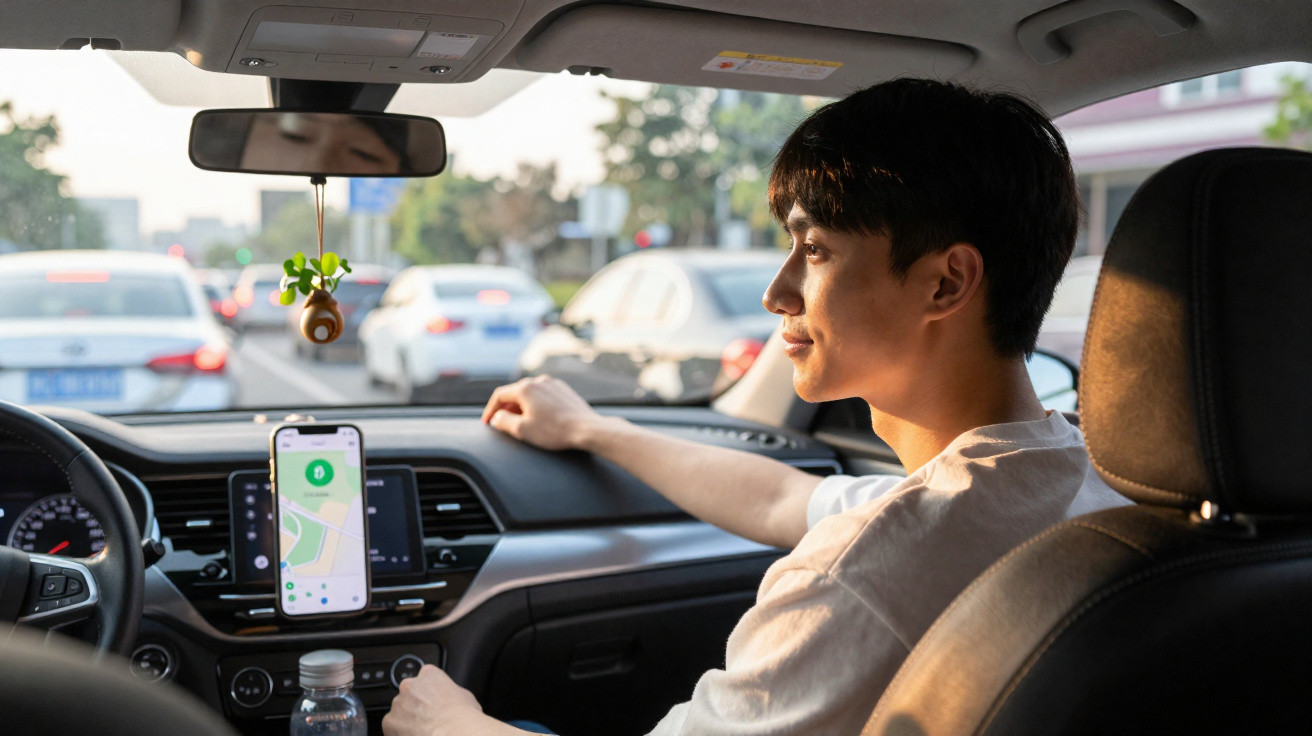
You notice them a second too late, press the brake a touch too sharply, and your coffee sloshes ominously in the cup holder. A white hatchback slices across two lanes without indicating, and your chest tightens before your brain has caught up. Your hand twitches towards the horn. You’re not only stuck in traffic - you’re stuck in your own head.
The radio churns out something instantly forgettable, your phone vibrates just out of reach, and outside nothing is moving. In the next vehicle, a woman talks to herself and throws her hands up at the windscreen. A delivery driver taps the steering wheel with clenched jaw. The motorway feels like a slow-motion pressure cooker.
In that suspended pause, a quiet thought surfaces: what if the issue isn’t only the traffic?
Why patience changes the whole feeling of driving
People often say they loathe driving in traffic, but the real misery is the sense of being boxed in. The car turns into a cramped little room you can’t step out of, filled with thoughts you’d rather not hear. Every minor delay starts to feel like it’s aimed at you. A green light switching to red stops being routine road management and becomes an offence against your timetable.
Once you treat patience as a proper driving skill, the edges begin to soften. That same red light becomes simply a pause. The driver who pulls out late is just another person having a chaotic day. You shift from constant reflex to calm noticing - and that small change alters the feel of the entire trip.
Researchers at the AAA Foundation in the US found that nearly 80% of drivers admitted to serious anger or aggression behind the wheel at least once in the past year. Not villains - everyday people who insist “I’m calm, honestly” over dinner and then explode at a roundabout. One Tuesday evening on the M25, I saw a man in a van erupt after missing a turning, thumping the steering wheel until his face went purple. Ten minutes later, still trapped alongside him in the same jam, he sat hunched and drained, worn out by his own outburst.
That’s the quieter price of impatience in traffic. It’s not only extra risk, more near misses, more harsh braking. It’s the emotional hangover - arriving home already spent, despite having been sat down the whole time. Patience won’t reduce the miles, but it can slash that hidden emotional bill.
At its simplest, patience gives your brain a moment to come online before your body acts. Neuroscientists point out that your emotional centre reacts faster than your rational brain. When someone cuts you up, the first surge is primitive: threat, anger, defence. Practising a brief pause in those moments gives the thinking part of your mind a fraction of a second to catch up.
That pause reduces the odds of aggressive responses, risky overtakes and late braking. It also changes what the journey feels like in your body: less cortisol, less shoulder tension, fewer phantom aches when you climb out. Patience rounds off the sharp corners, so driving feels less like combat and more like a shared journey across a living map of other people’s days.
Simple ways to practice patience while you’re actually in the car
Patience can sound airy, even moralistic. On the road it needs to be tangible and usable. One of the strongest tricks is almost laughably basic: leave five minutes earlier than you think you need. Not twenty - five. That tiny buffer is powerful because it removes the constant sense that the world is stealing your time.
Another approach is to choose one specific behaviour to soften. For a week, decide you’ll let someone merge at every busy junction, whatever the circumstances. Or commit to keeping one extra car length of space on the motorway. They’re small experiments, but they make patience something you can practise and improve, rather than a vague personality trait you either possess or don’t.
On a wet Wednesday in Manchester, a driving instructor told me he starts anxious learners with a “patience drill”. They sit in crawling traffic for ten minutes with the engine running, doing nothing except noticing: noticing how tightly they’re holding the wheel; noticing how often their mind wants to surge forward; noticing other drivers’ faces. One of his students - a young delivery rider who’d only recently moved from two wheels to four - later said the drill stopped him shouting at a dad in a people carrier who stalled at a green light.
We rarely train the waiting parts of driving. Lessons concentrate on clutch control, parking and signalling. The quiet stretches at red lights and clogged roundabouts are left to luck - and that’s where frustration breeds. When you gently rehearse those moments, even occasionally, busy roads stop feeling like a personal exam and start feeling like a setting you already know how to handle.
There’s a psychological feedback loop here. You feel rushed, you drive more aggressively, the traffic feels harsher, you arrive wound up, and your brain files driving under “hostile activity”. Next time you get in the car, your body is already braced for a fight. Patience is how you quietly interrupt that loop. Rather than confirming the story “everyone else is an idiot”, you reinforce a more workable script: “the road is messy, and I can manage messy”.
Over time, this doesn’t only lift your mood - it sharpens attention. When you’re not fantasising about teaching someone a lesson, you’re actually looking. You spot the cyclist in the blind spot. You notice the child edging too close to the kerb. Patience isn’t passive; it’s an active decision to stay available to what’s truly happening in front of your bonnet.
There’s another layer as well: self-respect. When your commute isn’t a stream of honking, tailgating or muttering through gritted teeth, you like yourself more when you turn off the ignition. That matters. It affects how you walk into your workplace, your kitchen, or the late-night corner shop run for milk.
Techniques that actually work in real traffic, not just in theory
A genuinely useful habit is a “micro-reset” rule. Each time you reach a red light or a standstill, instead of grabbing your phone, take three slow breaths: in for a count of four, hold for two, out for six. It’s a straightforward way to release your nervous system while the wheels are stopped. The lights will change either way - you might as well get a small reset from the pause.
Another targeted tactic is to choose a “calm anchor” inside the car. It might be the stitching on the steering wheel or the edge of the dashboard. When you feel the urge to swear at a stranger in a silver SUV, look at that spot for a second. The physical cue becomes a shortcut: notice, breathe, then choose. It sounds minor - even a bit daft - yet small, repeatable actions like this are what hold up when you’re tired, late and hungry.
More practically still, plan your route with one alternative already in mind. Knowing there’s a backup way home - even if you never use it - reduces the spike of panic when live traffic data announces a 30-minute delay ahead. Your brain settles when it knows there’s at least one other option, and that calmer baseline makes patient decisions feel less like giving in and more like good strategy.
Many people come unstuck when someone else’s poor driving feels personal: the car that barges in at the last second; the driver glued to your bumper as if trying to climb into your boot. Your jaw locks, your foot edges towards the accelerator, and you imagine “teaching them a lesson”. These are the moments when patience is most necessary - and hardest to access.
Let’s be honest: nobody pulls this off perfectly every single day. Most drivers only start thinking about it after a near miss, or after snapping at their partner the moment they walk through the door. If that’s you, you’re far from alone. The aim isn’t saint-like serenity; it’s one small upgrade. Instead of stamping on the brakes to punish a tailgater, move over when it’s safe and let them disappear. Instead of racing the car that accelerated to block you, ease off and watch how quickly the drama evaporates.
That doesn’t excuse their behaviour. It does safeguard your steering wheel, your blood pressure and everyone travelling with you. And, oddly, it can feel quietly strong to decide - deliberately - not to join somebody else’s chaos.
“The biggest shift came when I stopped pretending traffic owed me something,” said Tom, a 39-year-old sales rep from Birmingham. “Once I accepted that jams and bad drivers were part of the package, I stopped taking them as insults. My commute didn’t get shorter. It just stopped wrecking my mood for the rest of the day.”
Sometimes you need simple prompts within view. A note on the dashboard that reads “Everyone wants to get home”. A playlist that signals “calm mode” rather than a road-rage soundtrack. These gentle nudges act like small signposts for your mind, guiding it away from flare-ups. On a long drive back from Cornwall, I noticed that drivers who let others merge early and who slowed down in good time for congestion looked physically more relaxed when I caught up with them at service stations - less hunched, less wired, more present.
- Decide your “non-negotiables”: no tailgating, no revenge braking, no phone in hand at red lights.
- Keep one soothing audio option ready: a podcast, a playlist, or silence if noise irritates you.
- Use one repeatable phrase when frustration spikes, such as “We’ll get there when we get there”.
- Schedule one drive a week where you deliberately leave extra time and drive more slowly than usual.
- Notice how your body feels when you arrive calm versus angry, and keep that contrast in mind.
A different way of arriving, and of being on the road
Traffic isn’t going anywhere. Motorways will still seize up on Friday evenings. City centres will still clog near schools, stadiums and shopping centres. The lights will still flip just as you reach them. What can change is the story you tell yourself in those moments - and how your body reacts inside that moving metal box.
When you start viewing patience as an active driving skill rather than a nice personality trait, you win back a sizeable chunk of daily life. The commute stops being an empty, furious blur. It becomes something you can influence: a place to listen to something you enjoy; a buffer where you decompress from work before opening the front door; a space to practise one of the rare modern arts - doing nothing without blowing up.
On an ordinary morning, that might simply mean pausing before you hit the horn. Letting someone in even if they didn’t “earn” it. Accepting that red lights won’t speed up to suit your mood. None of this is heroic. No one applauds when you allow the third car to merge. But you’ll feel the shift when you step out: your shoulders drop, your breathing steadies, and the day ahead seems less like a scrap and more like something you can move through.
Zoom out and every patient choice sends small ripples through the traffic around you: the smoother merge, the near miss that never happens, the child in the back seat who grows up believing driving is normal life - not a permanent emergency. We don’t often connect our private mindset in the car with the wider driving culture on our roads, but in the end they are the same thing.
On a quiet Sunday evening, when the roads are half-empty and the sun spills across the dual carriageway, driving can still feel like freedom. Practising patience in the clogged, messy moments is what keeps a sliver of that feeling alive, even when brake lights stretch to the horizon and the sat-nav chirps about “unexpected delays”. The traffic hasn’t changed. You have.
| Key point | Detail | Why it matters to the reader |
|---|---|---|
| Patience as a skill | Treat it as a driving technique you can train, not a fixed character trait | Helps you make practical progress and feel less stressed at the wheel |
| Micro-habits in real situations | Breathing at red lights, a “calm anchor”, a 5-minute buffer | Gives you simple tools you can use from your very next journey |
| Benefits beyond the road | Less emotional fatigue, better mood when you arrive | Improves day-to-day quality of life, not only the driving experience |
FAQ:
- Does being patient in traffic actually make my journey faster? Usually not in terms of minutes, but it often feels shorter and smoother because you’re not spending energy on frustration.
- How can I stay calm when other drivers are clearly in the wrong? Treat their actions as background “road noise” and focus on what keeps you safe: space, speed and your breathing.
- Isn’t patience just letting people walk all over me on the road? Patience isn’t weakness; it’s choosing not to trade your safety and your mood for a few seconds of feeling “right”.
- What if I’m naturally impatient as a person? Start absurdly small: one calmer response per trip, one extra car length, one time you don’t honk. You’re building a habit, not reinventing your personality.
- Can practising patience while driving help in other areas of life? Yes. The same pause you develop behind the wheel often shows up later in queues, meetings and family arguments.

Comments
No comments yet. Be the first to comment!
Leave a Comment