
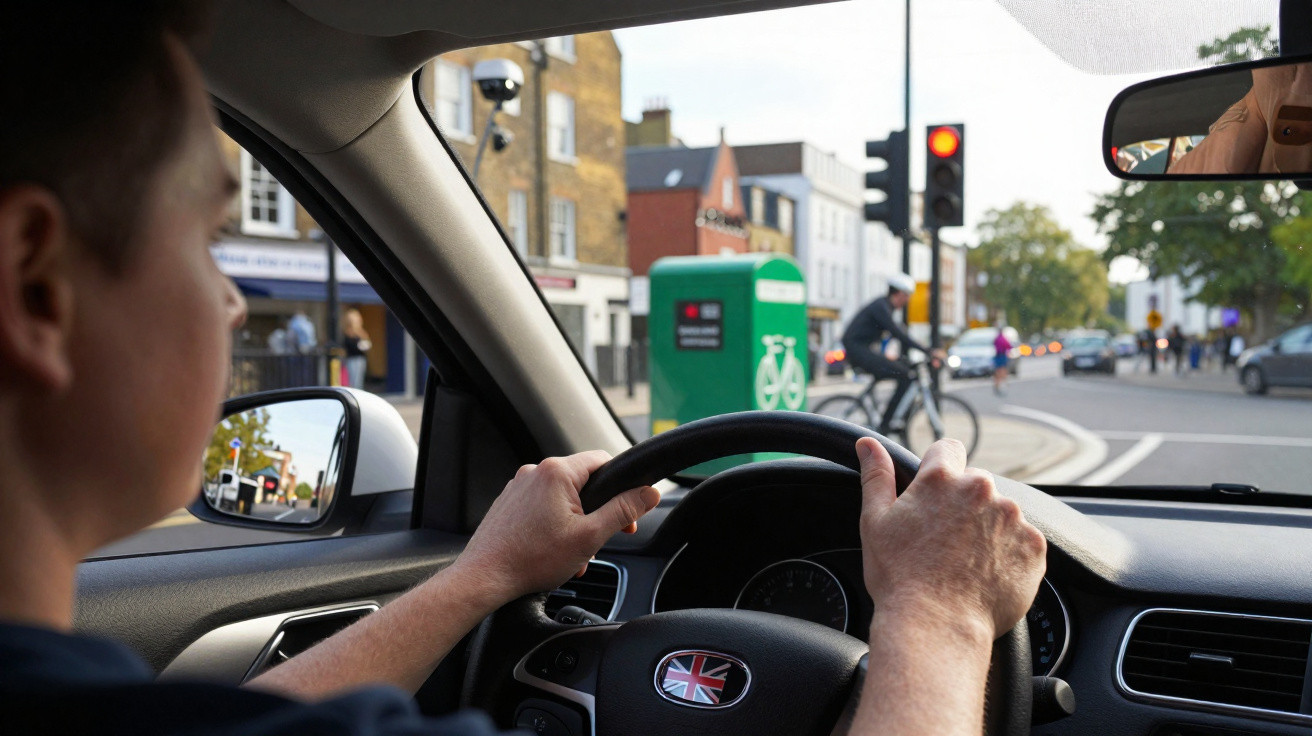
A minor tweak to the Highway Code, coupled with a new enforcement power for local councils, has abruptly turned something millions of drivers do without thinking from “it’s normal” into “that could cost you a fine”. The odd thing is that plenty of people still haven’t changed their behaviour.
It’s a little after 8.30am on a damp Tuesday in south London. A white SUV rolls up to the lights, edges past the thick white stop line and comes to rest right on the painted cycle box at the front. The driver checks her emails, creeps forward while the red holds, then accelerates as the signal turns amber. Two cyclists thread around her front bumper, their body language somewhere between a shrug and weary acceptance.
On the pavement, an older man murmurs, “You can’t sit there anymore, mate,” to no one in particular. The SUV has already moved on. The cycle box is empty again - a small patch of paint that can feel like it exists more in the Highway Code than on the road. But that little rectangle is central to a change many UK drivers have missed, and it goes well beyond where you stop at the lights.
This “little” habit that now breaks the rules
In towns and cities across the UK, a particular routine has become second nature: rolling forward and stopping on, or even beyond, the stop line at traffic lights. Drivers nose into the advanced stop box, creep into the junction while the light is red, or end up straddling a crossing because “there’s room”. It doesn’t feel reckless. You’re not blasting through a red light - you’re just edging.
But with recent Highway Code updates and new local enforcement powers, that edge is no longer merely discouraged. It’s a straightforward traffic offence, and more camera enforcement is now being used to deal with it. On paper, the change looks small; on the street, it’s a big shift. That casual shuffle over the line can now trigger a penalty charge you weren’t expecting.
A transport officer in Birmingham told me the effect is already visible. A newly installed camera at a busy crossroads logged thousands of drivers stopping on the cycle box or over the line in its first month. Not reckless “boy racers”, either - parents on the school run, tradespeople in vans, retirees in small hatchbacks. People who would insist they “always follow the rules”.
A lot of them hadn’t clocked that once the signal is red, entering the cycle box or crossing the white stop line is simply illegal - unless you were already beyond it when the light changed. The old assumption of “as long as I don’t drive through on red, I’m fine” no longer matches what’s written in the Code, or what the cameras are set to pick up.
The rationale is straightforward. Those painted advanced stop lines are meant to give cyclists a protected area, not serve as decoration beneath your front bumper. When a car or van occupies that space, cyclists are pushed back into blind spots and closer to lorries. It also raises the risk of drivers edging into a crossing, or into the path of someone stepping off the kerb.
The revised guidance also sits within a wider change in road priorities: the bigger and more dangerous the vehicle, the greater the responsibility placed on its driver. So a car blocking a cycle box or stop line is treated more seriously than, say, a cyclist drifting into an incorrect position. It isn’t a culture war - it’s physics. Larger vehicles can cause greater harm.
How the quiet rule change actually works – and what to do now
The technical wording may sound dull, but the day-to-day instruction is simple. The Highway Code now states that motorists must stop at the first white stop line when the signal is red. Where there is an advanced stop line, the advanced stop box is reserved for cyclists when the light is red. You wait behind the main line, even if the box looks empty and inviting.
Across England, many councils have also adopted new powers to enforce moving traffic offences. These include blocking junctions, entering yellow boxes, ignoring no-entry signs - and stopping where you shouldn’t at traffic lights. In other words, that “just this once” roll onto the cycle box can now be captured by an ANPR camera rather than spotted by a passing patrol car. No siren, no lecture - just a letter and a fine arriving on your doormat a few days later.
When drivers first hear this, the reaction is often irritation. “I’m only trying to see the light better.” “I’m leaving space for the cars behind.” On a pressured commute, those explanations feel reasonable. The updated rules take a different view: your position must not increase risk to cyclists or pedestrians. That means holding back, even if it leaves an awkward-looking gap, even if the driver behind seems to be right up on you.
In practice, one small adjustment can make it much easier: treat the road markings as your reference point, not the traffic light head itself. Choose a fixed cue - the edge of the stop line, a drain cover, a crack in the surface - and stop before the line, not on it. It can feel overly cautious for a few days. Then it quickly becomes routine.
On a busy high street, that tiny change can make the whole junction calmer. Drivers leave enough room for cyclists to filter to the front. Pedestrians aren’t forced to squeeze past bumpers encroaching on the crossing. The layout becomes easier to read. It’s almost dull - which is exactly what you want when you’re mixing nearly two tonnes of metal with unprotected human bodies.
Much of the annoyance stems from genuine uncertainty. People passed their test twenty or thirty years ago and haven’t opened the Highway Code since. The rules moved on; their habits didn’t. So when a penalty charge notice lands for “stopping beyond the stop line”, it can feel like a set-up.
On a human level, feeling caught out is understandable. On a safety level, the direction is obvious: cameras don’t lose focus, and councils are under pressure to cut casualties, particularly those involving cyclists and pedestrians. The old “everyone creeps forward a bit” norm is being quietly pushed out - one fine at a time.
“We’re not trying to punish people for the sake of it,” says a road safety campaigner in Manchester. “We’re trying to stop the kind of low‑level behaviour that leads to very high‑impact collisions.”
- New reality: Cycle boxes and stop lines are now actively enforced, not just painted suggestions.
- Common mistake: Rolling forward on red “to be ready” is now treated like running a light in slow motion.
- Simple win: Stopping a metre earlier gives cyclists and pedestrians that metre of safety they currently don’t have.
- Emotional takeaway: On a bad day, that tiny bit of space might be the difference between a scare and a 999 call.
What this says about how we share the road now
At heart, this quiet clampdown isn’t really about paint on the tarmac. It’s about who assumes they have the right to the very front. For years, plenty of drivers treated cycle boxes as optional - more like guidance than a rule. Cyclists were the guests; cars were the hosts. The newer Highway Code wording reverses that relationship.
It also taps into sensitivities that go beyond transport. Space is limited in British cities. Housing is stretched. Money is tight. The road is one of the few places where people still try to “win” a few seconds by pushing forward. When a rule suddenly tells you that your familiar “edge up, claim space” tactic is no longer allowed, it can feel like yet another loss.
We’ve all had the moment: you’re running late, stressed, the kids are bickering in the back, and the amber light feels like it’s aimed personally at you. That’s when creeping into the box or over the line seems harmless. Let’s be honest: nobody drives perfectly every day, by-the-book Highway Code style. Yet collision data at junctions keeps highlighting the same dynamic - small rule-bending meets bad timing and someone gets hurt.
That’s where the new rules quietly ask for something unfashionable: a bit of slack. Accept that sometimes you’ll wait a few metres further back, have a slightly worse view of the light, and lose a few seconds. For drivers used to shaving time everywhere, it can feel like defeat. For someone on a bike, or a parent crossing with a buggy, that slack can look a lot like respect.
This rule change isn’t dramatic enough to trend every week. It won’t dominate the talk-shows. But in places where cameras have gone up and the message has spread, it is already altering how junctions feel. Drivers are stopping earlier. Cyclists are actually able to use the boxes. Pedestrians are getting crossings that aren’t half blocked by bonnets.
Some will label it over-regulation, another “war on the motorist”. Others will see something simpler and more human: big shifts begin with small habits. Where you choose to stop your car says a lot about whose time - and whose body - you value on the road. That isn’t only a legal question. It’s a moral one.
As these changes bed in, the real test won’t be whether every driver can recite Highway Code paragraph numbers. It will be what happens in that messy, everyday moment at the lights: do we pick patience over pressure? Do we treat those painted boxes and lines as life-protecting boundaries, rather than obstacles to lean on?
| Key point | Detail | Why it matters to you |
|---|---|---|
| Cycle boxes are reserved | Entering the cycle box on a red light is now clearly prohibited for cars | Avoids a fine and reduces risk with cyclists in towns and cities |
| Stop lines monitored by cameras | Local councils can issue penalties for crossing or stopping beyond the stop line | Helps you understand why you received a “mystifying” penalty charge notice |
| New hierarchy of road users | Greater responsibility for vehicles that are heavier and faster | Adjust your driving to protect pedestrians and cyclists - and protect yourself legally |
FAQ:
What exactly is now banned at traffic lights?
Stopping beyond the solid white stop line when the light is red, and entering or waiting in the advanced stop box reserved for cyclists, unless you had already crossed the first line before the signal changed.Has the Highway Code really changed about cycle boxes?
Yes. The wording now makes it explicit that those boxes are for cyclists only on red, and drivers must wait at the first stop line, treating the box as out of bounds while the signal is red.Can councils really fine me just for stopping a bit over the line?
In many parts of England and Wales, yes. Councils with new moving-traffic enforcement powers can use cameras to issue penalty charge notices for stopping where you shouldn’t at signal-controlled junctions.What if I can’t see the traffic light well from behind the line?
The rule is still to stop at or before the stop line. Position your car so you can see the secondary lights, use your mirrors, and take your cue from traffic movement rather than inching forward into the box.Does this apply everywhere in the UK?
The Highway Code applies across the UK, but camera enforcement powers vary between England, Scotland, Wales and Northern Ireland. The safest approach is to treat every cycle box and stop line as fully enforceable, wherever you drive.






Comments
No comments yet. Be the first to comment!
Leave a Comment