
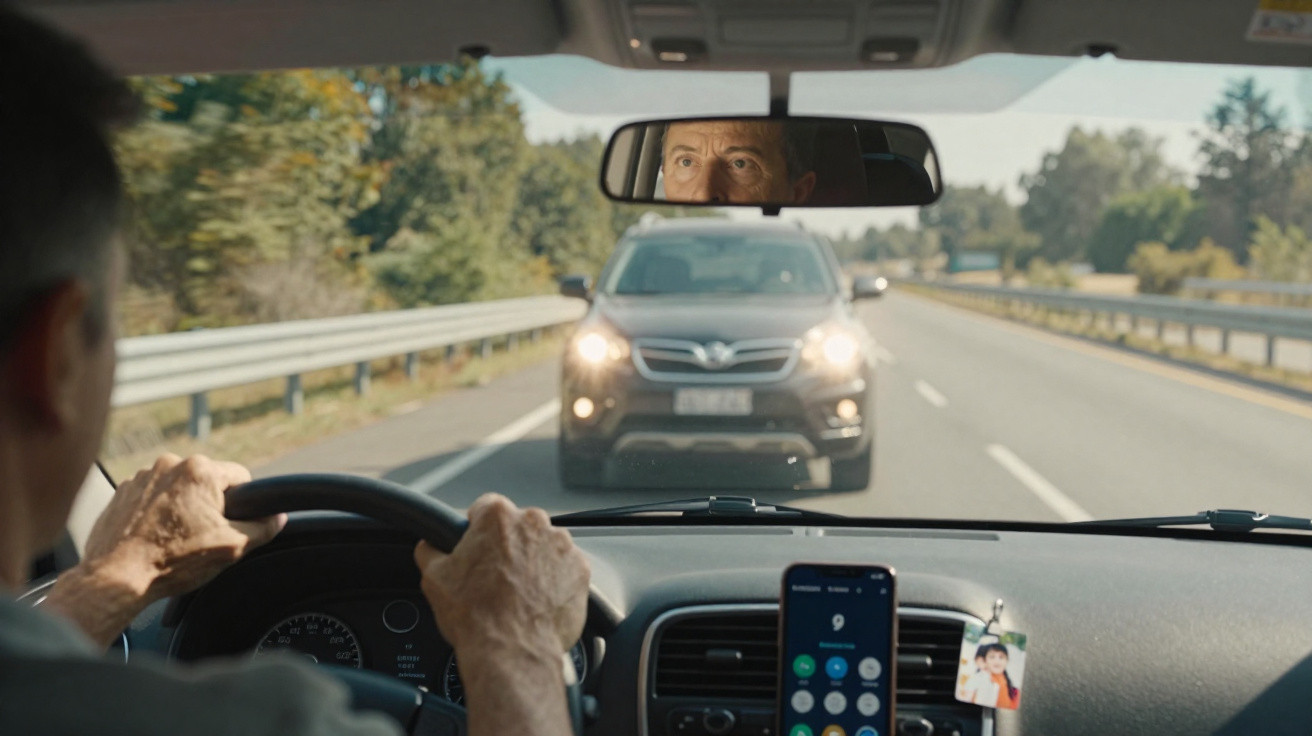
A sudden, hard flash of white filled the rear-view mirror, like a camera firing in the dark. Then it happened again, and again. The driver ahead tightened his grip on the wheel, his pulse rising with every burst. Had something gone wrong with the car-one of the rear lights out, a wisp of smoke, anything?
In moments, the vehicle behind surged closer until its headlights were pinned to the mirror. No breathing space, no time to think. On a deserted stretch of dual carriageway, that beam didn’t feel like a warning so much as a menace. When the flashing became a sharp swerve, the intent turned unmistakably frightening.
This wasn’t meant to help him.
“Move or else”: when headlights turn hostile
The man in the grey hatchback was on his way back from a late shift, already thinking about the leftover pizza waiting at home. The traffic was sparse-cars dotted along the road like tired fireflies. Then an SUV materialised behind him: bright, pushy, its headlights pulsing in a near-manic strobe.
He gave a gentle tap on the brakes as a restrained, civil signal. It made no difference. The SUV edged in closer still, so close the number plate disappeared from view. The next move was immediate: a violent dart to the right, nosing alongside his lane, followed by a lunge towards his car-as though it meant to shove him off the tarmac. For a sickening few seconds, the crash barrier felt far too near.
He got away only because there was a wide hard shoulder and he had the presence of mind to ease off and let the SUV shoot past, the other driver’s face a smear of fury. Then the road returned to quiet, as if nothing had happened.
Road-safety researchers have a clinical label for scenes like this: aggressive tailgating and forced lateral displacement. Most of us would call it what it is-being bullied off the road. Transport-agency research shows aggressive driving features in a large proportion of serious collisions, and it often begins with behaviour that looks “minor” at first: repeated flashing, following too closely, leaning on the horn-until it escalates into manoeuvres that can kill.
What stands out is the speed at which an ordinary drive can become a confrontation. A perceived snub, a lane change that felt too slow to the person behind, and a car stops being transport and starts being used like a weapon. The person in front almost never knows what’s fuelling it. Is the driver behind anxious, intoxicated, trying to impress someone, or simply accustomed to getting their way? From the front seat, only two things are obvious: the pressure, and the fear.
What to do when someone tries to push you off the road
In these moments, a quietly life-saving skill is refusing to “play”. If someone behind you is flashing incessantly, the safest response is deliberately dull. Gently ease off the accelerator. Leave more room ahead of you. Indicate early, move over only when it’s genuinely safe, and allow them to pass. It may bruise your ego, but it protects your body.
If the other driver cuts into your lane or tries to herd you towards the edge, adjust your approach rather than escalating. Keep both hands solidly on the steering wheel, focus your eyes on where you need the car to go, and don’t snap the steering. Sudden overcorrections can trigger a spin or rollover. If there’s a hard shoulder or a lay-by, move into it smoothly, switch on your hazard lights, and stop somewhere you can be seen-never tucked around a bend or obscured by a barrier.
Once you’ve stopped, stay in the vehicle with the doors locked. Phone the emergency services and give a clear, calm description, your location, and any part of the number plate you managed to catch. Your job is not to teach the other driver a lesson. Your job is to get home.
On a long, dark motorway, pressure makes the mind behave oddly. You might feel anger swell and the temptation to brake-check the car behind, or to hold your lane out of principle. That’s pride-and pride can crash at 120 km/h. Let’s be honest: nobody practises this perfectly every day, but rehearsing the idea of “letting the idiot win” in your head can change everything when it suddenly turns real.
A frequent error is trying to film or photograph the aggressor while you’re still driving. That piles distraction onto an already unstable situation. Another mistake is accelerating to “escape”, only to lose control on a bend or run into slower traffic ahead. At the wheel, fear can be as hazardous as the rage coming from behind.
There’s also an uncomfortable truth underneath: afterwards, the person targeted often feels embarrassed. “Maybe I did something wrong. Maybe I overreacted.” That doubt can stop people reporting what happened. Yet telling the story-police, friends, or even just putting it into words for yourself-can restore a sense of agency.
“When a driver tries to push you off the road, you’re not ‘overreacting’ if you feel shaken for days,” says a traffic psychologist I spoke to. “Your body just got a very real reminder of how thin the line is between everyday life and catastrophe.”
To stay mentally steady in the moment, cling to a few practical anchors:
- Let them pass: your pride can recover, your spine not always.
- Never stop face-to-face: choose a lit, public area or keep moving to a police station.
- Call for help early, even if “nothing happened in the end”.
- Note time, place, and details while they’re still fresh.
- Talk about it later; silence often keeps the fear alive.
Why these stories stay with us-and what we do next
Even after the flashing has vanished, the scene can keep looping in your head. The hiss of tyres touching the lane edge. The absurd detail that sticks-the air freshener swinging from the mirror, the radio song cutting through the surge of panic. Moments like these quietly reshape the way we drive.
On busy roads, every car contains a private life: break-ups, overdue bills, exhaustion, joy, migraines, a baby crying in the back. On a bad day, that tangle spills into the driver’s seat. On a worse one, it bursts outwards and becomes violence. On a good day, someone takes a breath and simply lets the other car go first.
Most of us have felt a stranger’s road behaviour that seemed wildly out of proportion to what actually happened. Perhaps you brushed it off. Perhaps you retold it over dinner. Or perhaps, like the man in the grey hatchback, you still ease off a little when a pair of headlights begins flashing in your mirror.
| Key point | Detail | Why it matters to the reader |
|---|---|---|
| Recognise dangerous behaviour | Repeated flashing, closing in too tightly, attempts to push you towards the verge | Understand when it’s no longer mere irritation, but a real threat |
| Immediate response | Slow down, create space, change lane safely, avoid confrontation | Lower the risk of a serious crash by staying in control |
| After the incident | Get to safety, call the emergency services, note details, talk about it | Protect your rights, your mental health, and other road users |
FAQ:
- What should I do if someone is aggressively flashing their headlights behind me? Keep your speed steady and slightly lower, indicate early, and move over only when it’s clearly safe. Let them go past without eye contact or gestures.
- Is flashing headlights always a sign of aggression? No. It can be a warning about a hazard or your lights. The context is key: repeated, close-range flashing combined with tailgating is when it becomes hostile.
- Should I stop and confront a driver who tried to force me off the road? No. Stop somewhere safe and visible, lock your doors, and call the police. Roadside confrontations can escalate very quickly.
- Can I use my phone to film an aggressive driver while I’m still driving? It’s unsafe and often illegal. Your attention must stay on the road. A dashcam is a safer way to record evidence.
- How do I calm down after a terrifying incident like this? Stop somewhere safe, slow your breathing, contact someone you trust, and talk through what happened. If the fear lingers, speaking with a professional can genuinely help.
Comments
No comments yet. Be the first to comment!
Leave a Comment