
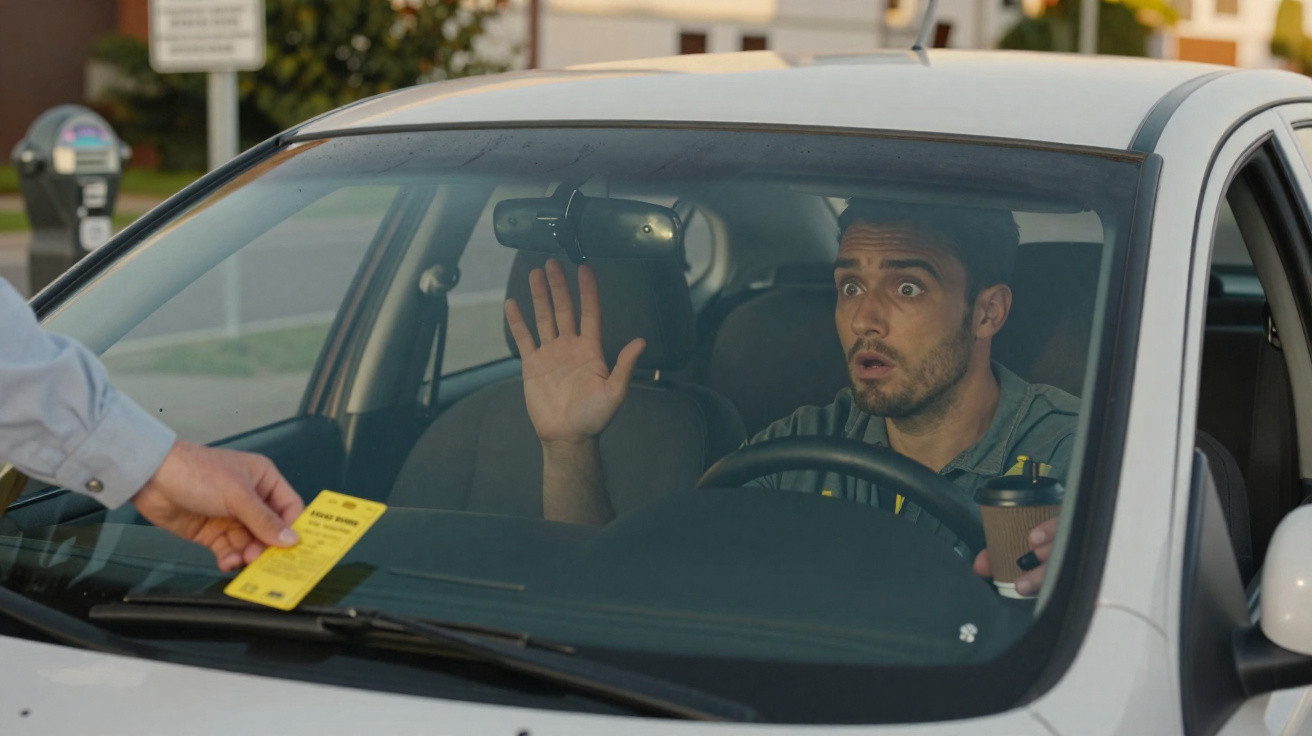
Engine off, phone on silent, hazard lights ticking away in the drizzle. The road was hushed: a soft hiss as tyres passed, and the corner shop’s sign pulsing "OPEN" in the grey. He kept checking the time, then the wipers, then the pharmacy door-watching his partner dash inside for a “quick” pickup that had already stretched ten minutes past quick.
Then a hi-vis jacket slid into view in the mirror.
The parking officer didn’t seem cross. If anything, she looked calm-almost indifferent-as she knocked lightly and gestured towards the windscreen. In a blink, a yellow envelope appeared under the wiper. He was still behind the wheel, seatbelt loose, keys in hand. He hadn’t stepped out once.
He lowered the window, ready with a baffled grin. Her reply erased it instantly.
“I’m in the car, how can this be a ticket?”
The first reaction wasn’t fury. It was pure disbelief-plus a pinch of embarrassment, like being told off for breaking rules you didn’t realise existed.
He reached for the familiar defence: “I’m not even parked, I’m just waiting.” He’d heard mates say it with the same casual confidence, as if it guaranteed immunity. In his mind, being in the car felt like a kind of invisibility cloak-particularly when you were half on a yellow line.
When the officer quietly indicated the small sign a few metres up the street-the one he’d failed to notice-that imagined protection collapsed in a single sentence.
His experience is anything but unusual. Across the UK, the US and elsewhere, drivers are astonished to receive a parking ticket while still sitting in the driver’s seat. They insist they were “only waiting”, or that “it can’t count if I didn’t get out”.
In London alone, councils issue millions of penalty charge notices each year. A portion of them land on people who never left the car. The emotional hit is consistent: it feels like being penalised for pausing-for simply existing in the wrong place for a few minutes.
Parking officers recount the same patterns. One spoke about couples bickering in front of her because one partner had promised, “It’s fine-stay in the car, it’s not parking if you don’t get out.” Another remembered a driver trying to “prove” he wasn’t parked by inching forwards at a walking pace.
Beneath the frustration is a straightforward principle: the law isn’t interested in whether you’re scrolling Instagram, staring at the dashboard, or rehearsing what you’re going to say. It focuses on where the vehicle is, and how long it’s there.
The reasoning is blunt but simple. Parking and traffic restrictions exist to keep roads moving and pavements safe, not to monitor whether your body is inside or outside the vehicle. In legal terms, the key issue is whether your car is “waiting” or “stopped” somewhere it shouldn’t be-or for longer than permitted. Remaining in the driver’s seat doesn’t transform that into a different activity.
So when he said, “I was just waiting for my wife,” it made perfect sense emotionally. From the officer’s perspective, though, it was just a vehicle stopped on a restricted line, taking up space others needed.
How the rules really see you (and your car)
In many situations, the moment you stop in a restricted place-engine off or not-the rules already treat you as parked. Some restrictions don’t even care whether the engine is running. The car is either in an authorised spot or it isn’t. That’s the unforgiving clarity hidden inside dense legal wording.
A short stop doesn’t necessarily save you. In controlled areas, there may be no “grace period” when signage clearly prohibits stopping or waiting at specific times. Double yellow lines, school safety zones, loading-only bays-these aren’t gentle hints. Sitting there with the engine idling and your hand on the gearstick can feel temporary; on paper, it can be a contravention almost immediately.
That mismatch catches out drivers every day: what seems harmless in the moment versus what enforcement sees as an obstruction on a busy street.
One parking officer we spoke to described a man who’d pulled up on zigzag markings outside a primary school, hazards flashing, with children weaving between vehicles. “I’m in the car, I can move if I need to,” he told her, voice rising, finger stabbing towards the steering wheel.
She gestured at the children. “By the time you move,” she said, “it might be too late.”
Elsewhere, a woman insisted she’d stopped for “two minutes” in a loading bay while waiting for a friend. By the time the friend arrived, the ticket was already printed. When she challenged it, CCTV showed she’d been there for nine minutes. In her head, it felt like three.
Those tiny time distortions are normal. Minutes drag when you’re waiting and shrink when you’re rushed. You remember the intention-“I’ll only be a second”-rather than what the clock recorded. That space between what you meant and what happened is where plenty of parking tickets are made.
Councils and lawmakers design rules for vehicles in bulk, not for individual intentions. If a no-stopping zone outside a school were enforced by “Well, he looked like he was about to move,” the result would be chaos. So the rules are drawn as hard boundaries: no stopping, no waiting, and no “just sitting there with the engine on” at certain places and times.
Seen from that perspective, the ticket looks less like punishment for being in your car and more like a crude tool to keep the system working. Crude tools sting when they land on you. That sting is real.
How to wait without waking up to a yellow envelope
One simple habit cuts your risk dramatically: check the sign before you let your mind drift to your phone, your errands, or your to-do list.
Focus on three points: where the restriction begins and ends (arrows or road markings), the times it applies, and what kind of stopping is permitted-parking, loading, drop-off only, or nothing at all. If you can’t work it out within ten seconds, move on. The ten-second rule may sound strict, but it’s kinder than arguing on the kerb with someone holding a handheld ticket machine.
If you genuinely need to wait, choose safer options: marked bays, side streets without lines, or short-stay areas that clearly allow brief stops. A quick loop round the block can be the difference between a calm evening and £60 down the drain.
There’s also the unglamorous answer: pay for legal parking. Not heroic, but often cheaper than a penalty-and cheaper than the hour you’ll spend stewing afterwards.
Most of us carry quiet parking myths without realising it. That hazard lights make anything acceptable for five minutes. That a quick dash into a shop “doesn’t count”. That staying in the driver’s seat means you’re hovering, not parked. Those ideas persist because they usually aren’t tested-until the day a parking officer happens to be on the same street as your little workaround.
On a human level, waiting in a restricted spot can feel innocent. Maybe your child is crying in the back, your boss is ringing, and your head is full. You don’t feel like a rule-breaker; you feel like someone trying to get through a hectic day. That emotional truth matters-even if the law doesn’t read feelings, only signs.
Let’s be honest: hardly anyone reads every sign as if it were an insurance contract. We glance, we guess, we hope. Most days, we get away with it. Which is exactly why the shock is so sharp when the yellow envelope finally appears beneath the wiper.
“When I finally appealed a ticket instead of just ranting about it, I realised I’d parked on a loading bay, right under a clear sign. I was so sure I’d been ‘unlucky’ that I never stopped to ask if I’d actually been wrong.”
The people who rack up fewer tickets aren’t necessarily those who’ve memorised every rule. They’re the ones who build small, dull habits that quietly keep them out of trouble.
- Look up for signs before you look down at your phone.
- Don’t stop on lines or markings if you’re even slightly unsure.
- Use legal car parks for longer waits, even if they feel “out of the way”.
- Keep a mental note of how long you’ve actually been there, not how long you planned to stay.
- If in doubt, move-arguing with yourself won’t cancel a fine.
The quiet question hiding inside every parking ticket
After getting ticketed while still in the driver’s seat, he went home livid. That evening he told the story three times, each retelling with bigger gestures. His friends agreed it was ridiculous. Social media agreed even more loudly.
Later, once the adrenaline wore off, he opened his laptop to submit an appeal. He zoomed in on the photos attached to the notice: his car, partly under a clear sign. The sign stating no stopping at that time. The argument in his chest loosened-just slightly.
There’s a particular, quiet loneliness to a parking fine. It isn’t only about the money. It’s the sense of being singled out-labelled “the one who did wrong”-in a world where it seems everyone else double-parks, waits on lines, and blocks pavements without consequence. On a bad day, that yellow envelope on your windscreen can feel like the city has turned against you.
On a different day, it can be something else: a nudge to pay attention during small, unglamorous moments. To accept that “I’m in the car” doesn’t make you invisible. To notice how your five-minute wait can become someone else’s blocked crossing, blocked view, or blocked ramp.
We all sit in the tension between private convenience and shared space-between “I’ll just stop here for a second” and “What if everyone did that?” No ticket can resolve that. But each one hides a question beneath the anger: the next time you’re waiting in a car on a busy street, how will you decide where to stop?
| Key point | Detail | Why it matters to you |
|---|---|---|
| Being in the car doesn’t protect you | The law looks at where the vehicle is stopped, not whether the driver is sitting inside it | Prevents a false sense of safety that leads to surprise fines |
| Read the sign first | Time restrictions, the type of parking, and no-stopping areas are often clearly shown | Greatly reduces the risk of a “how is this possible?” ticket |
| Build small habits | Choose side streets, legal car parks, and keep track of the actual time you’ve been stopped | Protects your wallet and day-to-day peace of mind |
FAQ:
- Can I get a parking ticket if I never left the driver’s seat? Yes. If your vehicle is stopped in a restricted area or you remain beyond the permitted time, you can be issued a ticket even while you’re still at the wheel.
- Do hazard lights make short stops legal? No. Hazard lights simply alert other road users that you’ve stopped; they do not override local stopping or parking restrictions.
- Is it worth appealing a parking ticket? Sometimes. If signage was unclear, missing or obscured, or if details on the ticket are incorrect, you may have grounds. If the evidence clearly shows a contravention, appeals seldom succeed.
- Are there grace periods for short stops? Some locations allow a brief grace period in standard bays, but no-stopping zones and school areas often have zero tolerance once you stop.
- What’s the safest way to wait for someone in the car? Use legal parking bays, short-stay car parks, or unrestricted side streets-and always check nearby signs before you settle in.

Comments
No comments yet. Be the first to comment!
Leave a Comment