
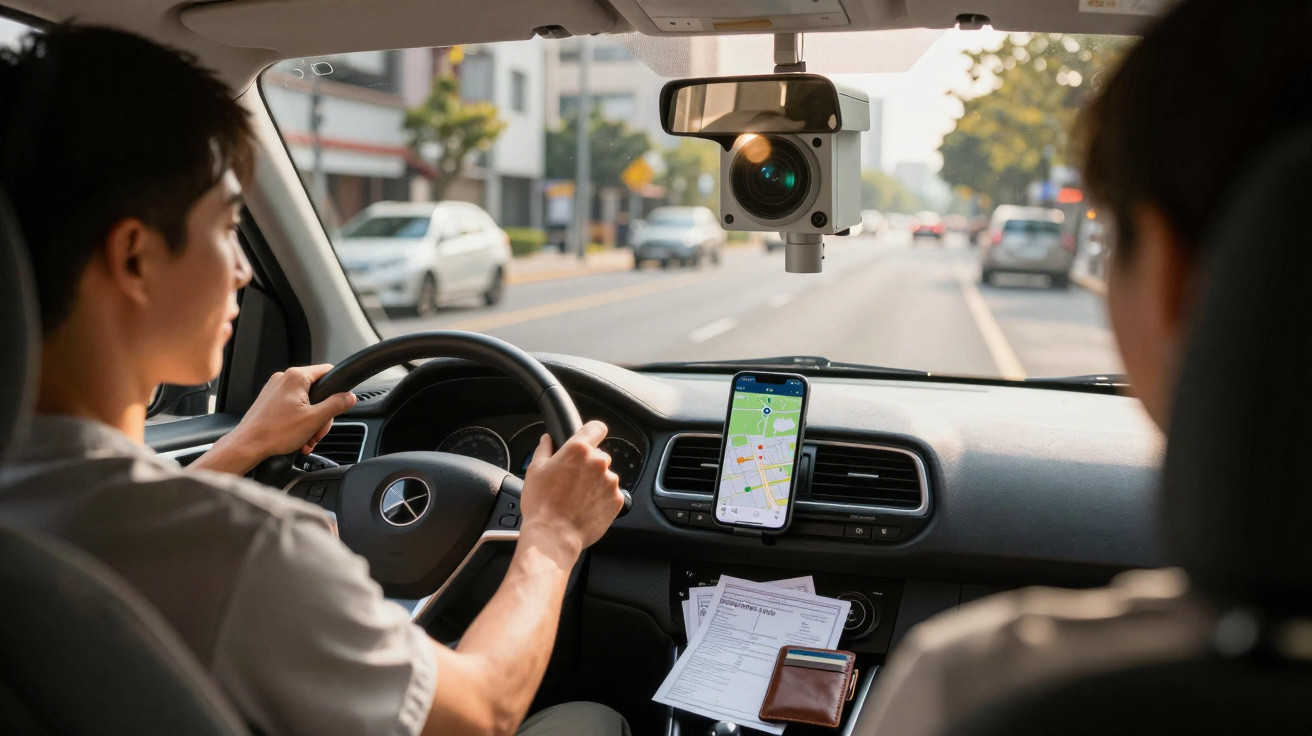
It begins with a brief flicker you barely register. A drab morning on the ring road: wipers squeal, the children bicker in the back, and the traffic rolls along. You glance down and see the needle sitting a touch above the limit-the way many people drive when the road is flowing. Then, a week later, an envelope lands on the doormat. Not a caution. A fine. No officer, no chat-just an amount, a reference number, and a nod to the new 2025 speed camera tolerances.
You run the trip back through your mind and feel that familiar, heavy blend of guilt and irritation. You weren’t tearing about. You were just… moving with everyone else.
Somewhere between “public safety” and “easy income”, the boundary has shifted-quietly.
From safety net to money trap: what changed in 2025
Speed cameras used to feel like a last line of defence. They were there to catch the truly blatant cases: the late-night racer blasting through a 30 zone at 55, or the motorway bully sitting on bumpers while doing 100 in the rain. Most drivers also had that half-official rule of thumb in mind-those legendary “10% plus 2 mph” buffers people swore by-and they drove as though there was a little padding built in.
In 2025, that padding got thinner. Without much fanfare. Allowances have been reduced, automated trigger points retuned, and people are finding out the hard way that 33 in a 30 isn’t met with a shrug and a stern note any more. It’s an invoice.
In early January on a suburban dual carriageway, a 43-year-old electrician from Birmingham picked up three separate tickets on the same stretch within a single week. Same van, same routine, same consistent 36 mph-on what had previously been a 40 zone. The limit had been cut to 30, and the tighter tolerance meant the camera flashed almost every time he went through.
His experience spread through Facebook groups and then into WhatsApp chats-shared like a tall tale until it became clear it was real. The figures echo it too: councils have reported double-digit rises in camera revenue in trial areas where tolerances were quietly narrowed in late 2024. Safer streets? From the passenger seat, it’s not obvious.
Here’s the awkward reality: 2025 didn’t bring some sudden breakthrough in road safety science. The laws of motion stayed the same; the equipment didn’t. Today’s digital cameras can measure speed to within a fraction of a mile per hour, and that level of accuracy made it easier to reframe enforcement-polished with a safety message, while delivering a very profitable side effect.
Small overruns, brief drifts over the line, momentary lapses: all of it can now be turned into revenue at scale. When enforcement is automatic and has no patience, it stops feeling like a deterrent and starts resembling a stealth charge. The message stops sounding like “slow down so nobody gets hurt”, and starts sounding like “slow down or pay”.
How to live with the new tolerances without losing your licence (or your mind)
The first coping tactic is dull but effective: change how you interpret your own speed. If you’ve always driven “a bit above” because that’s what the flow encourages, that habit now carries a clear cost. Instead of hovering at the edge, aim to sit 2–3 mph under the posted limit. On a 30 road, train yourself to think 27–28, not 32.
At first it feels painfully slow. Your mind keeps insisting, “Everyone’s getting past me.” Stick with it for a week and your internal sense of normal adjusts faster than you’d expect-particularly on urban roads.
A practical trick that genuinely helps is to choose one everyday route and be obsessively accurate on it for a month. Perhaps it’s the school run or your commute. On that one route, treat the limit as a firm ceiling: no grey area, no “I’m just keeping up”.
On a 50 road, hold 49. On a 60, keep yourself at 57–58. You’ll start noticing things you used to miss: the camera tucked behind a sign, the average-speed section you drifted through on autopilot, the sly downhill that adds 4 mph without you meaning to. On the map, it looks unchanged. In real life, it feels completely different.
There’s also a new layer to navigate: using technology to your advantage. Many newer cars have a digital speed display that’s more dependable than an old dial. And plenty of sat-nav apps now announce the limit and alert you when you cross it. It can be irritating-sometimes very irritating-but it’s still less irritating than three fines in a month.
Let’s be honest: hardly anyone keeps that up perfectly every day. You’ll forget, you’ll slip, you’ll lose focus because a baby is crying or a Teams call is going on. That’s exactly the gap the new tolerances are designed to exploit.
Why this feels like tax first, safety second
The way these 2025 changes were introduced is revealing. There was no nationwide TV campaign declaring, “We’re reducing tolerances to save lives.” No prime minister at a podium promising to cut fatalities with new enforcement rules. Instead, it arrived through quiet alterations to guidance, software adjustments, and lines buried in local authority paperwork.
When leaders truly believe in a safety measure, they promote it openly-like seatbelt laws. When it’s pushed through in a whisper, drivers understandably suspect the real motive is something else: revenue.
On a cold evening in Leeds, a driving instructor with 20 years’ experience watched a learner fail a test after briefly touching 31 in a newly reduced 20 zone on a downhill stretch. No children nearby, no traffic, no obvious danger in the moment. But there was a camera ahead. Technically, the limit was exceeded. Still, she walked away with that persistent feeling that something wasn’t quite right.
On paper, the new tolerances treat 23 in a 20 in much the same spirit as people used to treat 42 in a 30-as plainly wrong. Out on the road, those two situations don’t feel remotely alike. One could be a distracted parent for a few seconds; the other is outright reckless. The camera makes no distinction.
The logic is tempting: “If everyone follows the limit exactly, roads will be safer.” In a spreadsheet, it’s hard to argue with. In the real world, people aren’t machines. Speed varies with hills, weather, and the gaps between vehicles. A strict, low tolerance turns normal micro-variations into chargeable offences.
That is where the word “tax” starts to feel accurate. What’s being punished isn’t dramatic danger so much as everyday human imperfection. And when that imperfection produces millions each year with predictable reliability, calling it a hidden tax on drivers stops sounding dramatic and starts sounding like plain speaking.
Staying sane, staying mobile, and quietly pushing back
One clear way to protect yourself is to create a personal “red zone map”. Spend 20 minutes one evening sketching your typical month-work, the supermarket, school, sports clubs. Then, using Google Maps Street View or your sat-nav, identify and note every stretch with known cameras, particularly the newer 20 and 30 zones.
The following week, when you drive those roads, try dropping 3–4 mph below the limit at those specific points. Not everywhere and not all the time-only where you know the technology is waiting. It’s a small, focused change that can protect your licence more effectively than staring at the speedo nonstop.
Another defence is psychological. Replace “I’ll just go with the flow” with “I’ll be the slightly slower one, and that’s alright”. There’s a quiet strength in not letting the impatience behind you dictate your speed. Yes, someone will sit inches from your rear bumper. Yes, someone else will blast past at 38 in a 30.
On a bad day, it feels wrong that you’re the one being careful while others take the gamble. On a good day, you remember who pays if you get the new margins wrong: not the stranger behind you, but your bank balance, your points, and your insurance premium.
Drivers are also finding understated ways to challenge the idea that every extra mile per hour is a mortal sin. Online forums swap screenshots of roads where limits fell without an obvious safety justification-followed by a sudden rise in camera activations. Local groups are contacting councillors and asking to see collision data from before and after the limit changes.
“If this is about safety, show us the numbers. If it’s about money, be honest and call it what it is.”
A few practical levers you can pull yourself:
- Check whether your local authority publishes revenue and crash statistics by camera location.
- Ask your MP why tolerances are being tightened without transparent public debate.
- Join or start a local campaign calling for evidence-based limits, rather than blanket ones.
The bigger question hiding behind a tiny margin
Everyone understands that speed can kill. A 2 a.m. phone call, a knock at the door, a news alert about a drunk driver going too fast on a wet road-nobody wants to be part of that outcome. And yet something shifts when a driver doing 24 in a quiet 20 at 11 p.m. is treated almost the same as a boy racer charging through a school zone.
One way to separate the two is to think in terms of “dangerous by nature” versus “dangerous by policy”. Driving at 70 in thick fog is dangerous by nature. Doing 33 on a wide, empty 30 at midnight is dangerous by policy. For most people, only one of those feels like a moral failing.
On an emotional level, that’s why the 2025 speed camera tolerances grate. They don’t only go after real risk; they convert tiny slips-things that feel like ordinary life-into income. In a spreadsheet, those slips become a dependable revenue line. On your kitchen table, they arrive as an unpleasant jolt when you open the post.
Politically, it’s simpler to squeeze motorists than to raise income tax or properly reform fuel duty. Cameras don’t vote. Drivers do, but their anger is diluted because fines show up as isolated incidents, not as one big, unmistakable bill.
On the human level, this isn’t simply “boy racers versus everyone else”. It’s about whether roads are enforced as shared spaces where safety is genuinely prioritised, or as frictionless cash machines wrapped in a safety label. We can accept that slowing down near schools saves lives and still criticise a system that quietly tightens tolerances until ordinary people feel targeted rather than protected.
On a calm drive home, watching your speed wander between 28 and 31, you may find yourself thinking: do they truly want safer roads-or do they want more people stepping over an invisible, profitable line? You won’t find the answer in a slogan. It will be hidden in the data, and in how loudly we’re prepared to ask for it.
| Key point | Detail | Why it matters to the reader |
|---|---|---|
| New 2025 thresholds | Reduced tolerances, with cameras triggering on very small exceedances | Understand why fines are arriving even when driving feels “normal” |
| Real-world impact | Rising local revenue, with little clear evidence of a massive safety gain | Decide whether the change feels like a “hidden tax” |
| Defensive strategies | Driving 2–3 mph under the limit, creating a personal camera-zone map, using digital tools | Reduce fines, protect your licence and budget, and keep driving |
FAQ:
- Are speed camera tolerances really changing in 2025? In many regions, yes. Enforcement bodies are narrowing the gap between the posted limit and the trigger point, so smaller excesses are more likely to produce fines.
- Does stricter tolerance automatically mean safer roads? Not automatically. Safety gains mainly come from targeting high-risk behaviour and high-risk locations, rather than monetising tiny, low-risk deviations.
- Why do people call this a “hidden tax” on drivers? Because revenue from minor infractions is increasing sharply, while communication about the policy shift has been quiet and framed as pure safety rather than as a new income stream.
- How can I protect myself from unexpected fines? Drive a few mph under the limit in camera-dense areas, use digital speed readouts and sat-nav alerts, and learn where fixed and average-speed cameras sit on your regular routes.
- Can drivers influence these policies at all? Yes. By requesting data from local authorities, questioning MPs, and backing evidence-based speed limits, motorists can push for enforcement that prioritises genuine safety over easy revenue.

Comments
No comments yet. Be the first to comment!
Leave a Comment