
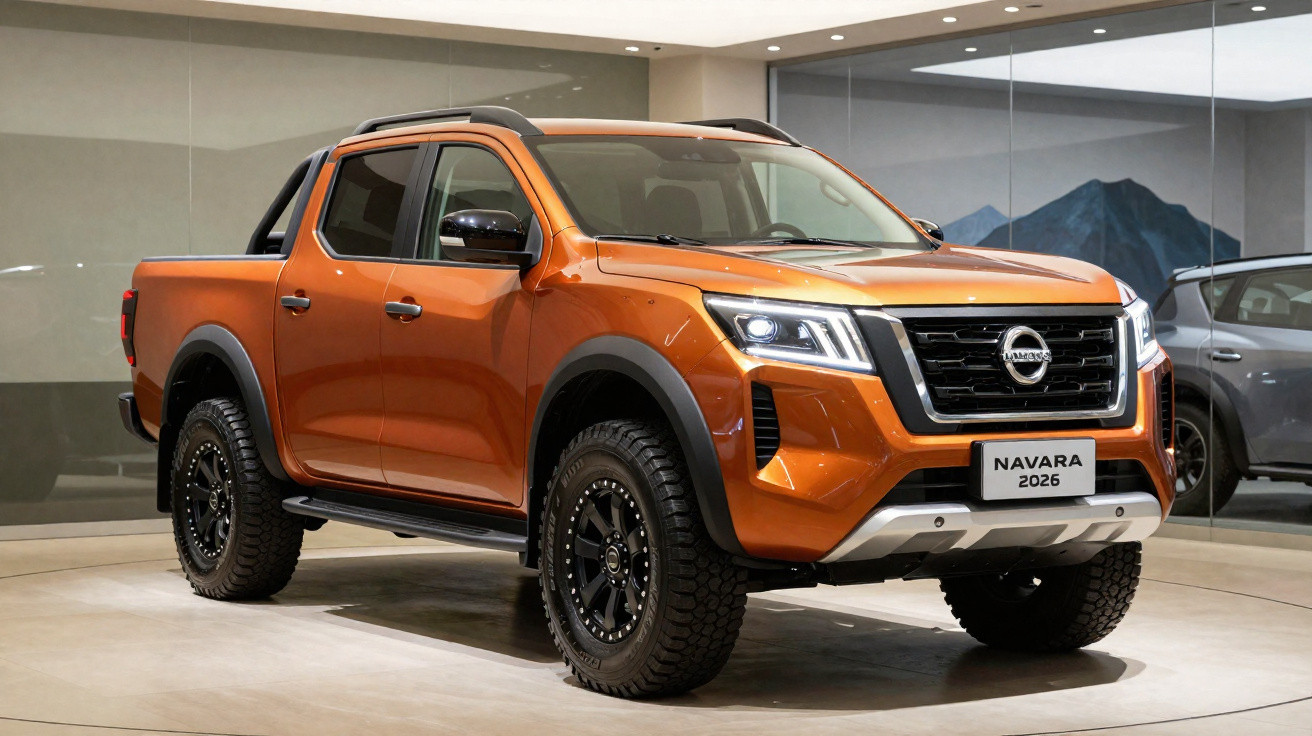
A well-known Japanese 4x4 badge, which recently vanished from European price lists with little fanfare, is now lining up for a return that few saw coming.
Nissan is gearing up to bring the Navara pick-up back in 2026. This time it will sit on Mitsubishi foundations, but with Nissan’s own look and feel, more hard-core off-road variants and clear worldwide intentions. The plan marks a fresh assault on the workhorse truck arena, arriving as interest in capable off-roaders starts to climb again.
Nissan’s tough icon returns to the front line
For a long time, the Navara was a popular choice in the mid-size pick-up class for tradespeople, farmers and overland travellers across Europe, Asia and other regions. When European production stopped in 2021, it seemed like the final chapter. It wasn’t.
Set for 2026, the next Navara is being treated as a genuine reboot, not a minor update. Nissan will lean on the newest Mitsubishi Triton (badged L200 in certain markets) for the mechanical starting point, enabled by the Renault–Nissan–Mitsubishi Alliance. That approach allows Nissan to re-enter a fiercely competitive segment without spending billions developing an all-new ladder-frame base from zero.
Nissan is relaunching the Navara as a proper global pick-up again, not as a niche derivative or regional special.
The game plan is clear: use Mitsubishi’s up-to-date pick-up engineering, apply Nissan’s own calibration and styling, then take on rivals including the Ford Ranger, Toyota Hilux, Isuzu D‑Max and Volkswagen Amarok. It also helps Nissan reinforce its reputation for rugged, body-on-frame vehicles at a time when its range is heavily tilted towards crossovers.
A Mitsubishi backbone, a Nissan personality
Underneath, the new Navara and the latest Triton are built around the same fundamental structure. Expect a conventional ladder-frame chassis, revised for improved torsional stiffness, safety performance and ride comfort. The layout remains traditional, but it has been modernised to satisfy current crash requirements and refinement standards.
Nissan says this will not be mere badge engineering. The team is working on bespoke steering and suspension tuning, updated electronic calibration, plus a clearly different exterior and interior design. The intention is that anyone stepping into a Navara should immediately recognise it as a Nissan, rather than a lightly rebranded Mitsubishi.
Under the skin sits Mitsubishi’s 2.4‑litre turbo diesel: around 201 hp and 470 Nm, paired with a six‑speed automatic and advanced four‑wheel drive.
That 2.4‑litre turbo diesel-already found in the Triton-puts the upcoming Navara towards the stronger end of the mid-size pick-up power spectrum. With 470 Nm arriving low in the rev range, it is well suited to towing, carrying heavy loads and controlled, slow-speed off‑roading. Drive is handled by a six-speed automatic, along with a selectable 4×4 system offering locking differentials and multiple terrain programmes tuned for mud, sand and rough surfaces.
On selected variants, towing is expected to be above three tonnes, positioning the Navara alongside the class’s key heavy hitters. The emphasis is on durability, distance capability and hard use, rather than electrified powertrains-which still find it difficult to deliver payload, range and pricing that add up in this category.
Muscular styling and hardcore off-road editions
Although development vehicles remain heavily disguised, the main design direction is already understood. Compared with its Mitsubishi relative, the Navara is due to adopt a more assertive nose, including a larger grille, a reprofiled bumper and vertical LED lighting signatures influenced by models such as the US‑market Nissan Frontier and the Patrol SUV.
Nissan is also placing a major bet on tougher off-road specifications, sold as Navara PRO‑4X or Navara Warrior depending on the country. These are aimed at customers who want an adventure-ready pick-up straight from the factory, rather than starting with a basic working truck and modifying it themselves.
Likely enhancements include:
- Strengthened suspension and additional ground clearance
- Chunkier all‑terrain tyres mounted on model-specific alloy wheels
- Skid plates underneath and protection for rocky terrain
- Revised front and rear bumpers to improve approach and departure angles
- Optional snorkel, sports bar, roof racks or an integrated winch, depending on market
Styling touches-such as blacked-out grilles, contrasting tow hooks and unique graphics-are expected to reinforce the more outdoors-focused positioning. In Australia and New Zealand, where these variants are confirmed first, that more aggressive appearance matters to many buyers just as much as the mechanical upgrades.
Cabin: from bare workhorse to lifestyle truck
Inside the cab, Nissan is aiming for a mix of toughness and comfort. The company has showcased interiors featuring hard-wearing finishes, extra storage solutions and strengthened seat upholstery intended for long stints on building sites or on trails. A central touchscreen with navigation and smartphone connectivity will be paired with physical switches for the core off-road functions.
The PRO‑4X-style cabin mixes practicality with visual flair: orange stitching, specific seats and a driving position adapted for intensive daily use.
Upper specifications are expected to add digital driver displays, driver-assistance systems and increased sound deadening, moving the Navara closer to SUV-like comfort on tarmac. This is increasingly important in places where a pick-up must serve as both a business tool and a family vehicle.
Where it’s going on sale – and where it might not
Manufacturing and the first customer deliveries are scheduled for Australia and New Zealand towards the end of 2025. These are established pick-up territories where one-tonne trucks frequently top sales charts, and where the Mitsubishi Triton already has a strong foothold.
After that, the Navara may expand into South America, Africa and the Middle East. In those markets, demand for robust diesel pick-ups remains healthy, and Nissan’s long-standing image-built by earlier Navara generations-still resonates.
Europe: a question mark with legal strings attached
Europe remains the biggest unknown. Stricter emissions regulation, tax treatment of higher‑CO2 vehicles and the broader move towards SUVs have put pressure on the traditional pick-up market. Even so, there are still pockets of demand-especially in southern and eastern Europe and in rural parts of France, Spain and the Balkans.
If the Navara does come back to these areas, it may do so in modest volumes, largely registered as light commercial vehicles. That “utility” classification can reduce or avoid some CO2-related penalties, helping a diesel pick-up make financial sense for businesses and the self‑employed.
| Market | Status for 2026 Navara | Main obstacles/opportunities |
|---|---|---|
| Australia & New Zealand | Confirmed | Strong pick-up culture, high demand for off-road versions |
| South America & Middle East | Likely | Reputation of previous Navara, need for robust work trucks |
| Europe | Uncertain | CO2 rules, taxation, growing SUV preference |
Why diesel and ladder frames still matter for many buyers
In an era dominated by electrification, the new Navara could be seen as a contrarian move. A large diesel engine, a traditional ladder frame and genuine off-road equipment do not sit neatly with urban emissions arguments. Yet for many users, that combination still delivers what they need.
A ladder-frame chassis supports heavy payloads, copes with twisting off-road tracks and accommodates aftermarket bodies and accessories. Body-on-frame construction can also make repairs more straightforward in regions with harsh road conditions. For remote, long-distance work, a diesel powertrain offering a 600–800 km range from one tank remains a proven and practical answer.
For remote-region trades, farmers and overlanders, the combination of tow capacity, range and serviceability often outweighs the promise of zero tailpipe emissions.
Battery-electric pick-ups are arriving in North America and China, but high purchase prices, sparse charging in rural areas and the compromises between payload and range continue to limit their appeal in the Navara’s core target markets.
What the relaunch says about Nissan and Mitsubishi
This model also highlights how the Alliance partners are planning ahead. Mitsubishi supplies decades of pick-up and off-road expertise, particularly across Asia-Pacific. Nissan adds a broader global footprint and an owner community with strong memories of older Navara models.
By sharing development, the two brands can spread costs while bringing safety and technology up to date more quickly. For customers, the result can be broader choice: two different products-Triton and Navara-tuned for slightly different preferences, yet built around the same proven components underneath.
How buyers might use the new Navara in practice
On the ground, a common Australian scenario could involve a dual-cab Navara Warrior towing a 2.5‑tonne caravan along gravel roads, carrying camping kit in the load bed, and then handling the weekday commute. In a Latin American city, a lower-spec work-focused version might spend most of its time transporting building supplies, using four‑wheel drive only when the wet season arrives.
For European fleets-if the truck is offered-the most likely buyers are trades that genuinely require the payload and towing ability: roofing, forestry, utilities maintenance or civil engineering. In those situations, whether it works on paper will depend on the balance between emissions-related costs and day-to-day productivity.
Key concepts: 4×4, 4×2, payload and towing
For anyone less familiar with pick-up terminology, a few Navara-related basics are worth explaining:
- 4×4 vs 4×2: 4×4 (four-wheel drive) drives all four wheels, boosting grip off-road and on slippery surfaces. 4×2 typically means rear-wheel drive only, which can help economy but reduces ability in mud or snow.
- Payload: the maximum total weight carried in the cab and load bed, including passengers and cargo.
- Towing capacity: the maximum trailer weight the vehicle can legally and safely pull. A rating “above 3 tonnes” places the Navara firmly among serious working trucks.
- Ladder frame: a separate rigid chassis shaped like a ladder, with the body bolted on top-traditional for pick-ups and heavy-duty off-road vehicles.
With these points in mind, it becomes clearer why the 2026 Navara is not merely a lifestyle prop. It is engineered primarily as a tool, with tougher styling and added comfort layered on for buyers who want a truck that can graft during the week and manage long off‑grid weekends.



Comments
No comments yet. Be the first to comment!
Leave a Comment