
Choppy water, a packed timetable and thousands of travellers to carry: the Rio de la Plata is about to gain a striking new arrival.
The debut of a vast battery-driven ferry linking Argentina and Uruguay suggests just how quickly short‑sea shipping could evolve-well away from the usual focus on aircraft and cars.
Hull 096: South America’s new electric sea giant
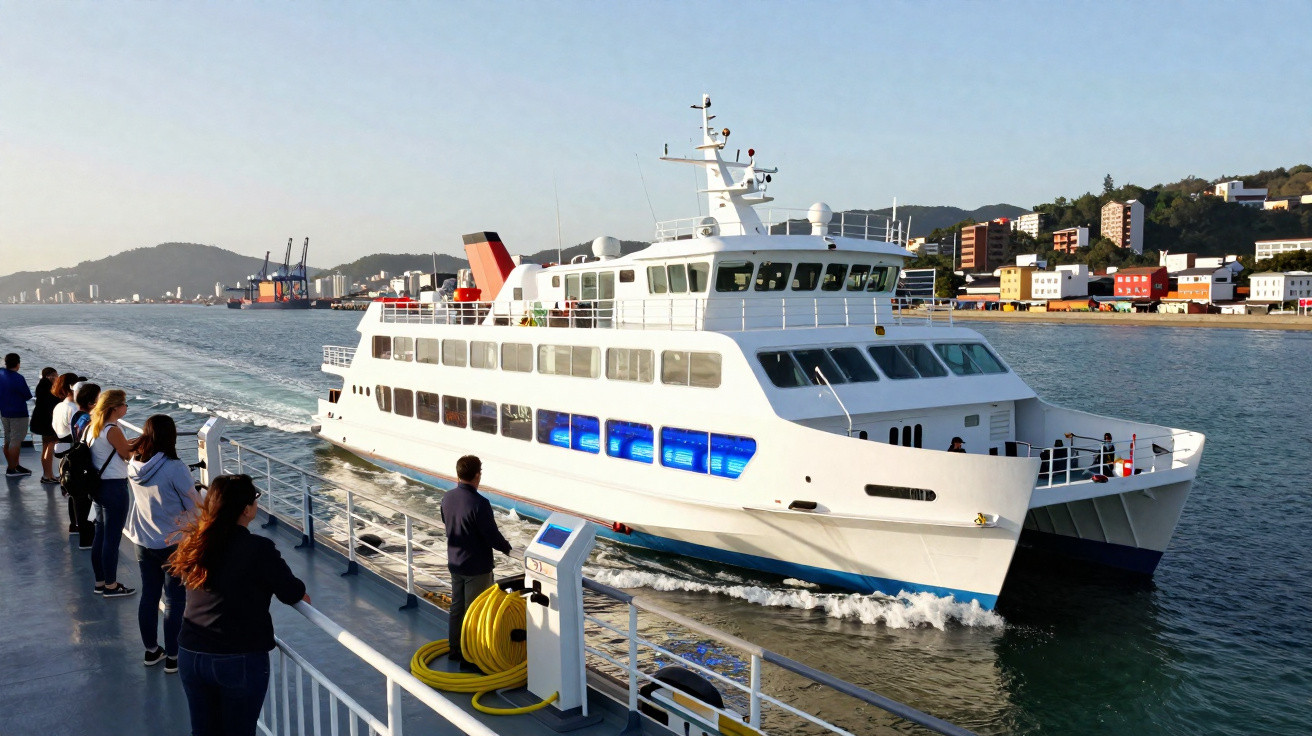
On 14 December 2025, Hull 096-an all‑electric ferry measuring 130 metres, constructed by Incat Tasmania for South American operator Buquebus-wrapped up its first sea trials. The run took place off Australia, yet its everyday work will be on the Rio de la Plata, running back and forth between Buenos Aires, Argentina, and Colonia del Sacramento, Uruguay.
Its purpose is straightforward: carry passengers and cars at speed, with low noise, and without consuming any fuel oil.
Hull 096 is the largest 100% battery‑electric ship ever built, with capacity for around 2,100 passengers and more than 220 vehicles.
Made from lightweight aluminium, the ferry spans 130 metres and uses a broad beam so it can accommodate both people and vehicles without the space feeling tight. The design has been pushed to maximise what fits: airy interior areas, extensive glazing, and a commercial deck that sets a new high-water mark for ferries.
A ferry built around the passenger
Buquebus operates one of the region’s busiest short crossings. The onboard mix includes business commuters, tourists and locals travelling across a wide estuary rather than the open sea-and that use case has shaped the vessel.
- Quick port turnarounds to keep to a demanding timetable.
- Spacious lounges and retail zones to earn revenue on every sailing.
- Car decks arranged for rapid loading and unloading.
- A lightweight build to keep electricity demand in check.
One feature is especially notable: the ship is set to include the largest commercial area ever fitted to a ferry, effectively turning a 90‑minute journey into a floating shopping centre. For Buquebus, income from shops, bars and services helps offset the sizeable electrical fit‑out.
Forty megawatt‑hours at sea
The biggest change is out of sight. Hull 096 operates solely on power supplied by more than 250 tonnes of lithium‑ion batteries. Altogether, 5,016 modules are distributed across four purpose‑built battery rooms, delivering storage capacity in excess of 40 MWh.
The energy on board is roughly four times higher than the largest maritime battery systems previously in service.
That battery system supplies eight electric waterjets. Rather than diesel engines turning conventional propellers, high‑output electric motors drive jets of water from the stern. This configuration offers brisk acceleration and strong handling for the constrained approaches into Buenos Aires and Colonia.
Fast crossings, fast charging
The ferry is expected to complete the Buenos Aires–Colonia run in roughly 90 minutes. Operations will be intensive: a swift passage, a short stay alongside, then the return trip. The charging arrangement therefore needed to keep up.
Each battery module is air‑cooled via its own fan, helping to preserve performance through repeated high‑power cycling. During turnarounds, shore systems at both terminals will recharge the vessel in about 40 minutes. That points to multi‑megawatt charging levels-comparable to the electricity demand of a small town-delivered in well under an hour.
From a grid standpoint, a draw of that size typically calls for dedicated substations, intelligent scheduling and, in many cases, local storage or buffering so the wider network is not destabilised. In South America, building this shoreside capability could prompt further upgrades at ports along the region’s coasts and rivers.
Why the ship switched from gas to batteries
Hull 096 did not begin as a battery project. The initial plan-under the name China Zorrilla-aimed for liquefied natural gas (LNG) propulsion, which a decade ago was widely viewed as a cleaner transitional fuel for shipping.
Buquebus and Incat later changed course to full electrification. Climate expectations contributed, as did volatile fuel prices and the increasing availability of large-scale maritime battery systems. The move also allowed Incat Tasmania to position itself as a builder of high‑precision electric ferries, at a moment when shipyards are under pressure to deliver real low‑carbon vessels rather than only concept renderings.
For the first time, a ship of this size and speed will operate on a commercial route using only battery power, with zero direct emissions.
Robert Clifford, Incat’s founder, called the sea trial a “turning point for shipbuilding”, indicating that large, fast passenger ships can now cover short and medium routes without combustion engines.
Maritime emissions under pressure
The shipping sector produces around 3% of global greenhouse gas emissions. Most vessels run on heavy fuel oil, among the most polluting outputs of the refining process. Regulators are increasingly demanding operators cut climate impacts while also lowering sulphur, nitrogen oxides and particulate emissions around ports.
Hull 096 tackles direct emissions at the source. With no main engines, no exhaust stacks and no marine diesel, local harbour pollution should drop markedly. The overall climate impact will depend on how Argentina and Uruguay generate the electricity used for charging, but air quality at terminals improves immediately. Lower vibration and reduced noise should also be noticeable to passengers and crew, often changing the feel of the journey.
A growing club of electric ships
Hull 096 is not an isolated development. It builds on roughly a decade of trials and early commercial deployments in Norway, China and across Europe-the major difference this time is scale.
| Vessel | Country | Type | Year | Main record | Battery capacity |
|---|---|---|---|---|---|
| Hull 096 | Australia / South America | Passenger ferry | 2025 | Largest 100% electric ship | > 40 MWh |
| Ampere | Norway | Ferry | 2015 | First fully electric commercial ferry | ≈ 1 MWh |
| Yara Birkeland | Norway | Container ship | 2021 | First electric, autonomous cargo vessel | ≈ 7 MWh |
| E‑Ferry Ellen | Denmark | Ferry | 2019 | Longest all‑electric crossing (22 nautical miles) | 4.3 MWh |
| Yangtze electric cargo | China | River cargo | 2023 | Largest electric river freighter | ≈ 20 MWh |
Norway’s Ampere showed back in 2015 that a ferry powered only by batteries could operate all day on a fixed schedule. Later, initiatives such as the autonomous Yara Birkeland demonstrated that short‑range container movements could also be electrified. In China, battery‑powered river freight vessels already haul thousands of tonnes using packs measured in tens of megawatt‑hours.
Hull 096 raises the bar again. Carrying more than 40 MWh, it exceeds the battery capacity of many newer electric or hybrid ferries by a wide margin. In doing so, it moves electric propulsion beyond the “small coastal shuttle” category and into the mainstream of fast regional connections.
Risks, trade‑offs and what comes next
A step change of this magnitude brings technical and commercial challenges. Battery installations on this scale require sophisticated fire detection and suppression, resilient thermal management, and careful separation from passenger spaces. Insurers also scrutinise how shipyards engineer and validate systems of this kind.
Financially, the up-front spend is significant. Large maritime battery packs are still costly, and shore charging equipment for a high-throughput terminal can reach tens of millions of dollars. Buquebus will aim to recover that through reduced fuel costs, lower maintenance from fewer moving parts, and increased onboard takings enabled by the expanded retail footprint.
The real test for Hull 096 will not be the first sea trial, but whether the business case holds over a decade of daily service.
For South American passengers, the benefits may be easy to perceive. Short‑sea ferries often berth close to city centres; removing exhaust fumes and engine rumble can improve waterfront air quality and make busy terminals more pleasant places to spend time.
Why short routes drive the electric transition
Routes that are short and repeatable-such as Buenos Aires–Colonia-are ideal for battery vessels. Operators can predict distance, speed requirements and charging windows precisely. For engineers, that certainty simplifies battery sizing, cooling design and grid-connection planning.
Long ocean voyages still tend to favour other low‑carbon options, including green methanol, ammonia and advanced biofuels. For the moment, battery mass and space constraints limit fully electric propulsion mainly to regional services. Even so, each new ship strengthens the supply chain: improved cells, safer enclosures, higher-efficiency power electronics and more standardised charging interfaces.
Hull 096 underlines the pace of that progress. Ten years ago, a 1 MWh maritime battery made headlines. Now, South America is preparing to introduce a ferry with forty times that capacity-carrying more than two thousand people across a busy estuary without burning a single litre of marine fuel.



Comments
No comments yet. Be the first to comment!
Leave a Comment