
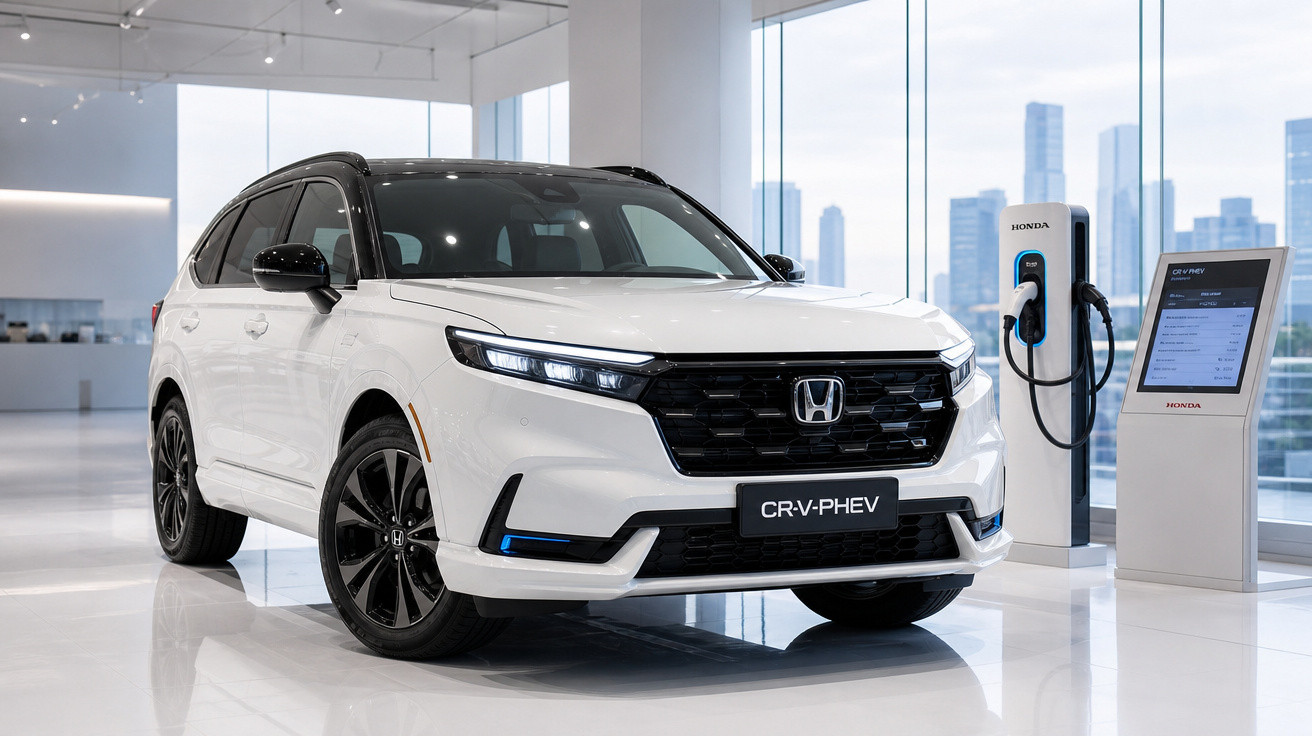
The new Honda CR-V debuts a plug-in hybrid system capable of covering more than 80 km in fully electric mode. We’ve already driven it.
The new Honda CR-V will arrive in Portugal later this year, but it is already on sale in China, where it is built and which remains one of its most important markets for commercial success. That helps explain features such as the huge front grille and the enlarged body proportions.
As well as being the largest SUV in the Japanese brand’s line-up, this sixth-generation Honda CR-V also becomes its first model to feature a plug-in hybrid system (e:PHEV).
It combines a 2.0-litre four-cylinder engine producing 148 hp with an electric motor delivering 184 hp, powered by a 17.7 kWh battery, and claims a maximum range of 81 km in fully electric mode.
For the dynamic presentation of the new Honda CR-V, the brand chose the Porto and Douro region, with front-wheel-drive and all-wheel-drive hybrid versions present, along with the plug-in hybrid, which brings the main technical innovation.
Functionality and more space
With the increase in body size, it is no surprise that there is also more room inside, to the point where it becomes one of the best-endowed SUVs in its class in this respect.
In the second row, where legroom can be adjusted thanks to the seats’ longitudinal and asymmetric sliding function over 19 cm, even NBA players can now travel without needing to fold themselves up.
Besides the generous space on offer, the seats are also very comfortable, feature eight-position backrest adjustment, and the absence of an intrusive transmission tunnel in the floor gives rear passengers greater freedom of movement.
In terms of access, the doors open to an angle close to 90 degrees, which greatly eases getting in and out, as well as fitting or removing child seats.
The boot has gained 99 litres compared with the previous CR-V, reaching a total of 587 litres. The gain is even greater in the PHEV version, which includes an underfloor compartment capable of holding 72 litres of smaller items, such as the battery charging cables.
It is unusual - not to say unheard of - for the plug-in version to have a larger boot, something made possible by the positioning of the battery and other components closer to the front section.
A near carbon copy of the Honda ZR-V
Up front, we find the familiar elements that define the dashboards of Honda’s latest models. In other words, a horizontal dashboard layout, solid assembly, materials with a good tactile quality, and the transverse honeycomb grille into which the air vents are integrated.
Also present are the 9-inch central infotainment screen and the 10.2-inch digital instrument display. They are easy enough to read, but their appearance already feels dated, both because of the graphics and the dominance of monochrome tones, not to mention the “old-fashioned” controls on the central screen, which feel like a nod to the 1990s.
Higher-spec versions already include a head-up display projected onto the windscreen, a more sophisticated solution than the pop-up blade mounted above the instrument cluster.
Compared with the Honda ZR-V, one of the most visible differences lies in the wider centre console, although it features the same automatic gearbox controls, the driving mode selector and another control dedicated to the hybrid system’s operating modes.
Handling approved
Ride quality is tuned more towards comfort, and there are no major differences between the driving modes. On the plug-in hybrid version, variable electronic dampers are already included, so ride comfort ranges between excellent and very satisfying - once again, the differences are not especially pronounced.
The performance of the CR-V plug-in hybrid is acceptable because the electric power, delivered instantly, helps ensure the CR-V never feels particularly strained in rolling acceleration, even if the 0 to 100 km/h sprint takes 9.4 seconds.
Even so, the plug-in hybrid version is heavier because of the larger battery, which affects its performance in some areas. On the other hand, because it is installed centrally in the floor of the car, the battery’s extra weight gives the CR-V greater stability and even a more “communicative” steering feel.
Driving modes of the e:PHEV system
In the hybrid version (e:HEV), there are no selectable drive modes, as the system itself makes those decisions. In the e:PHEV variant, however, the driver can choose between EV (pure electric), Auto (hybrid), Save (the system maintains the battery charge at the same level) and Charge (activated by pressing the drive mode control for a few seconds, using the petrol engine to charge the battery).
The EV programme is disabled when Sport mode is selected and switches off when full-throttle acceleration is used, in the interests of preserving electric range. Its use is also limited when battery charge is too low.
There are also paddles behind the steering wheel to vary the level of energy recuperation under deceleration, with four settings, but it is also possible to press the “B” button on the transmission selector to generate stronger braking force. Even so, the CR-V never allows true one-pedal driving, meaning it will never come to a complete stop unless the brake pedal is pressed.
One of the biggest advances in the latest generations of hybrid powertrains can be found in the continuously variable transmissions, which now manage to provide better alignment between engine noise and overall response.
That is clearly noticeable in the hybrid CR-V, but in the plug-in version it is spoiled somewhat by the synthetic acceleration sound when Sport mode is selected.
Not only is the sound rather “basic”, but what ends up happening is that the synthesised electric acceleration noise mixes with the sound of the petrol engine when accelerating hard - as it comes in to help with acceleration - creating a disjointed and far from harmonious racket.
Consumption and range
The 40 km route completed in the Honda CR-V e:HEV (hybrid) consisted almost entirely of national roads and ended with an average of 7.7 l/100 km, well above the 5.9 l/100 km stated by Honda.
Even so, it is an acceptable figure, bearing in mind that this was a test drive, with several harder accelerations and generally brisker driving than would be typical in everyday use.
At the wheel of the plug-in hybrid version, around 120 km were covered, 80 of them with battery charge available, effectively confirming the 81 km electric range claimed by Honda. However, the more demanding conditions of a test drive inflated the final recorded average further still, which ended up at 3.4 l/100 km (the official figure is 0.9 l/100 km).
On the other hand, by the time the battery’s “juice” had run out, the average was 2.9 l/100 km, meaning that the final 40 km of the route increased the consumption average by only half a litre. In other words, a figure that lends weight to Honda’s engineers, who “promise” an average of 6.2 l/100 km when the Honda CR-V is running without battery charge.
Brands such as Honda and Toyota are long-established specialists in hybrid systems, but not in plug-in hybrids, and the charging set-up is proof of that. For example, there is still no direct current (DC) charging, only alternating current (AC). In the case of the Honda CR-V, the on-board charger reaches only 6.8 kW, which translates into around 2.5 hours for a full charge of the 17.7 kWh battery.
Order books open
The new-generation Honda CR-V will reach the market later this year, but orders are already being taken. In our market, the main focus will be on the plug-in hybrid version, even though it carries a starting price of €61,500.
As an alternative, Honda will also offer the CR-V with a conventional hybrid system, although its final pricing has not yet been fully defined. Its starting point, however, should be around €52,000.
Later on, the hybrid version with four-wheel drive will also become available, although the brand expects it to have only limited relevance in our market.

Comments
No comments yet. Be the first to comment!
Leave a Comment