
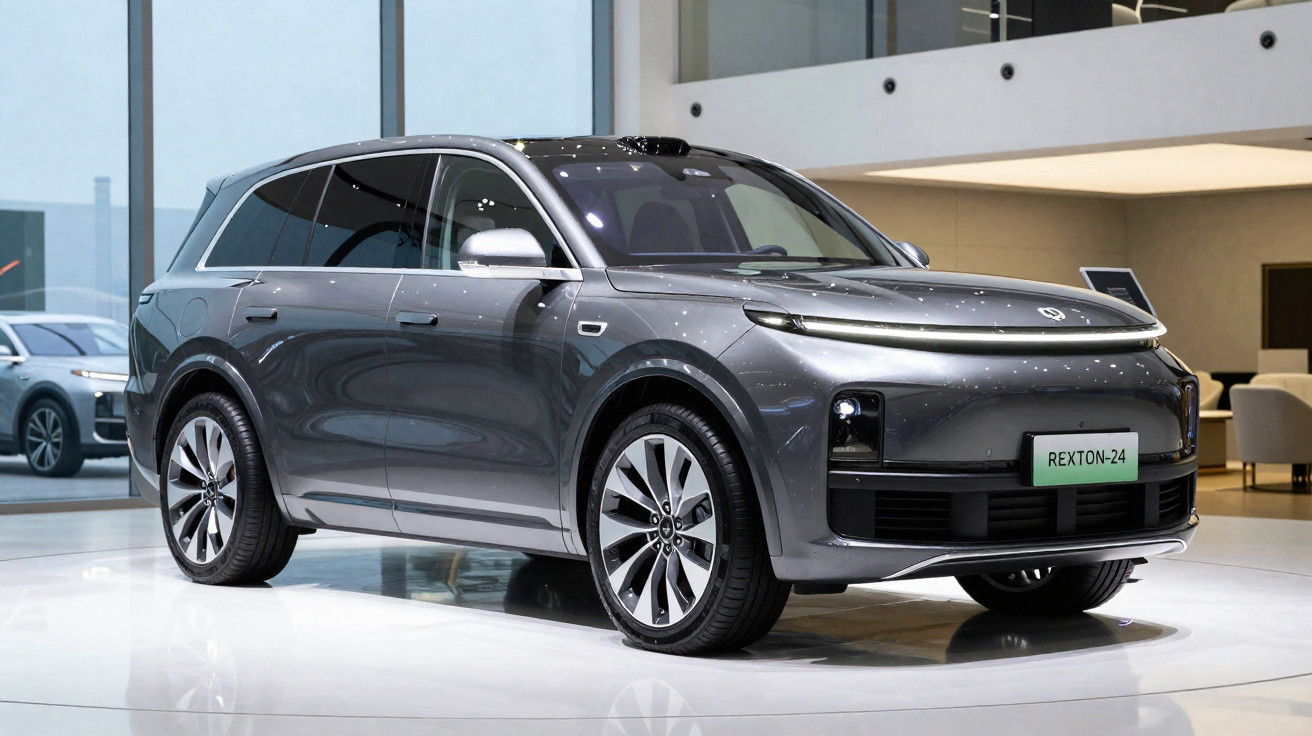
The KGM Rexton is a SUV of contrasts. On the one hand it is tough, roomy and generously equipped, but it is also noisy, thirsty and a little dated.
The KGM Rexton is the sort of SUV that has become increasingly rare: large (almost five metres long), powered by a Diesel engine with no electrical assistance, built on a ladder-frame chassis and able to carry seven occupants.
Even if it does not look it, it has already been around for some time. It arrived in 2017, still wearing the Ssangyong badge. In 2020 it received an extensive restyling, and in 2024 it was updated again for its relaunch-now as KGM, the company that acquired Ssangyong.
The problem is that the project’s age still shows through, despite the visual updates and the improvements in safety and comfort equipment.
KGM Rexton: style and space
With that said, the first few moments inside the KGM Rexton are encouraging. The design is attractive, the leather upholstery feels good quality, and the build comes across as careful and solid.
The driving position is also well judged, and the many (electric) adjustments make it easy to suit most body types. Only the steering column is adjusted manually.
For passengers travelling in the second row, space is also very generous. The middle seat does not spoil things too much, and the fold-down armrest is always welcome.
The KGM Rexton’s sizeable footprint-4.85 m long with a 2.865 m wheelbase-has made it possible to fit a third row of seats, adding extra points for versatility.
To get back there you need to fold the second-row seats, and using the third row is not especially straightforward. Even so, it is useful enough, if only for shorter journeys.
Almost a trip back in time
Driving the KGM Rexton feels almost like stepping back in time. Where electrification has brought greater smoothness and quieter running, in this South Korean SUV the Diesel engine’s clatter is ever-present the moment you start it, particularly from cold. After a few kilometres the noise does not vanish, but it fades into the background a little.
The 202 hp and 441 Nm do not deliver standout performance, but they do not hold you back either. It is really only the automatic gearbox that dislikes being rushed.
The ladder-frame chassis does not help the driving experience: despite independent suspension at both axles, road imperfections come through easily, there are more vibrations, and body movements are more pronounced than we have come to expect from newer models.
On top of that, the steering feels somewhat vague and lacking in feedback, which adds to the sense that the KGM Rexton does not inspire much confidence from behind the wheel.
I started by saying the Rexton is an "old guard" SUV, but in Portugal it is only sold with rear-wheel drive-in Spain, for instance, it is only available as a 4×4. As a result, off-road escapes are more limited, even though it does have a decent ground clearance of 22 cm.
By the end of the test, I recorded an average consumption of 9.8 l/100 km. That is not outrageous-after all, it is a two-tonne SUV-but it is clearly higher than the official combined figure of 7.8 l/100 km.
A simplified choice
Choosing a KGM Rexton in Portugal could hardly be simpler. It is sold in a single version-K5-priced at 58,000 euros. The good news is that it comes fully equipped: the only option is metallic paint.
A SUV with a Diesel engine and seven seats is a formula that is disappearing, even if, in the Rexton’s case, it is the model’s age that weighs against it rather than Diesel technology itself.
As an alternative there is the Skoda Kodiaq, slightly smaller, but more polished-thanks to its unibody construction. Its Diesel engine is also less powerful, with 150 hp, and the price is 12,000 euros lower.
The remaining alternatives already belong to the electrified era, whether hybrid or fully electric, such as the fellow Koreans Hyundai Santa Fe, Kia Sorento or the EV9.
Comments
No comments yet. Be the first to comment!
Leave a Comment