
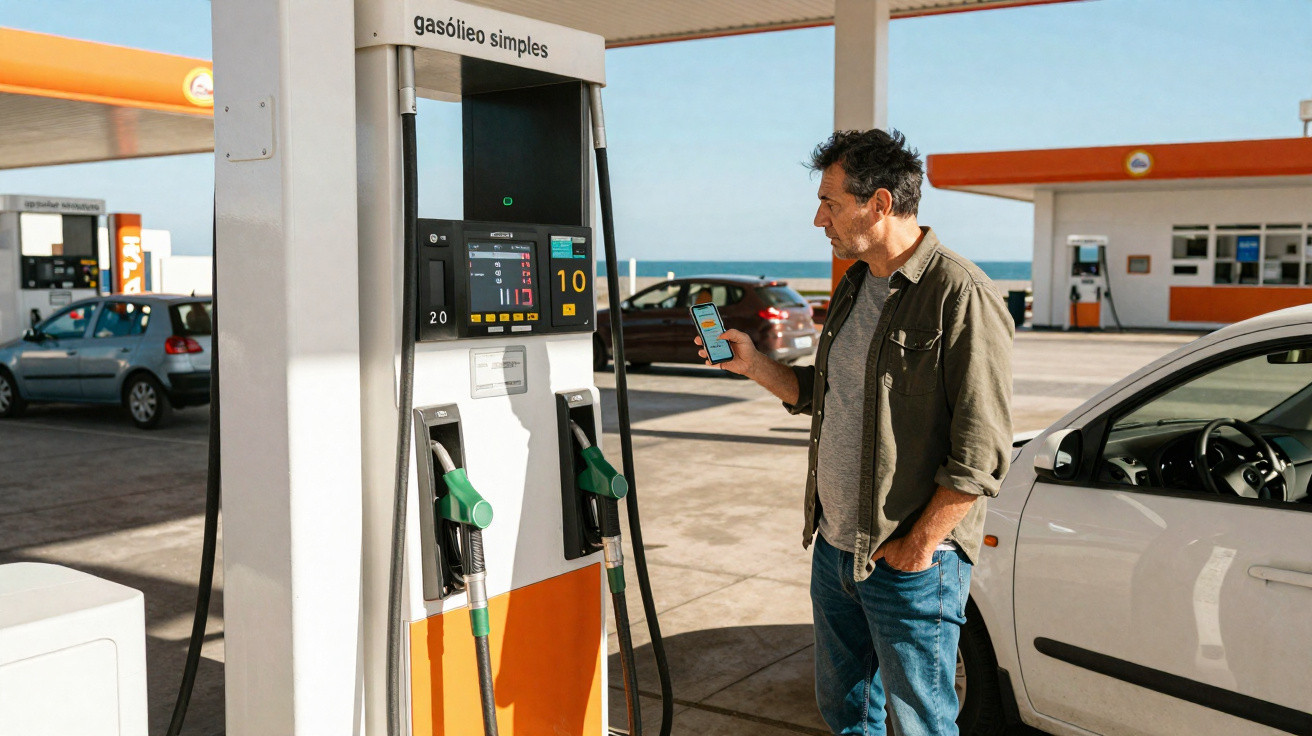
As flagged at the end of last week, this week (23 March) began with another sharp rise in fuel prices, with standard diesel seeing the biggest jump, according to industry sources.
Fuel prices in Portugal: the latest rises on 23 March
By the time this article was published on Monday, standard diesel had increased by 11 cents per litre, taking the average price to €2.037 per litre - a new all-time high. Diesel has not been this expensive since June 2022. Standard petrol also moved up, rising by 6.1 cents per litre, bringing the average price to €1.918 per litre.
How much prices have moved since the Iran conflict began
Adding it up, from the start of the conflict in Iran through to last Friday, standard diesel has already gone up by 29.2 cents per litre, while petrol has risen by 15 cents per litre (figures that already factor in the discounts currently being applied).
Changes at the main fuel retailers
Looking across the largest fuel brands, Galp recorded the steepest diesel increase, raising it by 14.2 cents per litre, while BP adjusted its diesel price by 14 cents per litre. At Repsol, the rise in standard diesel was 12.5 cents per litre. Petrol moved in a more uniform way, with increases ranging from seven cents (BP and Galp) to eight cents (Repsol).
The €2 per litre threshold has now been exceeded at the three main fuel retailers for both standard diesel and standard petrol.
As usual, the benchmark for calculating fuel prices is the data published by the Directorate-General for Energy and Geology (DGEG). In this case, the figures refer to last Friday, 20 March.
The DGEG values already include the discounts offered by fuel retailers, as well as the Government measures currently in place. Even so, it is important to stress that these are average, indicative figures and may differ from the prices shown at individual filling stations.
What is driving this?
The rise in fuel prices in Portugal and across Europe is directly connected to the escalation of tensions in the Middle East, which led to the closure of the Strait of Hormuz - one of the main routes for shipping oil from the Persian Gulf. Around 20% of global crude trade passes through this corridor.
The effect was felt immediately in the markets: Brent crude, the European benchmark, was at $72 before the conflict began and, at the time of publication, is hovering around $100. It is also worth noting that Brent started this week with a drop of more than eight dollars.
The conflict began at the start of the month, when Israel and the US launched strikes against Iran, saying they were neutralising imminent threats. In response, Tehran hit US bases and Israeli targets in the region using missiles and drones, further heightening instability.
Government measures currently in place
After industry forecasts pointed to record rises in fuel prices, the Government increased the extraordinary discount applied to ISP (Tax on Petroleum and Energy Products). As a result, the total tax discount this week stands at 9.3 cents per litre for standard diesel and 4.7 cents per litre for standard petrol (the cumulative amount since the start of the conflict).
This additional ISP cut is on top of the reduction in place since 2022, introduced to soften the impact of higher fuel prices following Russia’s invasion of Ukraine. That mechanism partially lowered the tax applied to petrol and diesel and has been adjusted gradually in line with price movements.





Comments
No comments yet. Be the first to comment!
Leave a Comment