
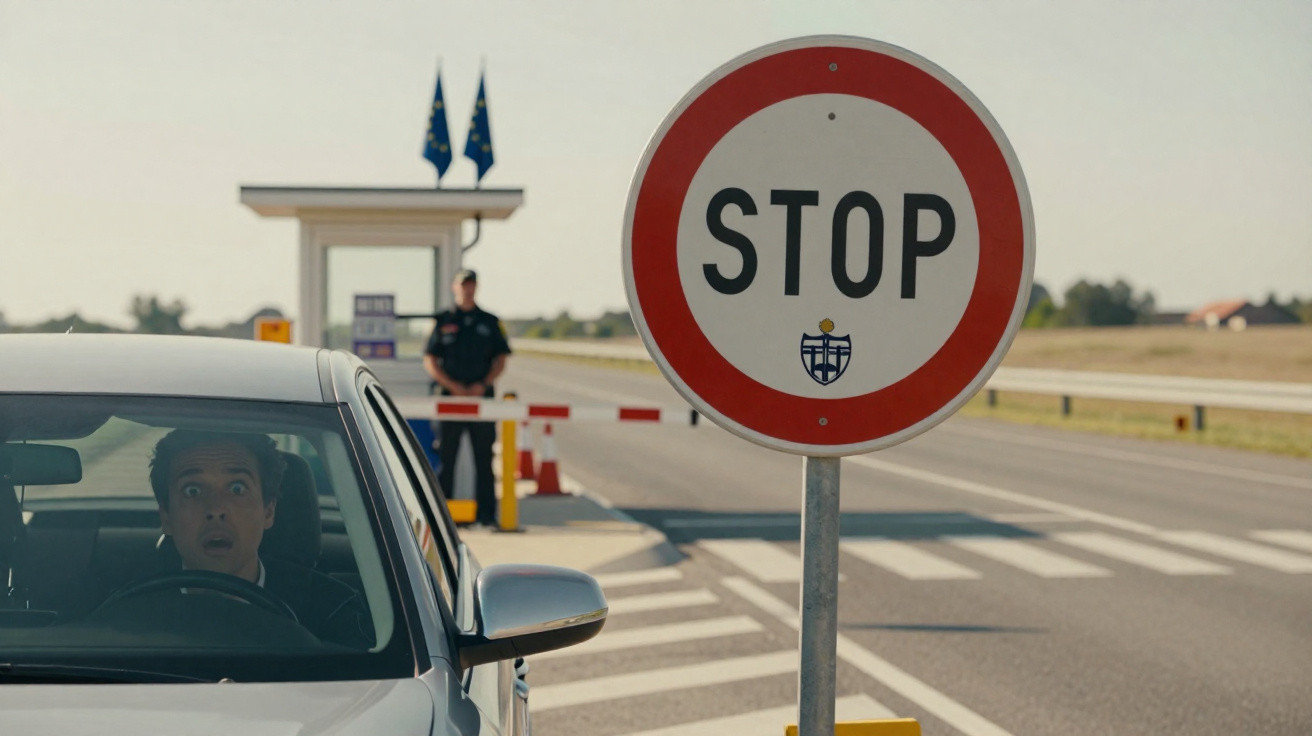
Many drivers glance at it, shrug, and carry on.
That unassuming red-and-white circle can, quietly, end up costing you a great deal.
Whether you’re driving in the UK or travelling across Europe, you’re bombarded with road signs every day. Some simply direct traffic. Others flag hazards. And a handful-often the ones people don’t recognise-can turn an ordinary trip into an unexpectedly expensive lesson.
The mysterious red-and-white circle that means “stop now”
When motorists think of an “obligatory stop”, most picture the familiar red octagon with “STOP” in white. But there’s another set of signs that creates exactly the same legal obligation, and many drivers hardly notice them.
On roads across Europe-especially those used by British holidaymakers driving on the continent-you may see a circular sign with a red border and a white centre carrying a single word: DOUANE, POLICE or GENDARMERIE. This isn’t a gentle prompt. It is a legal instruction to stop the vehicle completely.
This red-bordered round sign has the same force as a stop sign: you must fully stop, even if the road looks clear.
These signs belong to the “B” category under the Vienna Convention on Road Signs, followed by many European countries. Their plain, almost stripped-back design is precisely what leads some drivers to underestimate them.
Permanent stops: the border control sign
A widely encountered version is the B4 sign. Anyone crossing European land borders has likely passed it repeatedly without giving it much thought.
- Shape: circular
- Border: red
- Background: white
- Text: “DOUANE” or “CUSTOMS”, often in two languages
The B4 sign indicates an obligatory stop at a customs post. Even when the lane appears clear and the booth looks unattended, the requirement remains: you must stop fully at the line or checkpoint. Staff may operate in bursts, and cameras can capture vehicles that fail to comply.
Skipping a customs stop because “no one seemed to be there” counts as ignoring a lawful order, not as a harmless shortcut.
Mobile stops: police and gendarmerie roadblocks
Matters can be less obvious when the sign isn’t permanently installed. That’s where the B5 signs come in. They can be produced with little notice-often at night-during special operations, incident responses or security checks.
There are three common variants on European roads:
| Code | Who uses it? | Typical message | Nature |
|---|---|---|---|
| B5a | Gendarmerie / rural police | “STOP GENDARMERIE” | Mobile |
| B5b | Police | “STOP POLICE” | Mobile |
| B5c | Road / toll operators | “STOP PÉAGE” or toll sign | Mainly permanent |
Police officers or gendarmes transport these panels in their vehicles and can set them out in seconds. You might find them placed before a bend, at a village entrance, on a slip road, or in advance of a toll area. Their purpose is straightforward: to force all vehicles to stop before reaching the control point.
For British drivers heading by car to ski resorts, beaches or European cities, this kind of mobile sign can appear without warning-late at night, in heavy rain, just when attention is slipping. Driving past it can turn a holiday journey into a legal headache.
What the law expects from you at these signs
Some motorists treat “STOP POLICE” or “STOP CUSTOMS” boards as if they were merely firm guidance. They slow down, look about, and drift through at walking pace. Legally, that still counts as an offence.
To comply, the vehicle must come to a total halt, wheels no longer rotating, for at least a brief moment.
In much of Europe, the expectation matches the standard stop sign:
- Stop before the line, barrier or officer.
- Pause long enough to assess the situation and demonstrate you have yielded.
- Move off only once officials or the road markings clearly indicate you may proceed.
Police forces commonly advise pausing for two or three seconds, checking both directions, and then continuing. That brief stop shows clear compliance and gives officers time to signal if they want to speak to you.
The price of ignoring a mandatory stop
Failing to stop at a customs board, a police roadblock sign or a permanent stop panel is unlikely to go unnoticed. Modern enforcement often involves cameras, dashcams in patrol cars and toll-area video, making later identification straightforward.
On French roads, for instance, ignoring a mandatory stop can lead to:
- A fixed fine of around €135 for a standard offence.
- A loss of four points from the driving licence.
- Potential suspension of the licence if the behaviour is judged dangerous or repeated.
Other European countries use broadly comparable sanction levels. If you’re driving on a foreign licence, unpaid penalties can still follow you home through cross-border cooperation agreements. In some situations, failing to stop at a roadblock is treated as more than a traffic matter-seen instead as refusal to comply with law enforcement, bringing tougher consequences.
From the officer’s point of view, a car that does not stop when ordered might be trying to flee, transport contraband, or hide drink-driving.
That’s where the risk escalates quickly. What a driver might view as a casual “roll through” can be recorded, in police documentation, as attempted evasion. This difference in interpretation is why checks near borders, ports and toll plazas are backed by strict legal powers.
Why authorities rely on these lesser-known signs
These red-and-white circular signs are not simply about collecting revenue. They’re practical tools for controlling traffic flow and reducing danger in sensitive locations.
Common purposes include:
- Targeted drink- and drug-driving checks after major events.
- Border security operations looking for smugglers or traffickers.
- Road safety campaigns on accident-prone routes.
- Emergency situations, such as chemical spills or serious crashes ahead.
By requiring every driver to stop-or at least to be ready to stop-officers can quickly distinguish inattentive motorists from those who behave calmly and predictably. The clear, simple appearance of the sign also helps slow traffic, offering extra protection to officers on the carriageway at night.
How to react if you meet one on your next trip
For UK and US drivers hiring a car in Europe, the safest approach is uncomplicated: treat any red-bordered circular sign marked “STOP POLICE”, “STOP DOUANE” or similar wording as the equivalent of an absolute red light.
Slow early, signal, change down a gear, and approach as if a child could run into the road in front of you.
Five practical steps can help you avoid trouble:
- Notice the sign early and lift off the accelerator straight away.
- Check your mirrors so you know what’s behind you as you brake.
- Indicate if you need to change lane or pull into a coned-off area.
- Stop exactly where directed: at the line, before cones, or alongside the officer.
- Wait for a clear gesture or signal before moving off again.
At borders and tolls, staff may simply wave you through. At police checks, you might be asked for documents, have seat belts checked, or be given a quick breath test. Remaining calm-with the window slightly open, the engine idling, and both hands visible on the wheel-usually keeps the exchange brief.
Extra tips for frequent cross-border drivers
For commuters and lorry drivers who cross borders several times a week, these signs can fade into the background. That familiarity can breed habits that drift into illegality, such as rolling stops or approaching while distracted by a phone.
A helpful rule of thumb is to treat every B4 or B5 sign as if it were a checkpoint you’ve never encountered before. That mindset keeps you alert even on routes you know well. Fleet managers can reinforce this by including these panels in driver training, alongside reminders about fines and licence points in each country where they operate.
For occasional travellers, spending a few minutes reviewing unfamiliar European signs before departure can pay dividends. Many national road safety bodies publish straightforward diagrams of key foreign panels. Printing a one-page cheat sheet for the glovebox might seem old-fashioned, but it can prevent the sort of “I had no idea” moment that ends with a hefty fine and an anxious roadside conversation.


Comments
No comments yet. Be the first to comment!
Leave a Comment